


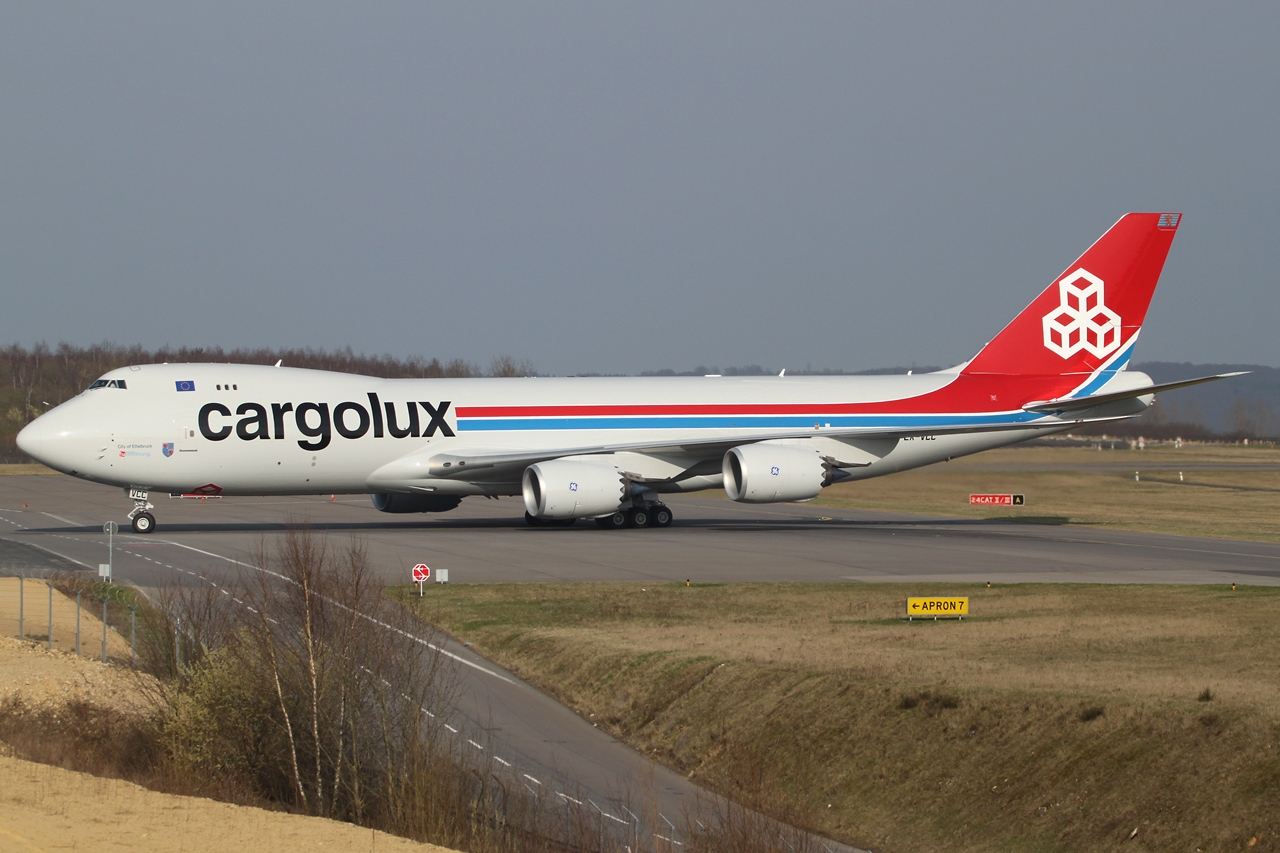
Cargolux Orders Fleetwide Boeing 747 Checks After Parked Jet’s Gear Collapses
Cargolux ordered additional inspections of every Boeing 747-8F it operates before each aircraft’s next flight after a parked freighter suffered a left landing-gear collapse at Luxembourg Airport. The unusual ground failure affected a basic load-bearing system while the aircraft was stationary, prompting a fleetwide precaution even though investigators had not announced a cause.

The aircraft, registered LX-VCF, was on its assigned stand when the collapse occurred on the morning of October 23. Luxembourg emergency crews responded at approximately 11:15 a.m. local time. No crew members, employees or other people were reported injured, and the occurrence was recorded by the Aviation Safety Network as a ground incident rather than a takeoff or landing accident.
Cargolux described the event as “the collapse of the left landing gear.” Recovery work was proceeding with Luxembourg authorities while an investigation examined the circumstances. No preliminary findings had been released, leaving unanswered whether investigators will ultimately focus on the gear itself, its supporting structure, aircraft loading, ground conditions or another factor.
Why a stationary collapse draws a fleet response
Landing gear continues to carry substantial static loads after an aircraft has stopped. The system also has to accommodate how those loads are distributed through tires, shock struts, gear attachments and the airframe. A collapse on the stand therefore presents a different investigative setting from a hard landing or runway excursion: investigators can begin with an aircraft that was not undergoing a documented landing impact when the failure occurred.
The fleetwide checks are an operational containment measure. They allow Cargolux to look for relevant abnormalities on its other 747-8Fs before those aircraft fly again, while the investigation develops evidence from LX-VCF. The available information does not specify the inspection method, components covered or findings required for return to service, so the scope cannot yet be equated with a regulator-mandated inspection program or a finding of a fleetwide defect.
The response can still affect readiness. Each aircraft must pass through an additional maintenance step before its next departure, requiring access to the airplane, qualified personnel and review of any observations. The resulting operational effect depends on inspection duration, scheduling and whether any aircraft requires further work. No wider airport shutdown or major disruption was reported.
The 747’s four-post landing-gear architecture
The Boeing 747-8 and 747-8F use four main landing-gear posts: two wing gear units and two body gear units. That arrangement is unusual among transport aircraft and changes how ground loads are shared across the landing gear and airframe. The Federal Aviation Administration addressed the configuration through special structural-design conditions for the 747-8 family because conventional rules were written around the more common two-post arrangement.
Those certification conditions cover landing, turning, braking, towing and other ground-load cases. They also require load distribution to account for factors including airframe flexibility, shock-strut stiffness and tire stiffness. This design background explains why the aircraft is assessed as an interconnected load-bearing system; it does not identify the cause of the Cargolux collapse.
The investigation will need to establish the aircraft’s condition and configuration at the stand, document the failed area and distinguish initiating damage from damage created during the collapse. Maintenance records and physical examination may then help determine whether the event was isolated or whether findings from the rest of the fleet have broader significance.
Recovery is an engineering task of its own
An immobilized widebody cannot simply be moved like an aircraft with functioning gear. Recovery planning must consider aircraft weight, center of gravity, safe lifting and leveling points, suitable equipment, personnel safety and the risk of causing additional structural damage. International Air Transport Association recovery training treats the removal of a disabled aircraft as an end-to-end operation involving the airline, airport, emergency services and maintenance organizations.
LX-VCF, serial number 35811, was delivered to Cargolux in September 2012 and was listed as an active fleet member. Its recovery and examination may provide the most direct physical evidence, but the first broader operational milestone comes sooner: every other Cargolux 747-8F must undergo the added inspection before returning to flight.
| More aerospace and engineering stories, right in your MSN feed. Follow AMI on MSN |
By Thomas Caldwell — AMI’s senior editor for mechanical and mobility engineering, covering vehicle electronics, systems integration, electrification, chassis systems, propulsion, and safety policy.




