


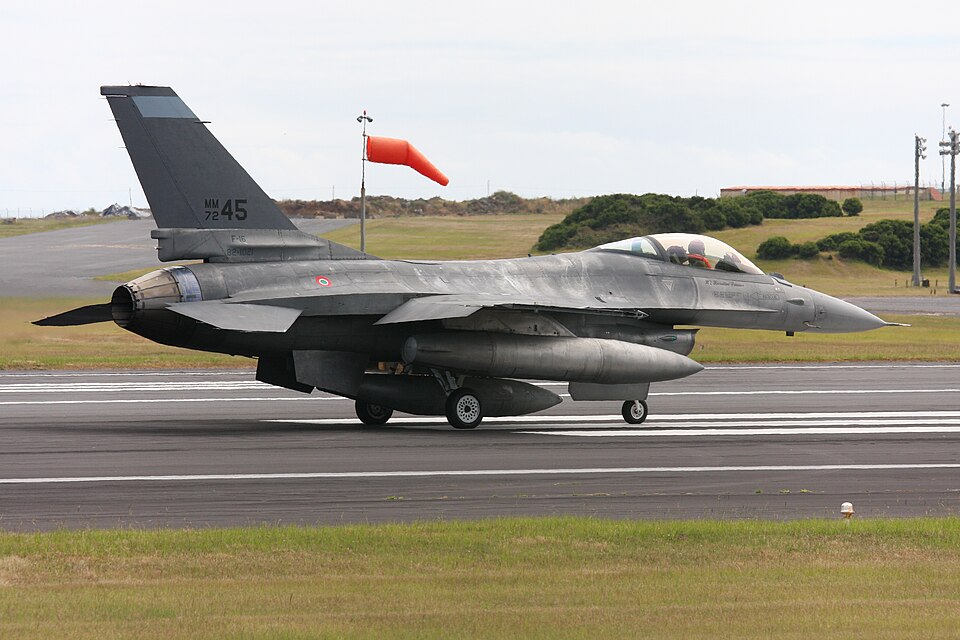
NORAD F-16 Makes Close Pass, Guides Civilian Plane to Safety
The first task in this interception was getting the civilian pilot to notice the fighter. A NORAD F-16 did that by flying closely in front of the aircraft a standard attention-getting tactic the command calls a “headbutt maneuver.” According to NORAD’s official account, the pass enabled communication to be established, after which the pilot followed instructions and safely left restricted airspace near Mar a Lago in Palm Beach, Florida.

Despite its forceful nickname, the maneuver was a non-contact visual signal. Its purpose was to put the unmistakable shape of an F-16 where the civilian pilot could see it, rather than to touch or physically redirect the other aircraft. That distinction explains the operational logic: when ordinary attempts to contact an aircraft have not produced a response, the interceptor itself becomes the signal.
The interception occurred at approximately 12:20 p.m. Eastern Time on Saturday, October 24. The general aviation aircraft had entered a Federal Aviation Administration Temporary Flight Restriction that NORAD was enforcing over Mar a Lago. President Trump was in West Palm Beach at the time, but the operational issue was the aircraft’s presence inside protected airspace not the pilot’s motive, which was not identified.
How a fighter communicates visually
A close forward pass is the attention phase, not the complete interception procedure. Once the other pilot recognizes the fighter, established visual signals and radio communications allow the interceptor to convey what should happen next. FAA interception guidance describes a fighter positioning itself slightly above and ahead of the intercepted aircraft, rocking its wings and then making a slow level turn toward the desired heading. The signal means the aircraft has been intercepted and should follow.
Those procedures are designed around a difficult mismatch. An F-16 has ample performance for reaching an aircraft quickly, but many general aviation airplanes operate much more slowly. The fighter therefore has to convert speed and visibility into controlled communication. Standardized signals give the civilian pilot a recognizable instruction even before two-way radio contact is restored.
In Palm Beach, NORAD reported that communication was established after the headbutt maneuver. The civilian pilot then complied with flight instructions and steered the aircraft out of the restricted area safely. NORAD did not identify the aircraft or pilot, and it did not report an unsafe outcome.
Temporary restrictions can appear around ordinary routes
Temporary Flight Restrictions reserve specified airspace for a limited period or purpose. The FAA can issue them for security and safety requirements ranging from presidential movements and major sporting events to disasters, hazardous conditions and spaceflight operations. They are distributed through Notices to Airmen, or NOTAMs, which pilots are expected to check during preflight planning.
That temporary character creates a practical flight-planning burden: airspace that was available on one trip may be restricted on the next. The boundaries, timing and access conditions are contained in the applicable notice. For pilots, checking current NOTAMs is therefore part of verifying that a familiar route remains available, rather than assuming yesterday’s airspace status still applies.
NORAD said pilots who violate a restriction may be met by federal authorities after landing and may face enforcement action. No subsequent enforcement was reported in this case. The immediate air-defense objective had already been completed: establish contact, communicate instructions and move the aircraft out of the protected area without a reported safety problem.
NORAD had also reported recent F-16 interceptions connected with temporary restrictions over Clemson, South Carolina, and Cincinnati, Ohio. The Palm Beach event shows why the fighter’s role is broader than simply arriving beside an unidentified airplane. The interceptor must gain attention, bridge a communications gap and guide a much slower aircraft toward compliance. Here, one deliberately conspicuous pass was enough to begin that sequence, and both aircraft departed the encounter safely.
| More aerospace and engineering stories, right in your MSN feed. Follow AMI on MSN |
By David Whitaker — Associate editor for AMI’s aerospace and drone systems desk, translating flight systems, aircraft programs, spaceflight, and UAV developments into accessible technical stories.



