


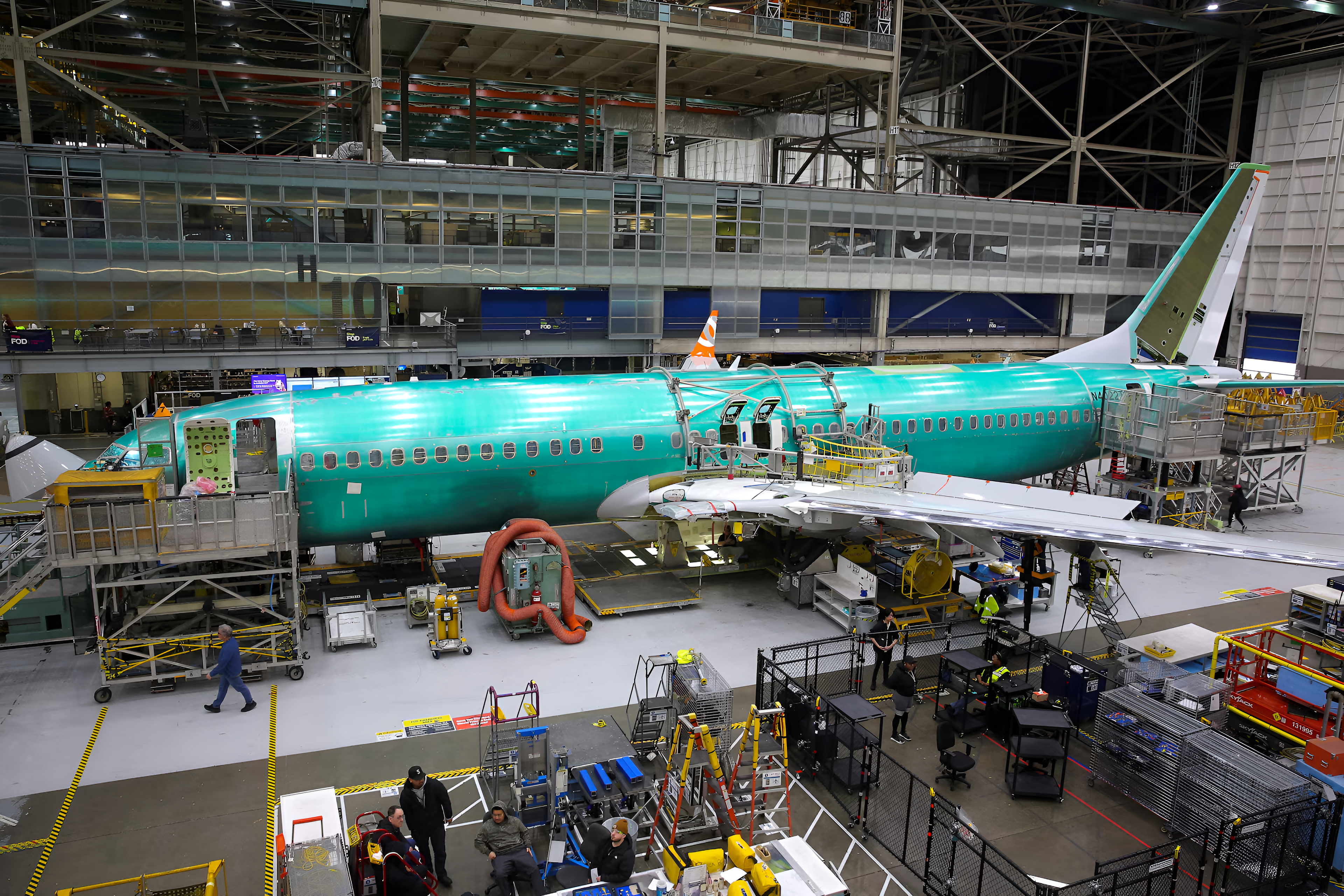
Boeing Delays 47-Jet Monthly 737 Max Target Until Early 2027
Boeing needs to deliver more 737 Max aircraft, but its production system is not yet stable enough to support the planned pace. The company has moved its target of producing 47 jets per month from summer 2026 to early 2027 as internal wing bottlenecks and more intensive testing constrain the final assembly line.
The revised schedule extends the recovery of Boeing’s most important passenger-aircraft production program. Airlines have been pressing for deliveries, while Boeing depends on handing over more aircraft to improve cash generation. Management’s response is to keep raising output at the Renton, Washington, plant, but only after the underlying manufacturing processes demonstrate sustained performance.
Wing output sets the pace for the entire line
A final assembly line cannot maintain a nominal monthly rate unless major structures arrive at the required cadence. Boeing CEO Kelly Ortberg acknowledged in September that internal wing production was slowing final assembly. Wings remain the pacing item as the company works toward the 47-aircraft rate.
This makes the revised target more than a scheduling change. A shortfall at a major upstream stage can propagate through the factory: final assembly cannot consistently complete aircraft faster than the wing operation can support them. Increasing activity elsewhere would not resolve that imbalance and could instead leave work accumulating between production stages.
Boeing has been evaluating measures intended to improve production flow. Some produced the expected savings, while others did not, leading the company to change its approach and add capacity in some areas. Early results were described as encouraging, but management had not yet demonstrated sustained wing output sufficient for 47 aircraft a month.
That operating boundary explains Boeing’s emphasis on measured discipline. The company wants each increase to rest on repeatable processes rather than a short burst of output that cannot be maintained. More intensive testing introduced to address earlier quality and manufacturing deficiencies also consumes time, but it is part of the process stability Boeing says must precede a faster ramp.
Higher costs show the strain behind the bottleneck
The production challenge is visible in Boeing’s third-quarter 2026 results. Boeing Commercial Airplanes reported $10.7 billion in revenue and a $697 million operating loss. The company attributed the commercial-aircraft result to a less favorable mix of deliveries, higher projected costs associated with future production-rate adjustments and increased estimated supply-chain costs.
Those figures illustrate the cost of trying to expand a complex manufacturing system while its internal and external flows remain uneven. Boeing must fund added capacity, testing and supplier support before the additional aircraft generate corresponding delivery revenue. The company is allocating resources to stabilize its global supply chains, while separate external parts shortages continue to delay the 787 Dreamliner and 777-200F programs.
The pressure is particularly acute on the 737 Max because deliveries are a key contributor to Boeing’s operating cash flow. Yet delivery volume naturally trails production when completed aircraft still have to move through remaining checks and handover processes. A stable factory rate is therefore a prerequisite for predictable deliveries, not a guarantee that airlines immediately receive the same number of aircraft each month.
Certification progress removes one constraint, not the factory bottleneck
Boeing did clear two important regulatory milestones during the period. The 737 Max 7 received amended certification during the summer quarter, and the Federal Aviation Administration certified the 737 Max 10 on October 20 following an extensive review that included thousands of hours of test flights. The Max 10 approval included an amended type certificate and updated authorization for production.
Those decisions expand the certified 737 Max lineup and remove regulatory barriers to delivering the two variants. They do not, however, increase the physical flow of wings through Boeing’s factories. Certification establishes that an aircraft design complies with applicable requirements; production capacity still depends on tooling, labor, testing and a synchronized supply chain.
Early 2027 is now the next test of that production system. Reaching 47 aircraft in an isolated month would be less consequential than sustaining the rate without disrupting quality or creating unfinished work. Boeing’s delayed target reflects that distinction: the company is prioritizing a repeatable flow of wings and completed jets over reaching a headline rate before the supporting processes are ready.
| More aerospace and engineering stories, right in your MSN feed. Follow AMI on MSN |
By Thomas Caldwell — AMI’s senior editor for mechanical and mobility engineering, covering vehicle electronics, systems integration, electrification, chassis systems, propulsion, and safety policy.



