


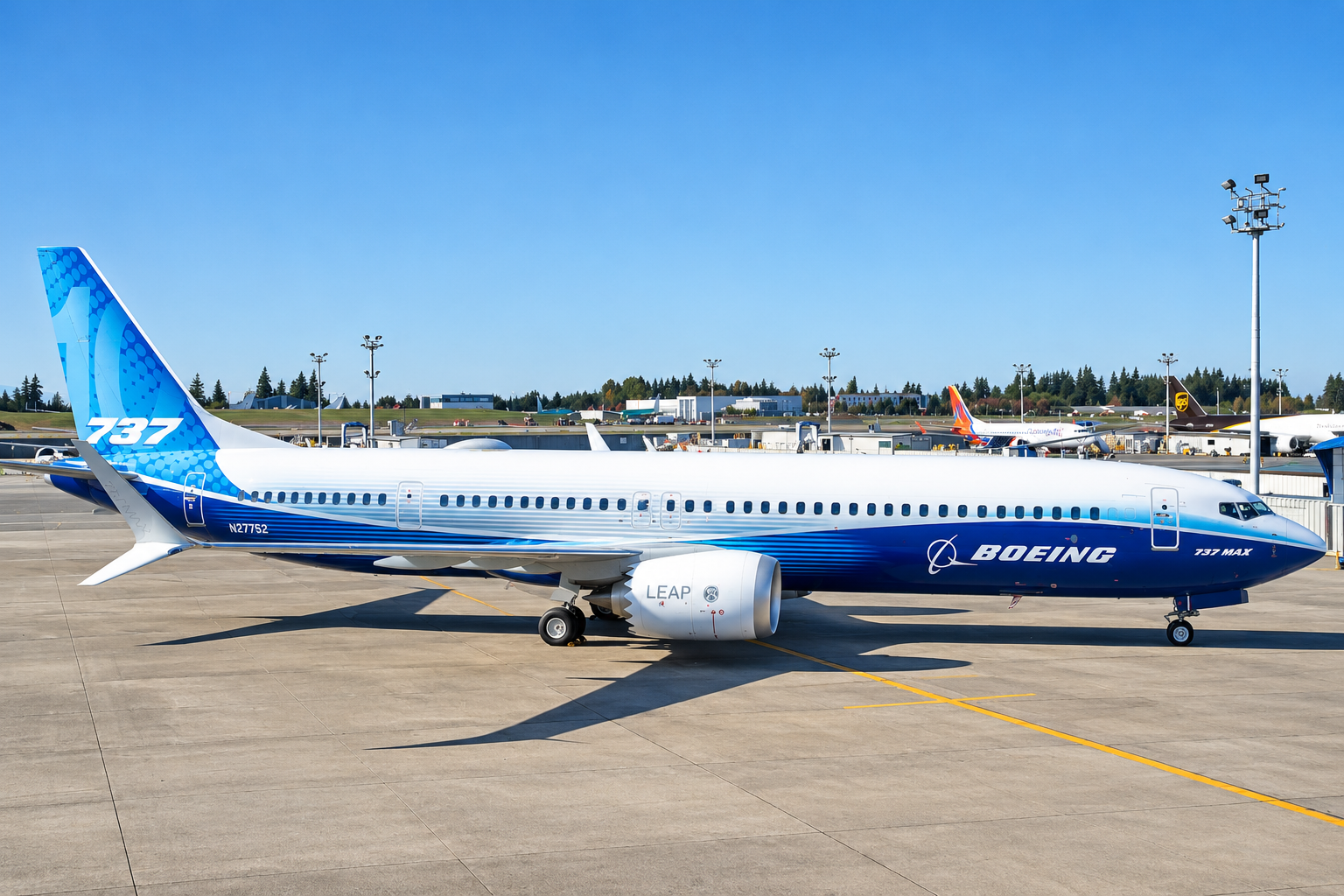
Boeing Posts Quarterly Loss Despite Record 737 MAX Delivery Pace
Boeing’s record 737 MAX delivery pace did not produce a quarterly profit. In its third-quarter results released October 27, the aircraft manufacturer reported a GAAP loss of 26 cents per share, slightly worse than the 21-cent loss analysts surveyed by LSEG had expected.
The result preserved the central tension behind Boeing’s recovery: aircraft are moving to customers faster, but raising production, absorbing supply-chain costs and completing the 777-9 certification campaign still require substantial resources. Boeing delivered 363 737 MAX aircraft during the first nine months of 2026, its fastest pace for that period, yet its commercial-aircraft division recorded a $697 million operating loss for the quarter.
More deliveries do not immediately mean higher margins
Aircraft deliveries are a major source of cash because manufacturers typically collect a significant portion of an airplane’s price at handover. Boeing generated $1.5 billion in operating cash flow and about $500 million in free cash flow during the quarter, exceeding the LSEG consensus estimate of $330.5 million in free cash flow.
Those positive cash figures coexisted with a companywide net loss and a 6.5% negative operating margin at Boeing Commercial Airplanes. Boeing attributed the commercial unit’s performance to a less favorable mix of delivered aircraft, higher projected costs associated with future production-rate changes and increased supply-chain costs.
Delivery count alone therefore provides an incomplete measure of the production system. The type of aircraft delivered, the cost accumulated while it waited for completion and the efficiency of the line all affect the margin on each handover. A record pace can improve cash generation without eliminating losses created by earlier delays, current industrial investment or expensive rate increases.
The 737 ramp remains the main capacity test
Boeing had been working to stabilize 737 production at 47 aircraft per month, but the increase took longer than executives expected. Following the results, the company said it now expected to reach that stable rate in early 2027 rather than during 2026. The delay also meant Boeing would miss its full-year target of 500 737 deliveries.
For an aircraft assembly system, reaching a monthly rate briefly is different from sustaining it. Wings, fuselages, engines, interiors, inspection capacity and skilled labor must arrive in sequence, while completed aircraft must meet quality requirements without creating excess rework. Boeing’s decision to remain at a rate until the supporting production flow is stable limits near-term deliveries but reduces the risk of pushing unfinished work downstream.
The 787 program presents a parallel constraint. Boeing said that production remained stable at eight aircraft per month, short of its effort to reach 10. That gap matters because widebody deliveries carry substantial cash value, but their complex global supply chains and customer-specific interiors can make output harder to increase evenly.
Certification and new facilities continue consuming resources
The quarter included two important certification milestones: the Federal Aviation Administration granted amended type certification to the 737-7, while the 737-10 received certification in October. Boeing was also selected by the U.S. Navy to design, build and deliver its next-generation F/A-XX aircraft, although that order was not yet included in the company’s backlog pending completion of the source-selection and evaluation review process.
Those wins did not remove the cost of programs still in development. Boeing continued 777-9 certification flight testing and maintained a target of first delivery in 2027. The company’s planning assumed certification around mid-2027, while additional portions of the flight-test program still required FAA authorization.
Capital spending also rose as Boeing invested in production sites in Charleston, South Carolina, and St. Louis. These facilities can support higher future output, but construction, tooling and equipment consume cash before the resulting aircraft or defense systems generate deliveries.
Boeing ended the quarter with a record $745 billion backlog, including more than 6,300 commercial airplanes. That demand provides years of prospective work, but converting it into durable cash generation depends on synchronized factories and suppliers rather than orders alone. The next consequential milestone is now early 2027, when Boeing expects the 737 system to demonstrate that it can hold 47 aircraft per month without sacrificing production discipline.
| More aerospace and engineering stories, right in your MSN feed. Follow AMI on MSN |
By Thomas Caldwell — AMI’s senior editor for mechanical and mobility engineering, covering vehicle electronics, systems integration, electrification, chassis systems, propulsion, and safety policy.



