


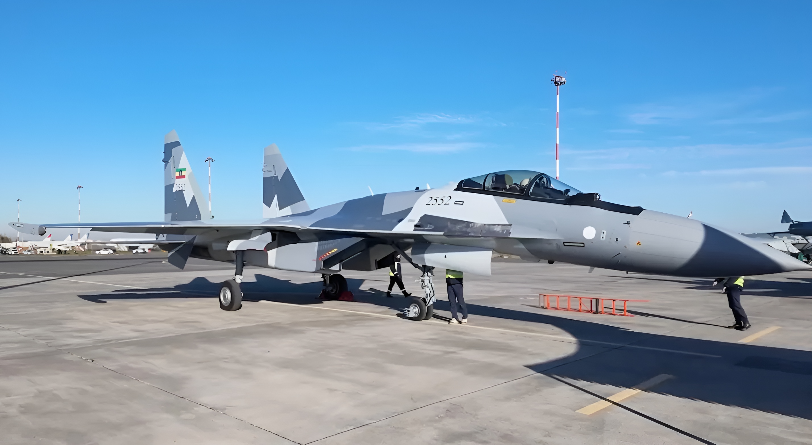
Ethiopia Receives Su-35 Fighters, but 12-Aircraft Fleet’s Origin Is Unclear
Ethiopia has begun receiving Russian Su-35 fighters, but the available public statements point to two aircraft delivered not 12 already on hand. Prime Minister Abiy Ahmed said Ethiopia would obtain 12 Su-35s, while Russian state arms exporter Rosoboronexport told Reuters that the first batch of two aircraft reached the Ethiopian Air Force on October 28, 2026.
The distinction resolves one immediate discrepancy while leaving a larger question open. Ethiopian reporting characterized the announcement as the arrival of the country’s first 12 advanced fighters, but Rosoboronexport’s statement describes a 12-aircraft acquisition beginning with a two-jet delivery. Abiy said the initial aircraft arrived a year earlier than scheduled, although neither side disclosed the agreement’s value, complete delivery timetable or production history.
Even at two aircraft, the delivery marks a material change in Ethiopia’s fighter-modernization program. Completion of the stated 12-aircraft plan would create a sizable Su-35 fleet alongside Ethiopia’s older Russian-designed fighters. The country continues to operate Su-27s acquired during the 2000s, although the number currently operational is uncertain, and it reportedly acquired at least six modernized Su-30 fighters in 2024.
A fleet transition, not a simple replacement
The Su-35 is a single-seat multirole fighter designed for air-superiority work as well as missions against ground and maritime targets. Ethiopia’s twin-seat Su-30s can perform combat missions while also supporting training and conversion, giving the air force a potential bridge for pilots moving into newer Russian-designed aircraft.
Ethiopia was also reported to have acquired 10 Yak-130 advanced jet trainers in 2026, though their delivery and operational status still require confirmation. Taken together, the reported Su-30, Yak-130 and Su-35 acquisitions suggest an effort to build more than a small group of advanced aircraft. Fighters require trained pilots, ground crews, maintenance equipment, spare parts and a sustainable flying-hour program. Adding types quickly can accelerate modernization, but it also expands the logistical and training burden.
The speed of the Su-35 delivery is especially notable because earlier foreign reporting described a contract for six export-model fighters with deliveries expected in 2027. The announced total is now twice that figure, and the first two aircraft reportedly arrived a year early. No public contract has yet reconciled those differences.
The airframes’ manufacturing history remains unknown
One possible explanation for an accelerated delivery is the availability of completed export aircraft. Foreign reports have said Russia manufactured 24 Su-35s for Egypt before 2022 and stored them after that export arrangement collapsed. A transfer from an existing pool could shorten the interval required for Ethiopia to receive aircraft compared with starting an entirely new production run.
The numbers are compatible with that possibility, but they do not establish it. No reliable public documentation identifies the Ethiopian fighters as former Egyptian aircraft, provides their production dates or traces their manufacturing records. Reports that some Egypt-bound aircraft might instead go to Iran also do not show that Ethiopia and Iran competed for the same jets or that Russia altered another customer’s contract.
That provenance question has practical consequences beyond the aircraft’s backstory. Newly manufactured jets and reassigned stored airframes can arrive with different inspection histories, configuration baselines and support requirements. Those factors influence acceptance work, maintenance planning and the time needed to generate a consistently available fleet, even when the aircraft share the same export designation.
For now, the confirmed picture is narrower than the initial 12-delivered characterization: Ethiopia has started receiving Su-35s, Russia identifies the first batch as two aircraft, and the stated plan calls for 12 in total. Establishing whether the remaining 10 are already built and whether any originated in the former Egyptian order will require documentation or attributable statements from Ethiopia, Rosoboronexport or the manufacturer.
| More aerospace and engineering stories, right in your MSN feed. Follow AMI on MSN |
By David Whitaker — Associate editor for AMI’s aerospace and drone systems desk, translating flight systems, aircraft programs, spaceflight, and UAV developments into accessible technical stories.



