


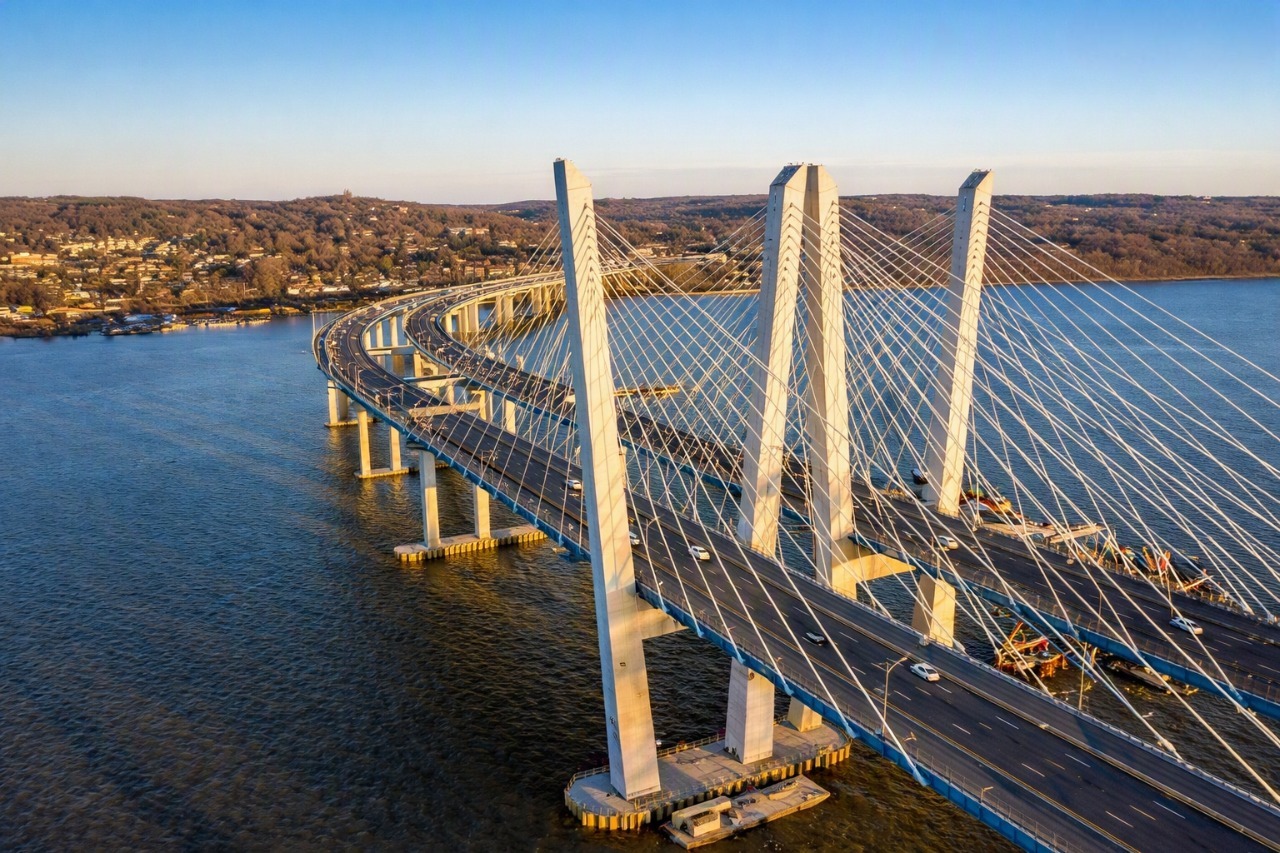
New York Replaced Tappan Zee While 140,000 Daily Vehicles Kept Moving
The central constraint was traffic: New York had to replace a roughly three-mile Hudson River bridge carrying more than 140,000 vehicles per day without taking that commuter route out of service for a prolonged period. The solution was to treat the approximately $4 billion replacement as a carefully sequenced transfer rather than a conventional demolition followed by construction.

Crews built the Governor Mario M. Cuomo Bridge beside the operating Tappan Zee Bridge, moved vehicles onto the new structure in stages and then removed the old crossing. What motorists experienced as a series of traffic changes was supported by years of marine construction, prefabrication and heavy lifting around an active highway.
Parallel construction kept the crossing open
The original Tappan Zee Bridge opened in 1955 and had been designed for an estimated service life of about 50 years. By its later decades, closing it completely was not considered viable because it had become a heavily used connection between Rockland and Westchester counties, about 20 miles north of New York City.
Instead of trying to rebuild within the old bridge’s footprint, engineers placed the replacement immediately alongside it. According to the Federal Highway Administration’s project profile, dredging began in August 2013 and the new westbound span opened in August 2017. Traffic could then be rerouted as work continued on the second span and the old bridge was dismantled.
This sequence reduced the route’s dependence on any single construction milestone. The project did not need the entire replacement to be finished before it could begin carrying vehicles. Each usable section created room for the next phase, allowing traffic operations, demolition and construction to overlap.
Prefabrication moved difficult work away from the final position
Large steel sections were prefabricated and transported to the site rather than assembled entirely over the navigation channel. The nearly 330-foot-tall Left Coast Lifter, a floating heavy-lift crane, then positioned major components from the river.
That approach concentrated lifting into planned operations and reduced the amount of assembly required at height over water. It also illustrates why the replacement depended on more than bridge design alone: fabrication tolerances, barge movements, crane capacity and the construction sequence all had to match. A component arriving out of order or unable to fit within the planned lift could affect marine operations and traffic transfers elsewhere in the project.
The foundations presented another systems problem. Large steel piles had to be driven deep into difficult Hudson River sediments from floating platforms. Thousands of workers, along with barges, safety teams and custom-made components, had to operate around live traffic and an existing structure that remained essential until enough replacement capacity was available.
Traffic transfers unlocked demolition
Once part of the new crossing was ready, planners shifted lanes onto it in controlled stages. That temporary operating arrangement created the space needed to remove the old bridge while completing the replacement’s remaining elements.
Most of the original structure was dismantled piece by piece using cranes and barges. One section considered too unstable for manual removal was taken down with controlled explosives under secured conditions. Demolition therefore followed the same risk-based logic as construction: use recoverable, incremental operations where practical and reserve a different method for the section that could not be handled safely that way.
The completed dual-span crossing provides wider lanes, emergency shoulders, structural backup systems, LED lighting and a shared bicycle and pedestrian path. Federal planning materials describe eight traffic lanes, four emergency lanes and provision for a dedicated commuter bus lane. The bridge was also designed to accommodate possible future transit configurations.
Its specified service life is at least 100 years, supported by stronger materials and improved corrosion protection. Those upgrades address more than longevity. Shoulders provide space for disabled vehicles and emergency access, while redundant structural support reduces dependence on a single load path.
The replacement’s most consequential feature, however, was the construction strategy itself. Building beside the old Tappan Zee required more river work, temporary arrangements and tightly coordinated transfers, but it preserved a connection used by more than 140,000 drivers each day. The old bridge could disappear only after the new one had already assumed its job.
| More aerospace and engineering stories, right in your MSN feed. Follow AMI on MSN |
By Thomas Caldwell — AMI’s senior editor for mechanical and mobility engineering, covering vehicle electronics, systems integration, electrification, chassis systems, propulsion, and safety policy.



