Ornadyne Says Birdlike O1 Drone Fooled Sensors at Air Force Exercise
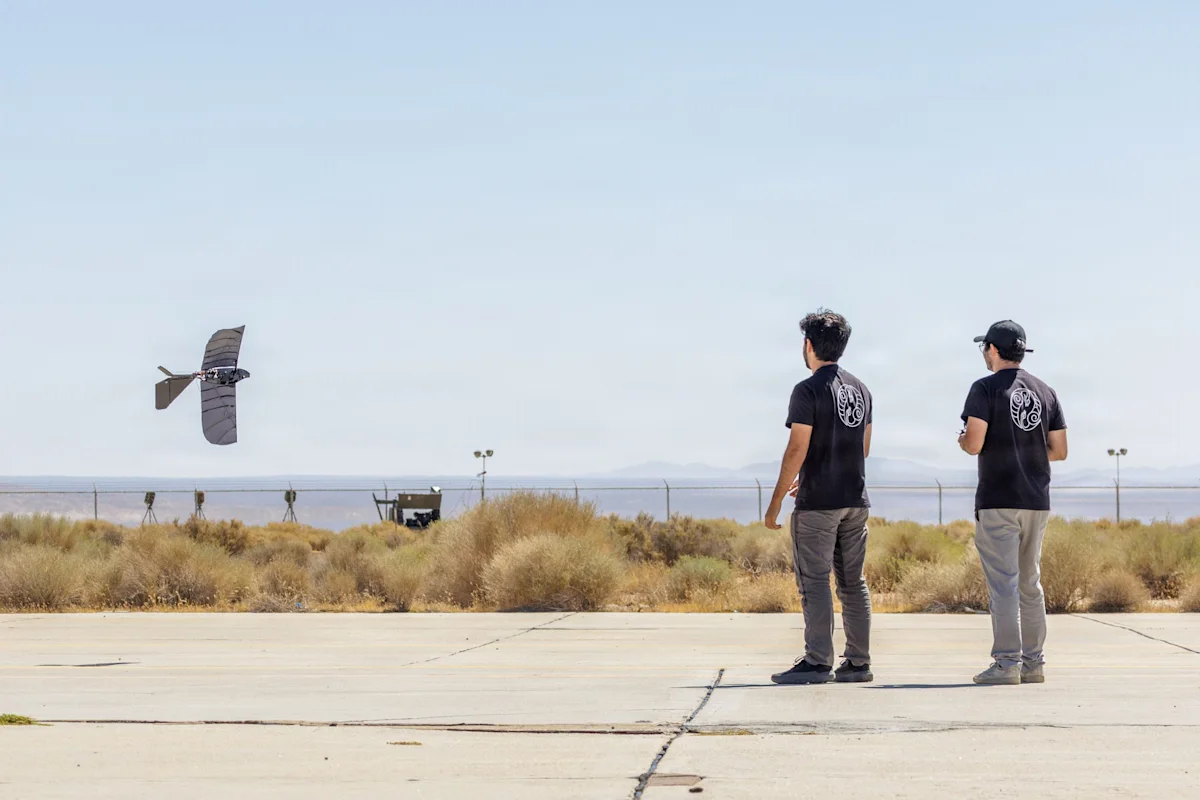
Ornadyne’s O1 does not generate lift with the fast-spinning propellers found on most small drones. The one-pound aircraft stays aloft by flapping semi-rigid wings, giving it the shape, motion and sound of a bird. At an Air Force technology exercise, the company says that combination led participating detection systems to register the aircraft as wildlife rather than establish it as a drone.
The O1 was demonstrated during the Sept. 14-18 “Game of Drones” event at Edwards Air Force Base in California’s Mojave Desert. An Air Force photo identifies a successful flight on Sept. 17. According to the Defense Contract Management Agency’s account of the exercise, sensors fielded by other participating companies classified the O1 as a bird. It was Ornadyne’s first test against counter-drone detection equipment developed and operated by other private companies.
That result remains a company-reported outcome from one experimental event, not an independently measured finding that the O1 can evade every counter-drone system. The test is still notable because it places an aircraft designed to resemble wildlife directly against systems intended to separate drones from ordinary objects in low-altitude airspace.
Why flapping wings change the signal
Conventional multicopters present several useful classification cues. Their rapidly rotating blades generate characteristic radar micro-Doppler patterns, while their motors and propellers produce a recognizable acoustic signature. Birds generate different motion patterns because their wings oscillate much more slowly.
The O1 changes that familiar distinction by replacing rotating blades with birdlike wing motion. Ornadyne co-founder Armen Arakelyan, a former SpaceX engineer, said the aircraft “looks like a bird” and moves similarly enough that people and counter-drone systems can misclassify it. He also said it is quieter because flapping wings replace propellers.
Its external appearance reinforces those mechanical cues. The aircraft flown at Edwards mimicked a crow in shape and profile. Ornadyne says it can alter the color, wingspan, proportions and silhouette of the design to resemble bird species found in different regions.
Radar classification research helps explain why the flight mechanism matters. Research on drone and bird micro-Doppler signatures has shown that classifiers can distinguish rotating propellers from oscillating wings. Those systems depend on training data that represent the targets they may encounter. An aircraft that combines a drone’s payload function with a bird’s wing motion creates a more difficult classification case than a typical quadcopter.
Detection and classification are also separate tasks. A sensor may register that something is moving through the air while still assigning it to the wrong category. Combining radar, cameras and acoustic sensors can provide more information, but a birdlike silhouette, flapping motion and reduced propeller noise place pressure on several classification cues at once.
One hour of flight frames the intended role
A company fact sheet says the O1 can remain airborne for more than an hour, travel as far as 10 kilometers and carry a small payload. Ornadyne describes cameras for target-recognition or surveillance work as one possible payload. Those figures are company specifications, but they show that the design is intended as more than a short demonstration aircraft.
The “Game of Drones” exercise was developed and sponsored by the Defense Contract Management Agency’s Blue List team with the Air Force 412th Test Wing’s Experimental Test Force and the Griffiss Institute. It gives drone manufacturers and detection-system developers an experimental environment in which different technologies can be evaluated together.
Ornadyne is not alone in pursuing flapping-wing aircraft. Such systems belong to the broader ornithopter category, which imitates the wing-driven flight of birds or insects. A 2024 Chinese military exercise also featured a small flapping-wing drone resembling a Eurasian tree sparrow.
For detection developers, the Edwards result identifies a specific reliability challenge: classification models built around the difference between propellers and feathers may need realistic data from aircraft that deliberately blur that boundary. Ornadyne plans to return to a future “Game of Drones” event, creating another opportunity to determine whether the O1’s bird classification persists as sensors and their training sets adapt.
| More aerospace and engineering stories, right in your MSN feed. Follow AMI on MSN |
By Stephen Wallace — Editor for AMI’s aerospace integration and unmanned mobility coverage, focused on drone manufacturing, VTOL systems, autonomous networks, and air-ground mobility links.