Textron M-346N Becomes Only Bid Left for Navy Trainer Replacement
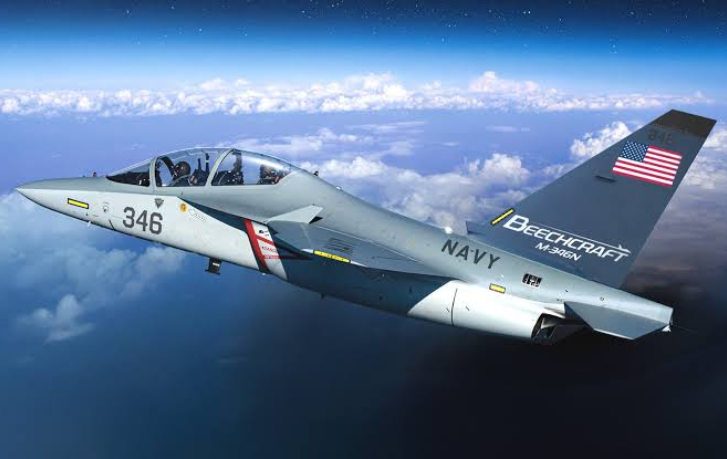
Textron Aviation Defense’s M-346N is the only submitted bid left in the U.S. Navy’s long-delayed effort to replace its T-45 jet trainers. Sierra Nevada Corporation declined to bid under the current contract conditions, following earlier withdrawals by Lockheed Martin, Boeing and Northrop Grumman.
That leaves the Textron-Leonardo team in an unusually strong position, but it does not make the M-346N the formal winner. The Navy is now evaluating proposals and intends to award the trainer contract in the fourth quarter of fiscal 2027, which runs from July through September 2027. The service could still change the acquisition structure or revisit its requirements before then.
Sierra Nevada said the contract structure drove its decision. The company concluded that it could not responsibly commit to firm, fixed production pricing before its proposed Freedom Trainer had completed the normal process of design maturation. It also left the door open to rejoining the effort if the Navy revises its approach.
The departure completes a steady contraction of what had once looked like a broad field. Lockheed Martin said in April 2026 that it would not submit its proposed T-50 variant. Boeing withdrew its T-7 in June, while Northrop Grumman left the Sierra Nevada-led Freedom Trainer team in September. Sierra Nevada then declined to submit the team’s clean-sheet aircraft by the October 30 proposal deadline.
Textron, by contrast, confirmed that it submitted the M-346N and said it was ready to support the Navy’s future training requirements. The aircraft is an Americanized version of Leonardo’s Italian M-346, with Textron planning U.S. production if it secures the contract.
A sole bid still requires a procurement decision
One submitted proposal is different from a sole-source contract awarded without a competition. The Navy opened the requirement to prospective bidders, but the other teams decided not to proceed. It must still determine whether Textron’s proposal satisfies its technical, schedule and pricing requirements before making an award.
The practical loss is competitive leverage. Multiple bids can give an agency stronger comparisons on price, production planning and technical approach. With one offer, the Navy’s evaluation shifts toward whether that proposal is acceptable on its own terms and whether the program can proceed without another restructuring.
The contract’s cost ceiling has already increased from about $1.8 billion to $2.7 billion, while the planned award has moved later. The Navy previously aimed to award the contract by March 2027; its current target is the final quarter of fiscal 2027. Those changes add weight to Sierra Nevada’s statement that it could reconsider if the acquisition approach is revised.
An established aircraft replaces a decades-old trainer
The M-346N would replace the T-45 Goshawk, the Navy’s fast-jet trainer since the 1990s. The service has 188 T-45s in use and has described a requirement for 216 new trainers. Although plans for a successor emerged about six years ago, the replacement effort has repeatedly slipped.
Textron’s central advantage is that the underlying aircraft is already established rather than a clean-sheet design. More than 103 M-346 airframes have been delivered, with the type serving seven countries and ordered by four more. That history does not remove the work required to configure, produce and support the M-346N for the Navy, but it provides a larger operating and delivery record than an aircraft beginning from a new design.
The twin-engine, two-seat trainer has a listed flight radius of 1,925 kilometers and endurance of up to two hours and 45 minutes without external fuel tanks. Its onboard training system can simulate sensors, weapons and opposing aircraft, allowing some instruction to occur without installing all of those systems physically.
The comparison with Boeing’s T-7 is relevant but limited. The Air Force’s T-7A has faced repeated delays and only recently received approval for low-rate initial production. Boeing withdrew it from the Navy contest over engine qualification requirements, not because the Navy had rejected the aircraft. The Air Force program therefore remains separate from the Navy’s source-selection decision.
The M-346N now has no submitted rival, yet Textron still faces the decisive step: convincing the Navy that one remaining proposal can meet a requirement that has spent roughly six years moving toward an award. Until that evaluation ends in 2027, the aircraft is the sole bidder not the selected replacement for the T-45.
| More aerospace and engineering stories, right in your MSN feed. Follow AMI on MSN |
By David Whitaker — Associate editor for AMI’s aerospace and drone systems desk, translating flight systems, aircraft programs, spaceflight, and UAV developments into accessible technical stories.