CSIS Proposes 300 Uncrewed Navy Vessels as Shipyard Delays Persist
Doubling the U.S. Navy’s planned uncrewed fleet would change the balance between sailors and autonomous systems, but it would not remove the industrial bottlenecks keeping ships and submarines from the fleet. The Center for Strategic and International Studies proposed on October 5 replacing a planned mix of 350 crewed vessels and 150 autonomous ships with 300 crewed vessels and 300 uncrewed units.

The recommendation in CSIS’s “Flip the Script” report is an outside proposal, not an adopted Navy procurement plan. Its central tension is already visible: autonomous vessels can distribute functions across more hulls, yet those hulls still require production lines, suppliers, workers, maintenance capacity, bases and support equipment. A fleet target can be revised quickly; the industrial system behind it cannot.
Uncrewed ships change requirements, not the need for support
Removing sailors from a vessel can eliminate accommodations and some human-support systems while allowing designers to tailor the hull around its payload and endurance requirements. The Navy itself has moved away from “optionally manned” concepts because retaining space and systems for people introduces additional cost and complexity. It has also consolidated requirements for medium and large uncrewed surface vessels into one general size concept, according to USNI News.
That design shift does not make an uncrewed vessel maintenance-free. Propulsion, electrical power, communications, computing equipment and payload interfaces still have to survive saltwater exposure, vibration and sustained operation. Those systems require testing before delivery and inspection, repair and software support afterward. A larger inventory also expands demand for spare parts and trained maintainers even if fewer sailors are aboard each hull.
The Navy is already experimenting with this support model at smaller scale. Its small uncrewed surface-vessel programs include production craft, modular communications and computing enclosures, autonomy testing and multiple prototypes. The service has also created training and career paths for personnel who will operate and maintain robotic systems. Those steps show that autonomy shifts labor rather than eliminating it: fewer people may sail on a particular vessel, but specialists are still needed ashore and across the fleet.
The larger constraint is throughput
Current U.S. production rates illustrate the gap between a force plan and delivered ships. American industry produces approximately 1.5 large surface combatants and 1.25 Virginia-class attack submarines annually. Chinese yards deliver nearly 10 large surface vessels and more than four nuclear-powered attack submarines per year, with the exact production multiple varying by the categories compared.
Major U.S. programs are also running years late. Reported delays reach 36 months for Virginia Block IV submarines and 24 months for Block V boats. Columbia-class submarines are 12 to 16 months behind, USS Enterprise is 18 to 26 months late and Constellation-class frigates are delayed by 36 months.
Substituting some crewed ships with uncrewed vessels could reduce pressure in certain yards if smaller or less complex craft can be produced through different suppliers. But the proposal does not establish that all 300 units could bypass existing shipbuilding constraints. Larger uncrewed vessels still compete for marine components, specialized fabrication, integration facilities and workers. Their sensors, autonomy packages and communications equipment also add separate supplier and testing demands.
Maintenance determines how much fleet is available
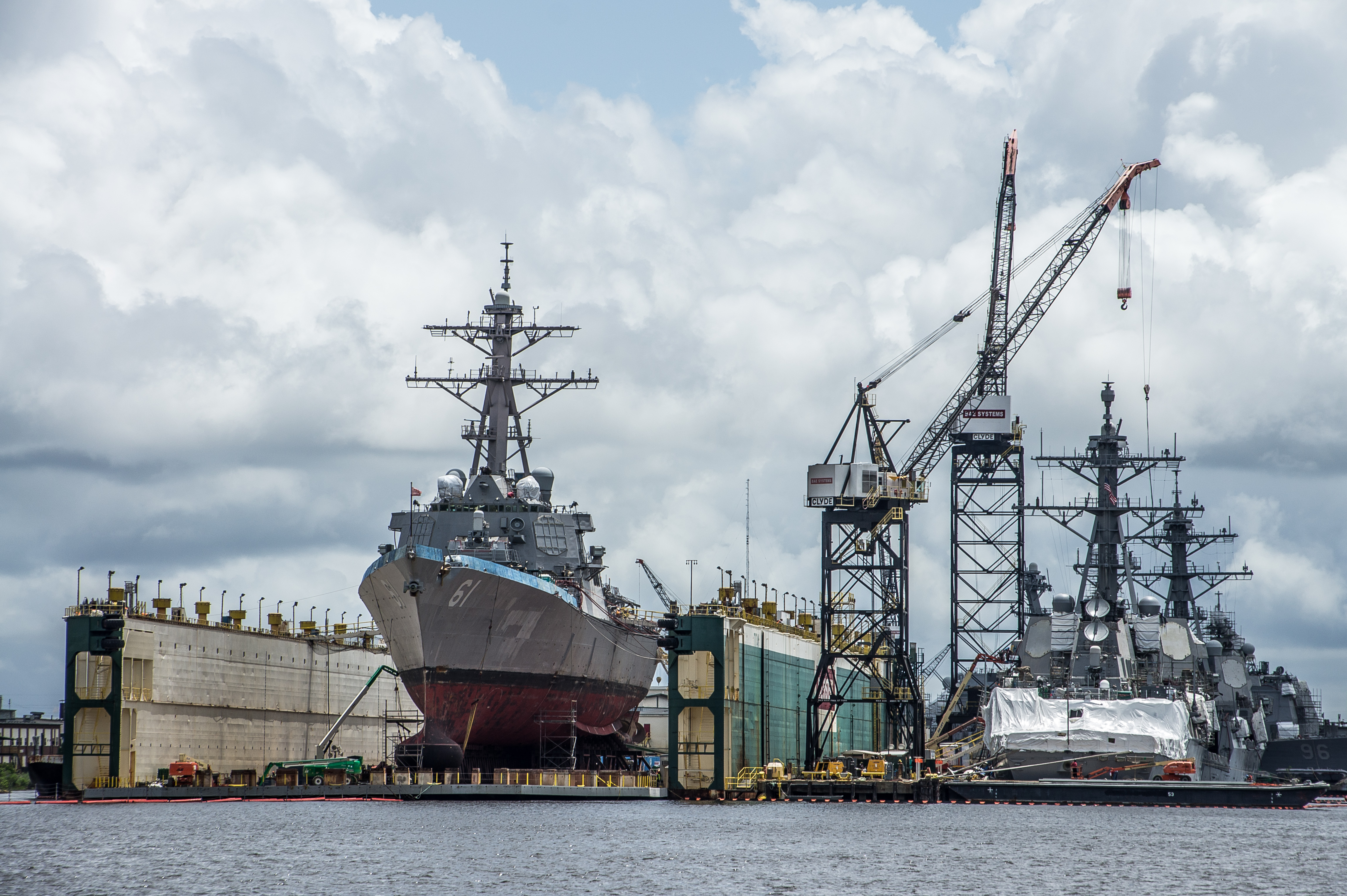
Construction totals capture only part of the problem. Government Accountability Office findings cited in the proposal show that nuclear-powered attack submarines lost more than 15,000 operational days to maintenance delays over a decade. From 2016 through 2025, only 11% of major attack-submarine overhauls finished on time. Their average duration increased from 744 to 809 days, excluding time spent waiting to enter a dry dock.
Expanding the fleet without increasing maintenance throughput risks producing a larger inventory on paper without a proportional increase in available vessels. Dry-dock access, work sequencing and skilled trades become as important as hull count. Workforce losses since the Covid pandemic, recruitment and retention difficulties, subcontracting problems and unstable planning have all contributed to the strain.
The scale of the repair challenge is measured in decades. Modernizing four public shipyards could exceed $200 billion and take more than 50 years, compared with an initial estimate of $21 billion over roughly 20 years. Against that timeline, CSIS’s 300-vessel uncrewed concept is best understood as a force-mix proposal not a substitute for the yards, workers and maintenance system that determine how much of any future Navy can actually put to sea.
| More aerospace and engineering stories, right in your MSN feed. Follow AMI on MSN |
By David Whitaker — Associate editor for AMI’s aerospace and drone systems desk, translating flight systems, aircraft programs, spaceflight, and UAV developments into accessible technical stories.