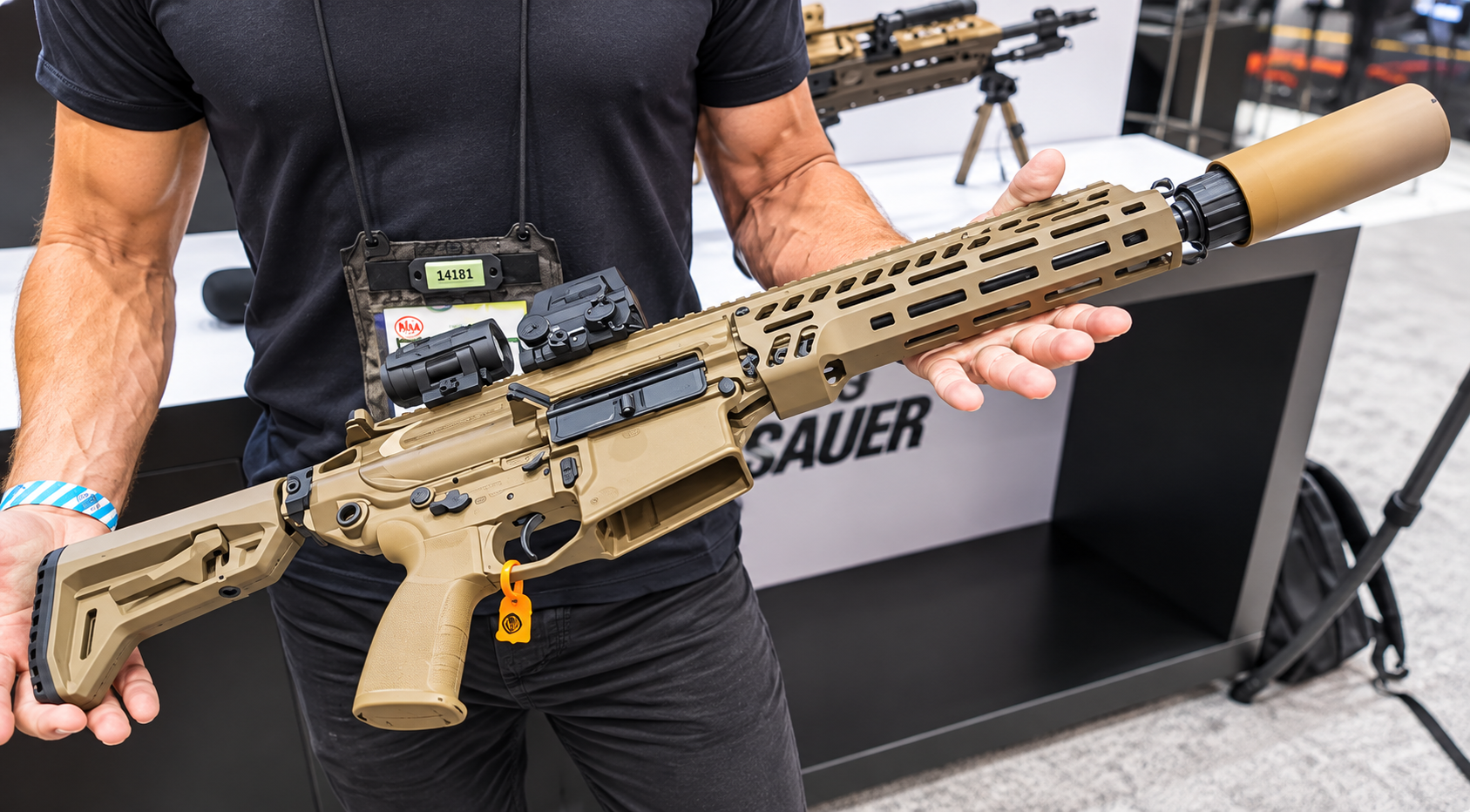
Army’s M8 Sheds a Pound and 3.5 Inches Before December Fielding
The Army is preparing to field a substantially lighter and shorter carbine only a few years after introducing the M7 rifle. The new M8 weighs 8.8 pounds with a suppressor, compared with 9.8 pounds for the M7 in the same stated configuration. The Pentagon also describes the M8 as approximately 3.5 inches shorter overall.
Initial fielding is scheduled for December with several units at Fort Bragg, North Carolina, according to information provided by manufacturer SIG Sauer. The company has already made initial production deliveries and is preparing to meet that schedule. Previously called the XM8, the carbine has dropped the experimental “X” designation.
The unresolved point is what, precisely, the M8 replaces. A Defense Department spokesperson said it will replace the M4A1 for soldiers in the Close Combat Force beginning in fiscal 2027. Current program descriptions, however, position the lighter M8 as the immediate successor to the M7 configuration. The two descriptions can fit the same transition the M4A1 is the legacy carbine being displaced, while the M7 is the newer design being superseded but the Army has not published a complete disposition plan for the M7s already delivered.
A major procurement shift is visible in the budget
The fiscal 2027 weapons acquisition request calls for 14,944 M8 carbines and no additional M7 rifles. Approximately 50,000 M7s have already been delivered, leaving the Army with a sizable inventory decision as the new configuration enters service.
Those rifles could remain with current units, move to training or reserve formations, or potentially be converted. SIG has said the shared architecture could support conversion kits, but Army leaders have not publicly selected or funded that course. Until they do, the M8’s long-term relationship with the fielded M7 inventory remains less settled than the December delivery schedule.
The broader program is staying intact. SIG received a 10-year contract in 2022 to produce the Army’s Next Generation Squad Weapons, including the rifle family and the M250 light machine gun. Both use the new 6.8x51mm cartridge adopted after an Army study identified requirements for greater energy at extended ranges and reduced shooter error through advanced fire control.
The M8 therefore represents a compact redesign inside that 6.8mm program rather than a return to the M4A1’s lighter 5.56mm system. Its listed configuration includes an 11-inch barrel and a 25-round magazine, versus the M7’s 13.5-inch barrel and 20-round magazine. The complete-weapon length comparison comes from the Pentagon’s approximately 3.5-inch figure; the listed barrel figures themselves differ by 2.5 inches.
Why one pound has an outsized role
A one-pound reduction is modest against an entire combat load, but the weapon is continuously handled rather than carried entirely by a pack. Its length and center of gravity also affect how that weight feels. Shortening the front of the system reduces the leverage imposed by mass near the muzzle, particularly when a suppressor is installed.
The wider load problem makes incremental reductions valuable. A Center for a New American Security assessment found that dismounted troops have carried 90 to 140 pounds or more, with heavier loads reducing mobility, increasing fatigue and degrading performance. Army professional guidance separately recommends that fighting loads remain within 30% of a soldier’s body weight and approach loads within 45%, although those targets are often exceeded.
Recent experimental work sharpens the design lesson. In a 2026 load-carriage study, 12 soldiers completed five-kilometer marches with three backpack variants while carrying the same total load. Researchers found no significant objective performance or physiological differences among the pack designs and concluded that load weight was the dominant factor. In practical terms, removing mass can matter more than rearranging it.
The same pressure is appearing elsewhere in the weapons family. SIG has developed a shorter, lighter M250A1 configuration with revised barrel options, buttstock and durability-related changes following Army feedback. The Army has not yet formally adopted that configuration, but the work shows that the M8 is part of a broader effort to reduce the bulk of the new 6.8mm systems without abandoning their shared ammunition architecture.
December fielding will move the M8 from design revision to soldier use. The harder procurement milestone comes next: deciding what happens to roughly 50,000 M7s while the Army requests nearly 15,000 lighter carbines and no more of the rifle configuration they follow.
| More aerospace and engineering stories, right in your MSN feed. Follow AMI on MSN |
By David Whitaker — Associate editor for AMI’s aerospace and drone systems desk, translating flight systems, aircraft programs, spaceflight, and UAV developments into accessible technical stories.