Caltech Robot Builds First Orbital Structure but Leaves Antenna Unfinished
A Caltech robot has autonomously assembled part of a 1.4-meter-wide reflective antenna in orbit, an important first that also exposed the distance between a small proof of concept and truly large space construction. The DARPA-funded demonstration ended before the robot could complete the truss or build additional antenna sections.
This is the first time that a structure has been autonomously constructed in space, said Sergio Pellegrino, the Caltech aerospace and civil engineering professor who leads the Autonomous In-Space Tensioned Reflector Assembly project, known as ASTRA.
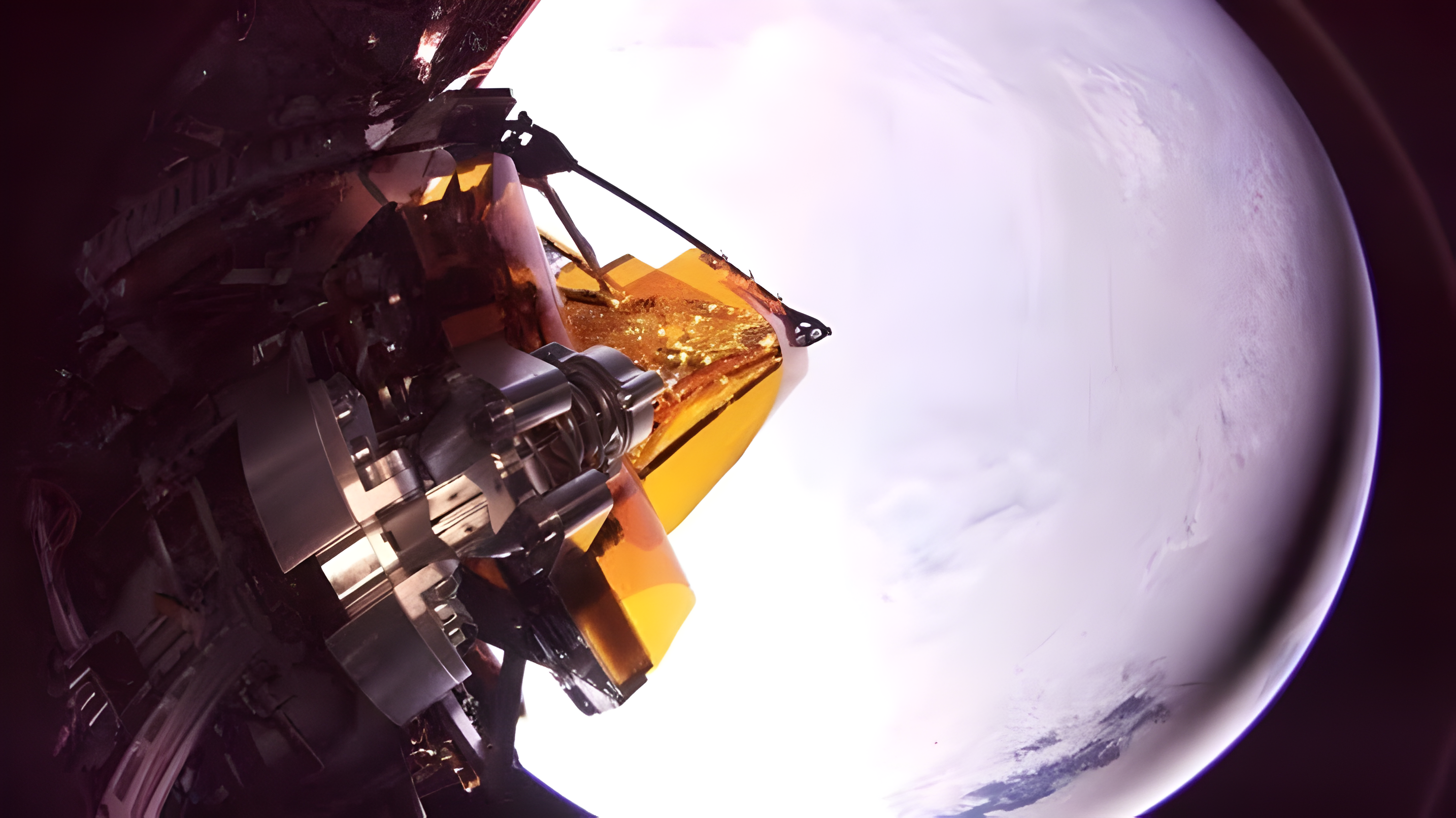
The qualification behind “autonomously” is important to understanding what ASTRA achieved. Engineers on Earth transmitted commands and checked photographs of the results during limited communication windows totaling about 15 minutes per day. They were not directly steering every motion. Once instructed, the robotic truss builder picked up individual components, moved them into position and performed the construction work on an assembly plate without a human at the controls.
The hardware was deliberately lightweight. ASTRA assembled the antenna section from composite fiber tubes and aluminum joints while deploying a thin, perforated Kapton film as its reflective surface. Its payload included two prebuilt truss sections, a robotic manipulator and components intended to complete the remaining structure after launch.
That division between prebuilt hardware and orbital assembly is the central engineering idea. Most spacecraft structures must either fit inside a rocket fairing, often in a carefully folded configuration, or be divided into large sections for later assembly. Building from smaller members at the operating location could loosen that geometric constraint, particularly for low-mass structures whose useful performance depends heavily on their deployed area.
A small structure aimed at a much larger problem
ASTRA reached orbit on March 30, 2026, aboard Momentus Inc.’s Vigoride 7 space tug, which launched on SpaceX’s Transporter-16 rideshare mission. The roughly 1-cubic-meter payload survived launch, released its restraints and deployed its two prebuilt truss bays before assembling another section in space.
The team encountered what its engineers described as numerous “little surprises” in the orbital environment. A flight spare in Caltech’s laboratory allowed them to reproduce problems and test responses on the ground before sending new commands. Time ultimately ran out before ASTRA could finish all 11 planned bays or construct further antenna sections.
The incomplete build limits what can be claimed. ASTRA showed that its assembly sequence can work in orbit, but it did not produce a complete 1.4-meter antenna, much less an operational structure at the scale envisioned by DARPA. Refining and simplifying the machinery will be necessary before the approach can move beyond a tightly bounded demonstration.
ASTRA is part of DARPA’s Novel Orbital and Moon Manufacturing, Materials, and Mass-efficient Design program. Program manager Andrew Detor said its objective is scalable construction of structures measuring hundreds of meters or even kilometers. “Nothing approaching that scale can be achieved today,” he said.
Closing that gap involves more than repeating the same motions for longer. A larger structure would demand reliable handling of many more members and joints, sustained power and communications, tighter control of accumulated alignment errors, and a design that can tolerate faults without requiring extensive intervention from Earth. ASTRA’s limited contact windows and unfinished truss illustrate how quickly operational time becomes a constraint even at 1.4 meters.
If those constraints can be managed, autonomous construction could support telescope mirrors, radio antennas, communications systems and large solar arrays that would be difficult to package inside a launch fairing. Pellegrino also sees potential for robots eventually to build larger telescope structures, while related robotic capabilities could contribute to fixing satellites in orbit. ASTRA itself demonstrated construction, not satellite repair.
DARPA’s broader program has another orbital manufacturing milestone ahead: a University of Illinois Urbana-Champaign project is expected to test a space-compatible resin system aboard the International Space Station. For ASTRA, however, the defining result is already clear the robot assembled a real truss in orbit, but its unfinished 1.4-meter antenna remains an early step toward structures hundreds or thousands of times larger.
| More aerospace and engineering stories, right in your MSN feed. Follow AMI on MSN |
By David Whitaker — Associate editor for AMI’s aerospace and drone systems desk, translating flight systems, aircraft programs, spaceflight, and UAV developments into accessible technical stories.