Tesla Will End Cybertruck Production, Refund Deposits to Build Cybercab
Tesla says Cybertruck orders are arriving faster than it can build the electric pickup, yet the company plans to close the production line and return deposits to many waiting customers. CEO Elon Musk said Tesla will make as many trucks as possible before the line shuts in about eight months, but the remaining production window will not be long enough to fill the order book.

“We will try to make as many as possible before shutting down the line in about 8 months, but will have to return deposits for a lot of people,” Musk wrote Monday, according to Reuters. He described the Cybertruck order rate as “far exceeding” its production rate. In a separate post, he put the remaining run at eight to nine months, consistent with his previously announced target of ending production at Tesla’s Texas factory by mid-2027.
The decision creates an unusual tension: Tesla is retiring a vehicle while its CEO says unfilled orders remain. Musk’s explanation is not that every available order lacks value. It is that the factory resources assigned to the Cybertruck could generate more value building the Cybercab robotaxi.
A capacity decision shaped by manufacturing complexity
Musk denied that Tesla is ending Cybertruck production because the pickup is unprofitable. Instead, he said the “opportunity cost of the complexity of Cybertruck is vastly outweighed by the value of incremental Cybercab production.” In practical manufacturing terms, Tesla is comparing what its Texas plant can produce with a limited pool of floor space, equipment, labor and management attention.
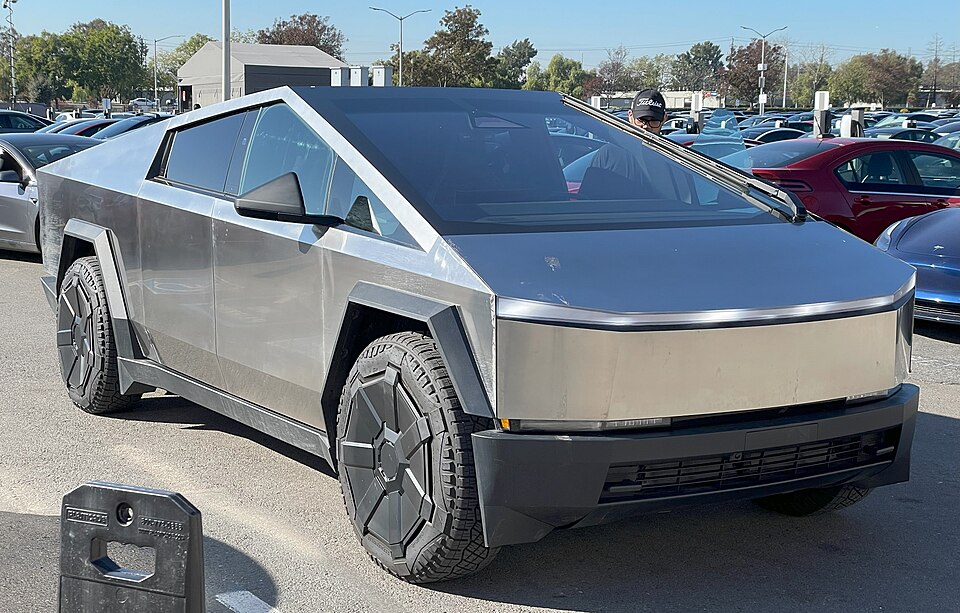
The Cybertruck’s distinctive construction helps explain why complexity is central to that comparison. Its stainless-steel exterior is difficult to form and leaves dimensional variation readily visible across large, flat surfaces. Tesla developed an “air bending” process to shape the material with high air pressure without touching its surface, vehicle engineering executive Lars Moravy previously explained in a discussion cited by CNBC.
That architecture separates the Cybertruck from conventional pickups, but it also makes production less interchangeable with ordinary high-volume vehicle manufacturing. Thick stainless steel, straight edges and exposed flat planes impose demanding forming and fit requirements. Errors that paint, curves or trim might visually soften on another vehicle can remain conspicuous on bright, unpainted metal.
Closing the line therefore releases more than a nominal production slot. It allows Tesla to dismantle or repurpose a manufacturing system built around an unusually difficult body design and redirect factory resources toward scaling Cybercab. The available information does not specify how much Cybercab output the change will add or which equipment can be reused, so the exact capacity benefit remains unquantified.
Musk and an outside analyst offer conflicting demand explanations
Dan Ives, senior managing director at Yorkville Ives & Co., offered a different reading of the shutdown. He said the “writing was on the wall” because of the Cybertruck’s high price and low demand. Ives also said ending production would let Musk concentrate more heavily on robotics and robotaxis.
That assessment conflicts directly with Musk’s claim that the current order rate exceeds production. Both can describe different parts of the program’s history or different definitions of viable demand, but Tesla has not provided the order count, production rate or number of deposits it expects to refund. Without those figures, customers cannot determine how large the backlog is or how Tesla is prioritizing the final trucks.
Tesla unveiled the Cybertruck in 2019 with a stated starting price of $69,000, building much of its identity around a body and shape unlike those of conventional pickups. Musk now says, “There will never be another vehicle like it.” For customers whose orders fall beyond the final production allocation, that claim will have a concrete consequence: a returned deposit rather than the distinctive truck they reserved.
| More aerospace and engineering stories, right in your MSN feed. Follow AMI on MSN |
By Robert McKinney — Editor-in-Chief for AMI’s automotive and mobility coverage, with a mechanical engineering background and a decade reporting on powertrain systems, EV innovation, and global vehicle manufacturing.