Secret North American Blue Energy Deal Gives U.S. 35% Stake, $30 Oil
Oil is already moving under a confidential 50-year agreement that gives the United States a 35 percent stake in North American Blue Energy Partners and access to 20 percent of its Venezuelan production at $30 a barrel. The contract offers unusually favorable terms, but their public value depends on whether NABEP can complete an expensive expansion, manage heavy crude and preserve an arrangement facing legal and political review.
An 18-page contract reviewed by The Washington Post gives Washington its equity position for nearly nothing. After Venezuela takes royalties ranging from 16 to 40 percent of production, the United States can purchase 20 percent of the remaining NABEP output at the fixed price. It also receives first purchase rights on the rest at market rates.
Initial shipments began arriving in the United States late last month, including a reported one-million-barrel cargo. That first delivery was publicly described as free to taxpayers, but reporting on the cargo’s payment structure indicated that its value may be reconciled through future pricing adjustments rather than absorbed as an outright commercial gift. Only the first shipment was described as carrying no upfront taxpayer cost.
The $30 figure is not the delivered cost
The contract price is strikingly low, but it does not represent the complete cost of placing usable crude at a U.S. refinery. The agreement’s disclosed terms do not include the cost of the blending material needed to move some Venezuelan oil. Much of the country’s crude is sufficiently viscous that it must be mixed with 20 percent or more thinner petroleum products before it can flow through pipelines.
NABEP has said much of its production needs little or no diluent and that blending would not materially undermine its economics. The engineering burden will vary by field and crude grade, so neither the headline contract price nor a national description of Venezuelan heavy oil establishes the cost of every NABEP barrel.
The United States does have a technically suitable destination for the supply. Many Gulf Coast refineries are configured for heavy, sulfur-rich crude, and S&P Global estimated that the region could absorb another 300,000 to 400,000 barrels per day of Venezuelan heavy oil while increasing utilization of existing coking equipment. Additional imports could also displace lighter domestic crude into export markets, limiting any one-for-one increase in U.S. fuel production.
That is why discounted government access cannot be treated as a guaranteed reduction in gasoline prices. Crude acquisition is only one part of the retail price, alongside transport, refining, distribution and taxes. Energy analyst Francisco Monaldi said the venture is unlikely to reduce U.S. gasoline prices materially and characterized its prospects as “90 percent smoke and mirrors.”
Production must rise almost fivefold
A larger constraint is the gap between NABEP’s reported operation and its 2033 objective. Alejandro Betancourt said the company increased output from 18,000 barrels per day in late 2023 to roughly 223,000. He projected 275,000 before the end of 2026, 350,000 the following year and more than 1.015 million barrels per day by 2033.
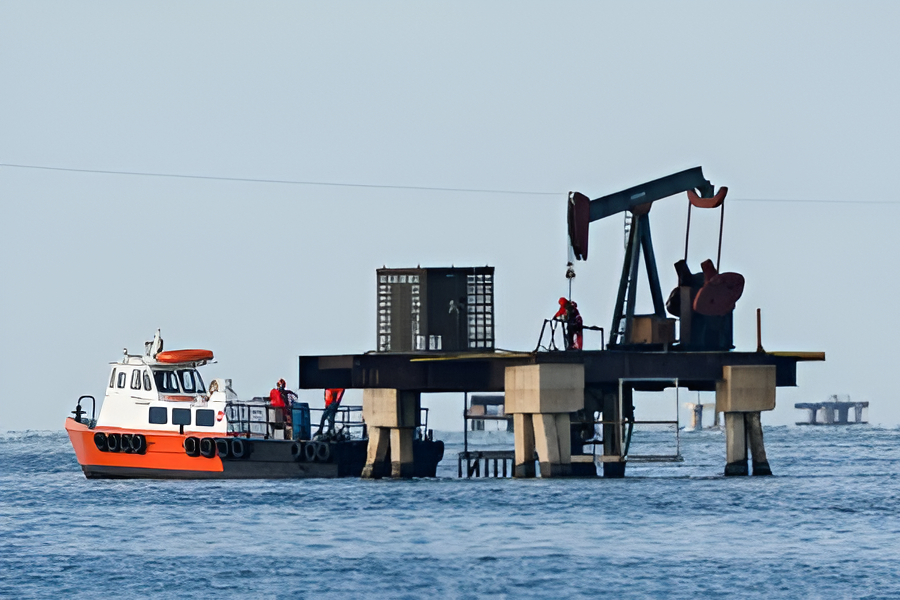
The Washington Post observed drilling at four sites during a visit. Betancourt said 11 sites were operating, while NABEP holds rights to 17 sites and fields believed to contain 63.7 billion barrels. Those underground resources are not equivalent to available production: rigs, wells, power, heated drilling equipment, processing systems, diluent supplies, worker transport, storage and export capacity must be financed and operated as a connected system.
NABEP plans to reach 60 drilling rigs and deploy the remaining equipment within 36 months. Betancourt also said virtually all of more than $5 billion in projected 2026 cash flow would be reinvested. His dividends cannot begin until production exceeds 1.015 million barrels per day, linking his payout to the most aggressive target without ensuring that the necessary infrastructure can be delivered.
Untouched Orinoco Belt acreage presents the toughest boundary. Energy specialist Oswaldo Felizzola estimated that even minimum development of a greenfield site could require five to 10 years and $15 billion to $20 billion. Existing producing fields may support near-term shipments, but reaching the million-barrel target would require a much broader industrial buildout.
A 50-year contract still faces institutional tests
The agreement attempts to create continuity through a long duration and a governing structure designed to resist reversal. Yet Democratic lawmakers preparing to control Congress have challenged the legal authority and wisdom of the government’s direct investment. Venezuelan opposition leader María Corina Machado has separately questioned the contract’s transparency and suggested that it could be reviewed. Those are political and legal objections, not adjudicated findings.
The contract reportedly requires anti-money-laundering controls, external audits, government access to records, an annual budget and quarterly unaudited financial statements. It remains unclear whether those materials will be public, leaving taxpayers without the routine visibility normally needed to evaluate costs, revenue, dilution expenses and the performance of a government-owned stake.
The agreement has therefore secured valuable rights before it has secured production at the promised scale. Its next meaningful test is whether NABEP can turn current shipments and operating fields into a sustained expansion while financing a buildout that, in untouched parts of the Orinoco Belt, may take a decade and cost as much as $20 billion.
| More aerospace and engineering stories, right in your MSN feed. Follow AMI on MSN |
By Thomas Caldwell — AMI’s senior editor for mechanical and mobility engineering, covering vehicle electronics, systems integration, electrification, chassis systems, propulsion, and safety policy.