U.S.-Venezuela Oil Pact Covers 65 Billion Barrels, but Contract Stays Secret
A newly announced U.S.-Venezuela oil partnership reaches across 17 fields and a claimed 65 billion recoverable barrels more than the cited 46 billion barrels of proved reserves in the United States. Yet neither government has published the contract, identified the operators or explained how those companies will be selected, leaving the project’s legal structure, public return and production outlook difficult to assess.
Venezuela’s interim President Delcy Rodriguez said the partnership would run for at least 25 years, attract $100 billion in investment and generate $209.3 billion in royalties and taxes. The plan reportedly envisions 55% U.S. participation, but that does not mean the United States would own Venezuela’s underground oil. Under Venezuela’s reformed hydrocarbons framework, deposits remain property of the Republic even when private companies receive operating or production-sharing rights.
The reserve figure depends on a recovery assumption
The largest technical uncertainty sits inside the 65-billion-barrel headline. Gas Energy Latin America estimated that the fields hold 63.7 billion barrels of proved reserves by applying a 20% recovery factor the portion of oil in place assumed to be technically recoverable. That rate was described as feasible but has not been achieved across these assets.
A recoverable-reserve estimate is therefore a modeled production boundary, not a tank of oil ready for export. Reservoir behavior, well performance, surface equipment, processing capacity, maintenance and capital deployment all determine how much crude can actually be produced economically. A lower realized recovery factor would reduce the obtainable volume even if the underlying geological estimate remained unchanged.
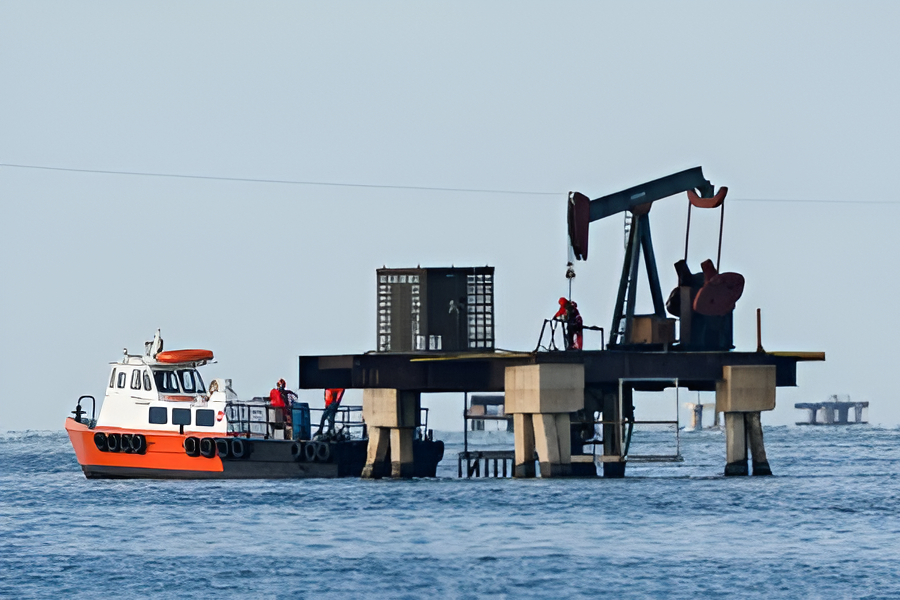
Field location also matters. Most of the estimated reserves are concentrated in eight large Orinoco Belt blocks containing extra-heavy crude. Undeveloped areas there require development plans and new investment before they can support sustained output. The remaining assets around Lake Maracaibo include existing infrastructure, but that infrastructure requires repairs. The portfolio may provide some initial exportable production by combining developed and undeveloped properties, although experts expect full recovery of the estimated resource to take longer than the announced 25-year minimum term.
That timing separates reserve control from energy supply. Even a legally durable agreement would not convert tens of billions of barrels into rapid production. Extra-heavy-oil development and rehabilitation of aging facilities are infrastructure programs involving wells, gathering systems, processing equipment, transportation and continuing maintenance. Each stage adds cost, schedule risk and operating dependencies.
Unpublished terms conceal the allocation of risk and revenue
The missing contract prevents the public from seeing who pays for those systems, how production is divided, what performance obligations apply and which government bears the consequences of delay. Rodriguez’s projections of $100 billion in investment and $209.3 billion in royalties and taxes cannot be tested fully without assumptions covering oil prices, production profiles, project costs, tax rates and the timing of cash flows.
Venezuela’s January 2026 legal reform widened the routes for private participation. Private operators domiciled in Venezuela can undertake primary oil activities at their own cost and risk under agreements with state-owned companies, while minority shareholders in mixed companies may receive operational and commercial authority. The revised system also permits project-specific royalties of up to 30%, an integrated hydrocarbons tax of up to 15% of gross monthly income and potential adjustments intended to preserve a project’s economic balance.
Those flexible ranges make contract-level disclosure especially important. Francisco Monaldi of Rice University’s Baker Institute called the announced taxes “incredibly low.” Without the applicable royalty, tax, cost-recovery and production-sharing terms, citizens cannot determine how the projected public revenue compares with the value transferred to operators or the investment risk those companies would assume.
The selection process adds another accountability issue. The agreement was negotiated secretly and did not pass through a competitive process. North American Blue Energy Partners told The New York Times that it looked forward to working with the United States amid reports of possible participation, but no operator list has been released. The White House directed questions to the Department of Energy, which did not respond; Venezuela’s oil ministry and state energy company PDVSA also did not respond.
Legal durability remains unresolved as well. Juan Carlos Apitz, head of the Central University of Venezuela’s law faculty, said the agreement could face a future court challenge despite U.S. recognition. Columbia University energy-policy scholar Luisa Palacios warned that the transaction could further weaken Venezuela’s institutional framework rather than reduce investment risk.
The partnership’s scale is real as an announced resource claim, but its practical value will be determined field by field and clause by clause. Until the contract, operators, fiscal terms and production assumptions are disclosed, 65 billion barrels remains a long-range recovery estimate attached to an infrastructure-intensive plan not 65 billion barrels of near-term supply.
| More aerospace and engineering stories, right in your MSN feed. Follow AMI on MSN |
By Thomas Caldwell — AMI’s senior editor for mechanical and mobility engineering, covering vehicle electronics, systems integration, electrification, chassis systems, propulsion, and safety policy.