Mercedes Hands-Free Driving Reaches 85 Miles Per Hour but Needs Constant Attention
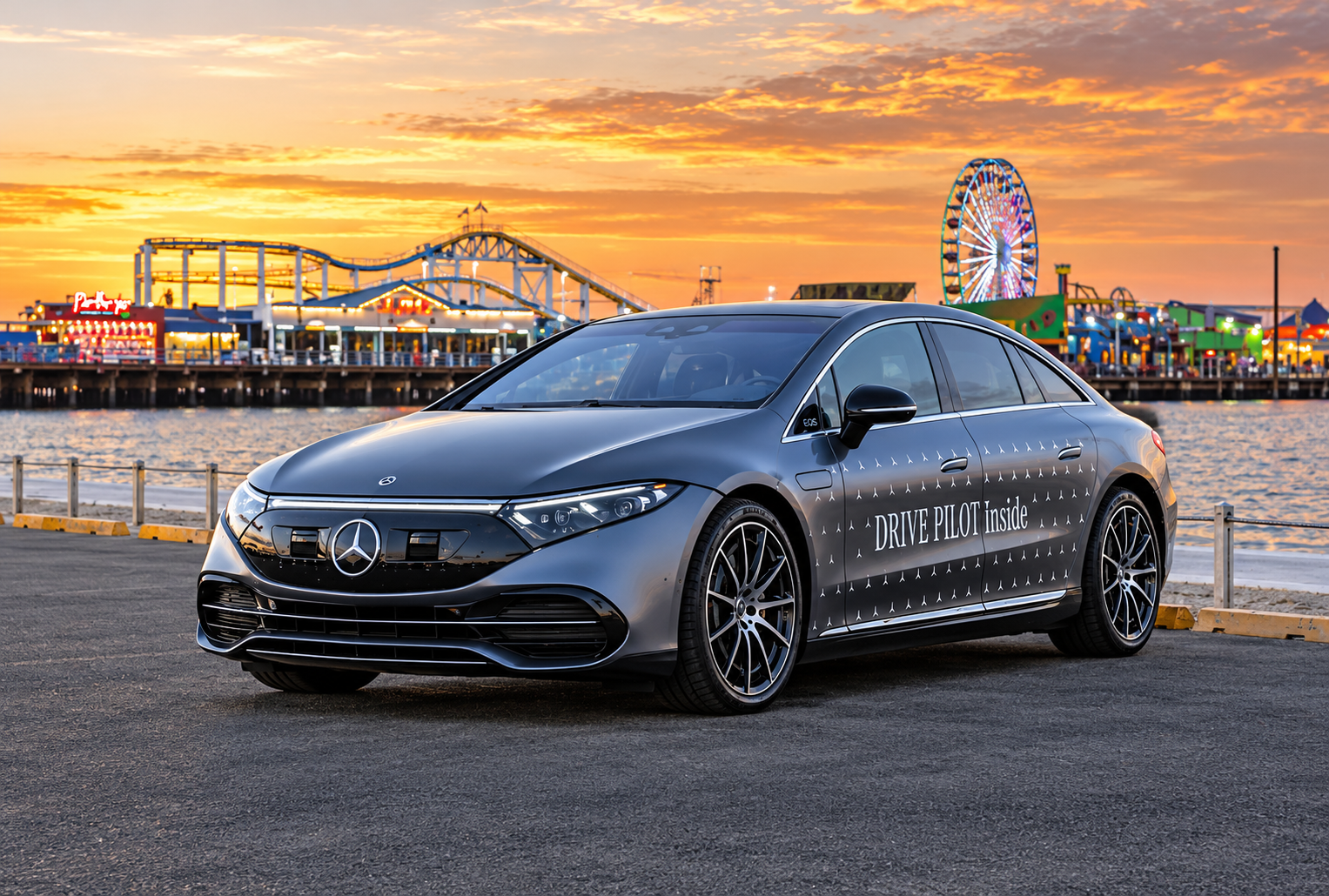
Mercedes-Benz is preparing to let drivers take their hands off the wheel at up to 85 miles per hour on eligible highways, but the person in the driver’s seat will remain responsible for watching traffic and correcting the vehicle. During a San Francisco preview attended by Design News, the automaker’s new Level 2 assistance systems required several driver interventions around crosswalks, pedestrians, parking vehicles and an intersection.
The rollout involves two products with different operating boundaries. Hands-Free Highway Assist permits hands-off driving on eligible controlled-access highways under acceptable conditions. MB.Drive Assist Pro can follow a navigation route through more complex urban traffic, but the driver must keep both hands on the steering wheel. Both require continuous attention to the road.
Select eligible customers in California are scheduled to receive early access beginning in December. Mercedes plans to expand Hands-Free Highway Assist nationwide in spring 2027, with MB.Drive Assist Pro following later in 2027.
Hands-free does not mean self-driving
Mercedes classifies both products as Level 2 driver assistance. Under the SAE driving-automation framework, Level 1 and Level 2 technologies are driver-support systems. At Level 2, the vehicle can control steering and speed together, but the human driver must still detect hazards, interpret unusual situations and respond when the system’s decision is unsuitable.
That division of labor was visible in San Francisco. MB.Drive Assist Pro successfully maneuvered around double-parked delivery vehicles, demonstrating its ability to manage some common urban obstructions. Yet the driver intervened after the system attempted to stop in traffic on marked pedestrian crosswalks. Another override was required when it pulled directly behind a vehicle preparing to reverse into a parallel-parking space, leaving the Mercedes waiting for a car that was not going to move forward.
Other interventions involved children crossing a street, a standoff with a pedestrian and a pedestrian entering an intersection after another driver waved the person across. These situations share a systems challenge: traffic participants often communicate through position, timing, eye contact and informal courtesy rather than through cleanly defined right-of-way rules. A vehicle can correctly detect an object while still choosing a path or stopping position that a supervising driver considers inappropriate.
Highway operation has a narrower environment
Controlled-access highways remove many of the complications found on city streets, including crosswalks and most direct interaction with pedestrians. Even there, the preview identified behavior requiring close supervision. Automatic lane changes were hesitant enough to leave openings that other motorists could occupy. The test did not encounter the repeated disengagements the publication had previously experienced with Ford’s system, but maintaining engagement was still necessary.
The route-aware function can position the vehicle in the right lane before an exit. Near closely spaced interchanges, however, that movement may conflict with traffic entering from an adjacent ramp. The assistance system must balance route preparation against the immediate behavior of merging vehicles a dynamic judgment that remains with the driver when the software’s choice does not fit the situation.
This supervisory role creates a human-factors tension. Automation can reduce continuous steering and speed-control work while asking the driver to remain ready for an irregular event. A literature survey on driver engagement while supervising automation found longstanding concerns about sustained attention and identified support for drivers’ mental models and better use of environmental context among the most common proposed design approaches. The practical requirement is not merely detecting whether a driver is looking forward; the interface must help the driver understand what the system sees, what it intends to do and where its capability is likely to narrow.
Hardware supports a software-delivered rollout
MB.Drive Assist Pro uses 27 sensing components: 10 cameras, five radar sensors and 12 ultrasonic sensors. Their information is processed by an Nvidia computer rated at up to 254 trillion operations per second. The sensor mix provides overlapping ways to observe lane geometry, vehicles, pedestrians and nearby objects, but the San Francisco encounters show why sensing an environment and negotiating it appropriately are separate engineering tasks.
Some 2027 CLA Electric, GLE, GLS and S-Class vehicles already carry the necessary hardware. Mercedes plans to extend that hardware across more of its U.S. passenger-car portfolio beginning with the 2028 model year. Customers will be able to activate the features through the Mercedes-Benz Store using an over-the-air update and subscribe for periods of one to three years.
The 85-mile-per-hour limit expands where hands-off assistance may be useful, but it does not transfer the driving responsibility. For Mercedes customers entering the early-access program, the defining operating condition will remain the person behind the wheel: hands may come off on eligible highways, while attention cannot.
| More aerospace and engineering stories, right in your MSN feed. Follow AMI on MSN |
By Thomas Caldwell — AMI’s senior editor for mechanical and mobility engineering, covering vehicle electronics, systems integration, electrification, chassis systems, propulsion, and safety policy.