NASA Receives Voyager 1 Signal After Its 24-Hour Trip to Earth
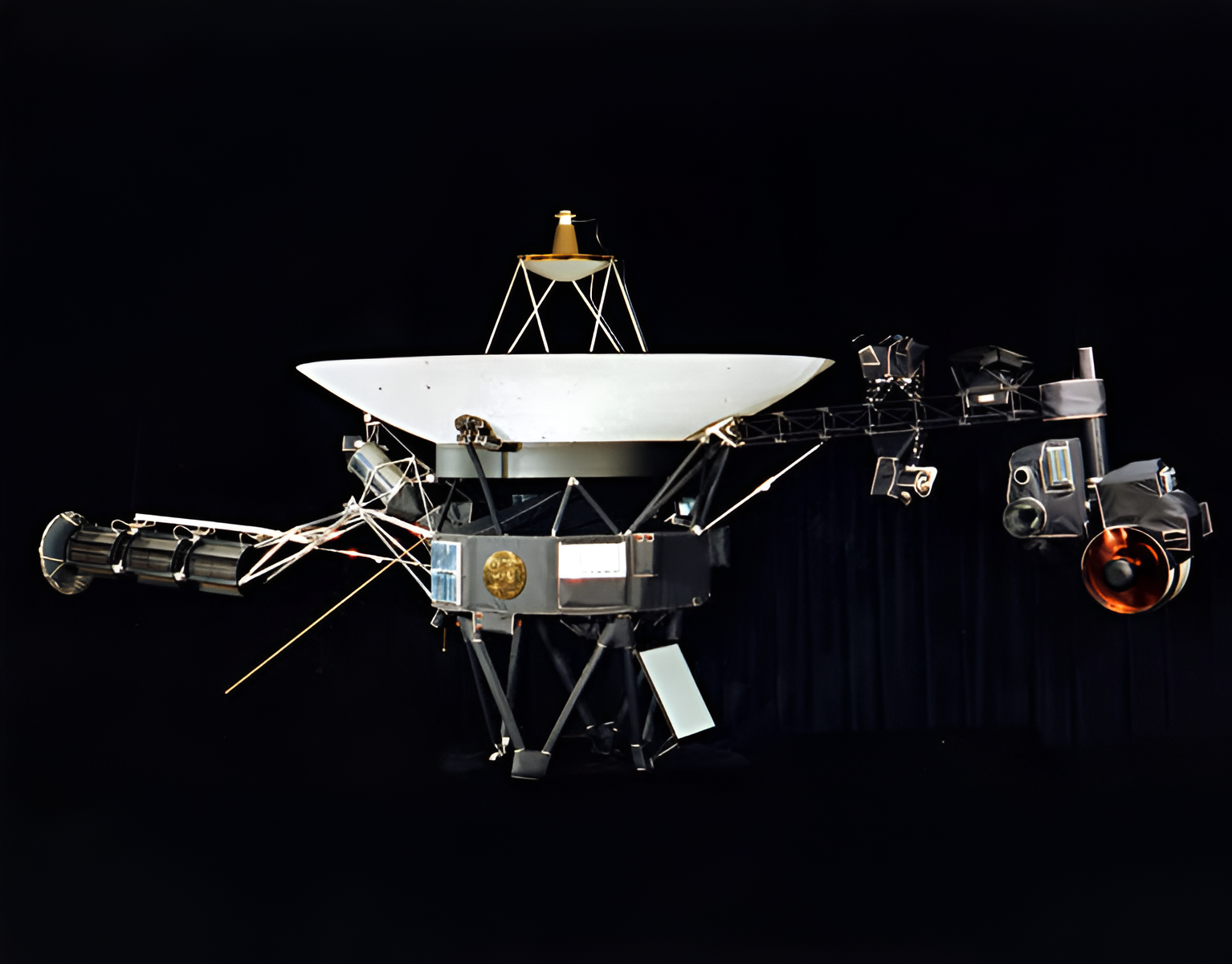
Twenty-four hours. That is how long a radio signal from NASA’s Voyager 1 needed to reach Earth after the spacecraft crossed the one-light-day mark. Flight controllers received the call early Thursday, exactly one day after it left the probe more than 16 billion miles away, according to NASA’s mission update.

The completed transmission makes an immense distance tangible. Voyager 1 can still phone home from interstellar space, but even information moving at the speed of light can no longer bridge the gap in less than a full day. NASA describes the spacecraft as the first human-made object to communicate with Earth from one light-day away.
A one-day delay in each direction
The reported 24-hour trip covered one direction, from Voyager 1 to Earth. A command sent from Earth now faces the same delay before it reaches the spacecraft. If controllers transmit an instruction and need a returning signal to confirm the result, the earliest possible confirmation is therefore about 48 hours after the command leaves Earth.
That delay rules out anything resembling a real-time exchange. Mission planning must account for a full day before a command arrives and another full day before its response can return. Any diagnosis based on a command-and-response sequence consequently unfolds across days, even before engineers spend time evaluating the information.
Voyager 1 reached the milestone at 2:16 a.m. Pacific time on Nov. 18, 2026. A light-day is a measure of distance rather than the spacecraft’s travel time: it is how far light moves through a vacuum in 24 hours. For Voyager 1, that boundary was about 16.1 billion miles from Earth.
The radio transmission itself moves at light speed because radio waves are a form of electromagnetic radiation, just like visible light. The spacecraft’s distance, rather than a slow communications system, imposes the delay. There is no faster signal available to eliminate it.
Earth needs enormous antennas to hear Voyager
Reaching Earth is only part of the communications problem. Voyager’s radio signal is extremely weak by the time it arrives, so NASA relies on the Deep Space Network, a worldwide collection of large radio antennas used to communicate with distant spacecraft. Its sites near Canberra, Australia; Madrid, Spain; and Goldstone, California, are positioned around the planet so Earth’s rotation does not end continuous access to deep-space targets.
The largest antenna at each site measures 70 meters, or 230 feet, across. NASA says the power received from a Voyager signal is 20 billion times weaker than the amount needed to run a digital watch. Large receiving dishes, sensitive electronics and signal processing allow controllers to detect that faint transmission across interstellar distance.
The signal received after the milestone was a carrier signal, the radio link normally used to convey spacecraft information. NASA said the team had not received science and engineering data from Voyager 1 since Nov. 14 and was analyzing that issue. Engineers used the carrier signal and trajectory calculations to confirm that the spacecraft had crossed the one-light-day boundary.
NASA listens for Voyager 1 every day and sends commands weekly. At its new distance, those routine contacts operate on an unavoidable schedule set by physics: a message transmitted today reaches Voyager tomorrow, and any reply cannot arrive until the following day. The probe remains connected to Earth, but every exchange now spans at least two calendar days.
| More aerospace and engineering stories, right in your MSN feed. Follow AMI on MSN |
By David Whitaker — Associate editor for AMI’s aerospace and drone systems desk, translating flight systems, aircraft programs, spaceflight, and UAV developments into accessible technical stories.