Russia’s Sarmat Missile Nears Service After Two Publicly Known Test Failures
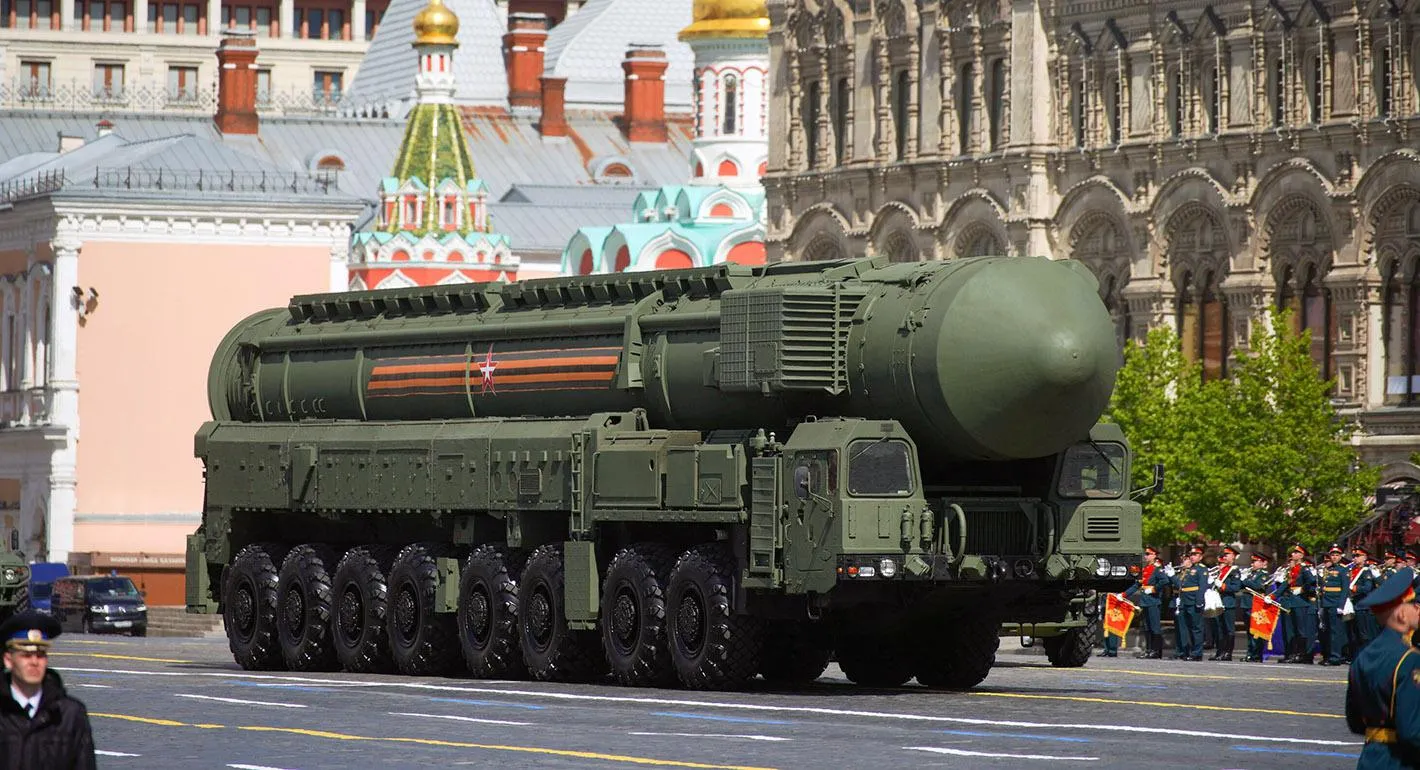
Russia may be moving its nuclear-capable RS-28 Sarmat missile into service after a publicly known flight-test record of two successes and two failures. A new International Institute for Strategic Studies assessment identifies satellite-imagery signs consistent with loading a missile into a silo at the Uzhur base in Siberia. The imagery indicates progress toward deployment, but it does not confirm that Sarmat is fully operational or carrying a nuclear warhead.
That creates a consequential gap between deployment activity and demonstrated reliability. Sarmat is intended to replace aging Russian intercontinental ballistic missiles, yet its limited public test record includes a 2024 missile that exploded inside its silo and a 2025 missile that left the silo, inverted during flight and crashed nearby. Successful flights occurred in 2022 and on May 12, 2026.
What the silo activity indicates
Satellite imagery captured on June 6 showed an open silo at Uzhur surrounded by at least six vehicles. IISS identified equipment resembling the type used to transport and load missile sections, with one platform raised near the silo opening. A protective structure that can be associated with a missile section appeared to have been removed and placed on another vehicle.
A crane was also positioned beside the silo. Similar equipment can be used during payload installation, so IISS assessed that the activity could represent loading and preparation for service. These are meaningful indicators because silo deployment requires more than delivering a complete missile to a base: separate sections and associated equipment must be brought together and prepared within the fixed launch complex.
Satellite imagery cannot show whether every internal system has passed acceptance checks, whether the missile has reached full combat status or whether a nuclear payload is present. The visible work therefore supports an assessment of movement toward service rather than confirmation that Russia has fielded a fully operational, nuclear-armed Sarmat.
Deployment cannot substitute for flight testing
A missile can be installed in its intended operating environment while questions remain about how consistently the complete system performs in flight. Sarmat’s two known successful launches show that the design has completed full-flight trials, but four publicly known tests are a small record from which to judge repeatability especially when half ended in failure.
The 2024 and 2025 failures also occurred at markedly different points. One missile was lost inside its silo, while the other cleared the silo before losing controlled flight. At a high level, that spread underscores why a successful launch is only one part of reliability: the complete chain includes preparation, departure from the silo and sustained operation through the flight sequence.
Russia’s RS-24 Yars entered combat duty after three successful tests, according to IISS. Sarmat may be moving toward deployment after two because Russia faces pressure to replace its older RS-20V Voevoda and UR-100N missiles. Those liquid-fueled systems have received service-life extensions exceeding 20 years, making delay its own readiness problem.
That comparison does not establish a universal minimum number of tests. Different missile programs use different designs, qualification work and acceptance standards. It does show the tradeoff facing Russia: waiting for more successful flights could strengthen confidence in Sarmat, while further delay would keep older missiles in service longer.
Another test may be approaching
Colonel General Sergey Karakayev, commander of Russia’s Strategic Rocket Forces, said in May that the successful 2026 flight could enable Sarmat to enter service later in the year. Separate satellite activity at Dombarovsky, where the May launch occurred, resumed around October 22. IISS assessed that the vehicles and machinery there may indicate preparations for a third Sarmat flight test, although no additional launch has been confirmed.
Another successful trial would add evidence that the program can repeat its 2026 result. Another failure would deepen uncertainty around a missile intended to carry multiple independently targetable nuclear warheads and potentially hypersonic boost-glide vehicles.
For the United States and its allies, even an incompletely proven Sarmat must enter strategic-force assessments if Russia is placing it into service. Deployment affects planning because the system may be available; the sparse and uneven test record affects how confidently anyone can judge that availability. The next confirmed flight test not activity around an open silo will provide the clearer measure of whether Sarmat is becoming a dependable replacement for Russia’s aging missiles.
| More aerospace and engineering stories, right in your MSN feed. Follow AMI on MSN |
By David Whitaker — Associate editor for AMI’s aerospace and drone systems desk, translating flight systems, aircraft programs, spaceflight, and UAV developments into accessible technical stories.