Ford Maverick’s 50-Horsepower Upgrade Adds Labor Costs and Excludes California
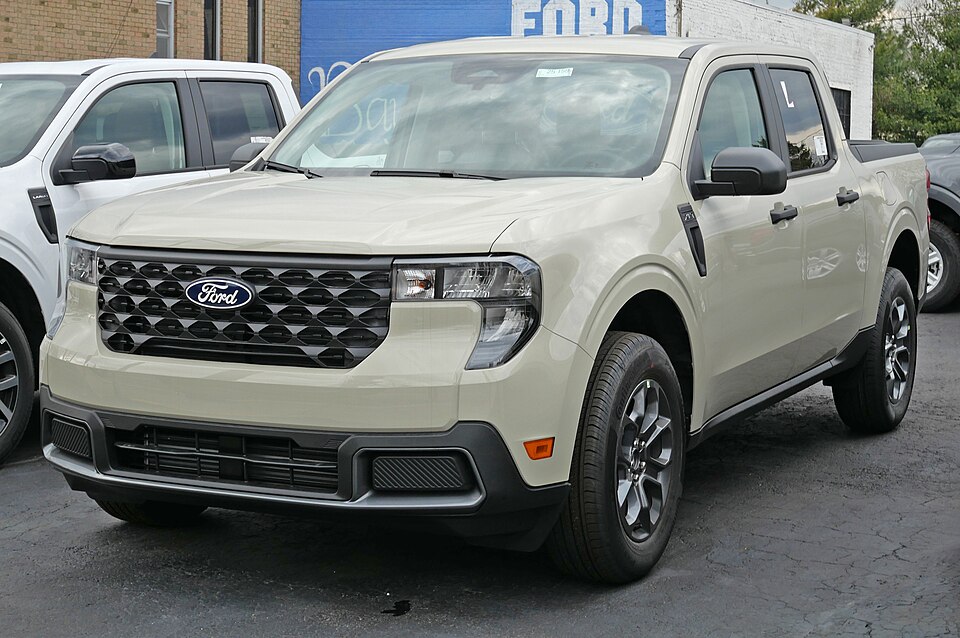
Ford’s 50-horsepower Maverick upgrade comes with a newly documented boundary: the complete SV300T package is reportedly not legal in California. That restriction narrows the market for a Ford-backed modification already limited to selected trims, while more detailed pricing shows that obtaining a fully installed truck costs substantially more than the package’s earlier headline figure of roughly $5,000 before labor.

The California restriction also exposes an important certification distinction. Ford describes the upgraded intercooler included in the package as 50-state approved under a California Air Resources Board executive order, but that approval applies to the intercooler rather than necessarily covering the complete combination of turbocharger, calibration and exhaust. Ford’s package page does not present the entire SV300T system as 50-state legal.
For buyers elsewhere, the central proposition remains unusual for a compact pickup: the Ford Custom Garage SV300T package raises output from 250 to 300 horsepower without replacing the Maverick’s 2.0-liter four-cylinder engine. Torque rises from 280 to 350 pound-feet on premium fuel under Ford’s latest specifications. The 20% horsepower increase is available for eligible 2025 and 2026 Maverick XLT, Lariat and Lobo trucks with the turbocharged engine and all-wheel drive. The hybrid, front-wheel-drive configurations and entry-level XL are outside the approved fitment list.
The larger turbo requires supporting systems
The power increase is not produced by calibration alone. Ford installs a Mustang-sourced turbocharger with a larger compressor wheel, pairs it with an upgraded intercooler and adds a model-specific powertrain calibration. A Borla sport exhaust is also part of the package.
That systems approach is important because increasing boost also increases the thermal load placed on the intake charge. Ford lists the replacement intercooler at 73% efficiency compared with 60% for the stock unit, with a lower pressure drop and a smaller outlet-temperature rise under its stated test conditions. Those figures explain why cooling hardware accompanies the turbo rather than being treated as an appearance or sound option.
The SV300T also changes how the truck sits and responds. XLT and Lariat versions receive lowering springs, Lobo-derived shocks, and upgraded stabilizer components. Twenty-inch wheels, graphics, tailgate lettering and a front lower spoiler complete the street-oriented treatment. The Lobo already carries much of the relevant chassis hardware, so its package contains fewer suspension parts.
Upgraded front brakes with larger rotors and two-piston calipers are optional for XLT and Lariat trucks, not standard SV300T content. The Lobo already has its own upgraded braking equipment. Buyers therefore should not infer from the higher engine output that every eligible trim receives a brake upgrade in the base package.
The installed price is far above $5,000
Ford’s current detailed pricing replaces the simplicity of the earlier $5,000-before-installation description with several acquisition paths. The parts kit carries a $6,075 manufacturer’s suggested price for XLT and Lariat trucks and $4,500 for the Lobo. Owners choosing that route must arrange installation through an appropriately certified technician, and tires may be an additional expense.
For a new truck delivered with the work already completed, Ford lists a much larger turnkey price: $15,595 for an XLT package and $13,395 for a Lobo package. Those amounts include installation, recommended tires and transportation, although dealer charges can vary. The difference reflects both labor and the Lobo’s existing suspension equipment, which avoids duplicating several components required on the other trims.
Ford backs package content with a three-year or 36,000-mile warranty when installation and registration conditions are met. Crucially, that period starts from the vehicle’s original in-service date, not the date an existing owner adds the equipment. A retrofit performed well into ownership can therefore have considerably less package coverage remaining than the headline warranty term suggests.
Ford confirms that owners of eligible 2025 and 2026 trucks can pursue dealer installation, resolving much of the earlier uncertainty about retrofits. That does not extend compatibility to every older Maverick, however, and no XL application has been announced. The practical choice is consequently narrower than the 50-horsepower gain first suggests: it requires the correct engine, all-wheel drive, an approved trim and model year, a substantial installed budget and, for now, an address where the complete package can legally be used.
| More aerospace and engineering stories, right in your MSN feed. Follow AMI on MSN |
By Thomas Caldwell — AMI’s senior editor for mechanical and mobility engineering, covering vehicle electronics, systems integration, electrification, chassis systems, propulsion, and safety policy.