


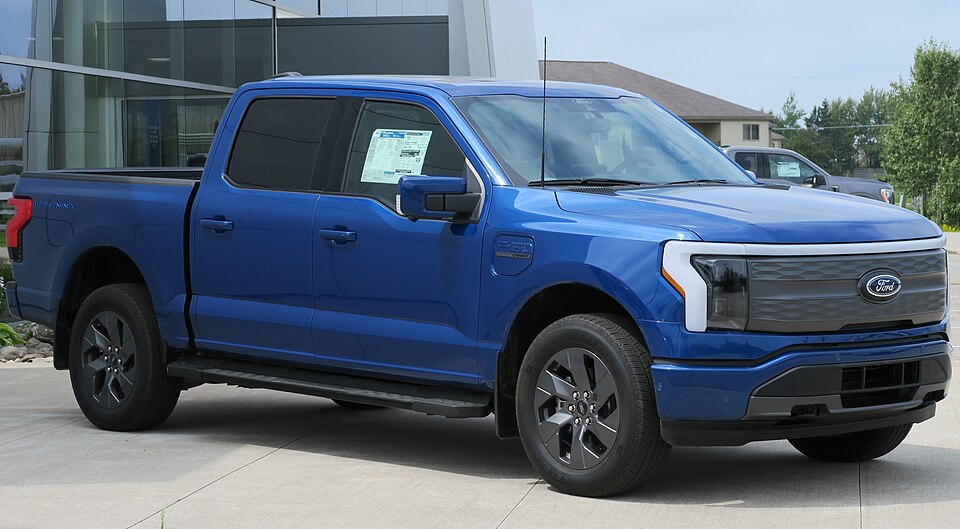
F-150 Lightning Range Swings From 332 Miles to Three-Hour Wyoming Stop
An extended-range Ford F-150 Lightning traveled 332 miles in an independent Edmunds range test, exceeding that truck’s 300-mile EPA estimate. Yet a Lightning owner identified as Ken reported reaching a charger in Sheridan, Wyoming, with only 5% battery remaining and losing three hours to waiting and charging. Together, the results show why a pickup’s rated range cannot by itself predict whether a rural trip will be routine.

The contrast is substantial, but it is not evidence that either result is wrong. Edmunds tested under its own controlled route and operating conditions. Ken’s journey from Colorado to Bozeman, Montana, was an owner-reported trip involving temperatures around 30 degrees Fahrenheit, a headwind and sustained highway driving. His experience cannot establish the range every Lightning will deliver, just as a favorable independent test cannot guarantee 332 miles in winter.
Several loads consumed the same battery reserve
Ken described his truck as having 310 miles of nominal range. The extended-range Lightning identified in the account has a 131-kilowatt-hour battery, while an extended-range configuration has carried an EPA estimate of 320 miles. Ratings vary by configuration and test basis, but none guarantees an identical distance across different speeds, temperatures and weather.
Cold weather can raise cabin-heating demand and affect battery performance. A headwind raises the effective air speed over the vehicle, while aerodynamic drag increases rapidly as air speed rises. For a large pickup operating at highway velocity, temperature, wind, speed and accessory demand can reduce route margin at the same time.
AAA research offers a broader illustration: Its testing found an average 41% EV range reduction at 20 degrees Fahrenheit with cabin heat operating. That figure cannot be assigned to this Lightning at roughly 30 degrees because the vehicles and test conditions differed. It does demonstrate why an EPA estimate is a standardized comparison figure rather than a guaranteed winter-trip radius.
The battery percentages Ken reported show how little reserve remained on several legs. He said the truck fell from 100% to 6% between Cheyenne and Casper, reached Sheridan at 5%, used 100% to 12% between Sheridan and Billings, and declined from 80% to 15% between Billings and Bozeman. A trip that repeatedly consumes most of the pack has little tolerance for a detour, worsening weather or an unavailable charger.
A 50-kilowatt charger turned low reserve into lost time
In Sheridan, Ken said the only suitable charger he found was a 50-kilowatt unit at a Jeep dealership. Another vehicle was using it when he arrived, and he reported that a Tesla destination charger at his hotel was not working. His combined wait and charging time was three hours.
The charger’s power rating helps explain the delay. At a theoretical and uninterrupted 50 kilowatts, adding energy equal to 95% of a 131-kilowatt-hour pack would require nearly 2.5 hours. Actual charging can take longer because the vehicle may reduce power as the battery fills, while the nameplate rate does not account for conversion losses or time spent waiting for another driver.
This is the systems-level limitation exposed by the trip: range, charger power and redundancy are interdependent. A map pin confirms that charging equipment exists, but it does not ensure that the connector is compatible, the unit is working, the plug is available or the site can restore enough energy promptly. With only 5% remaining, a backup elsewhere may also be beyond practical reach.
Wyoming is beginning to address those constraints. Its first National Electric Vehicle Infrastructure request for proposals covers urban and rural corridor clusters. Under the Wyoming Department of Transportation requirements, funded stations must be within three driving miles of a corridor exit, offer at least four charging ports and include at least two fast-charging ports. Federal funding will cover 80% of eligible project costs, with station owners responsible for the remaining 20%.
Those requirements target both placement and resilience. Multiple ports reduce the chance that one occupied or unavailable unit will halt a trip, although two fast-charging ports still provide less operational redundancy than a larger station. Network expansion also helps only when sites lie along the routes drivers actually use. Ford owners can access compatible Tesla Superchargers with an adapter, while Rivian says its Adventure Network supports both major North American connector formats and is open to other EVs.
Ken also reported driving unusually slowly and following a truck closely while trying to reach Sheridan, saying he was nearly rear-ended. Close following is not a safe energy-management method because it reduces reaction distance and converts a range problem into a collision risk. The practical measure for rural electric travel is therefore not whether nominal range exceeds the distance between towns. It is whether the truck can preserve a safe reserve under actual conditions and reach a station with enough working, available power to recover without surrendering hours.
| More aerospace and engineering stories, right in your MSN feed. Follow AMI on MSN |
By Thomas Caldwell — AMI’s senior editor for mechanical and mobility engineering, covering vehicle electronics, systems integration, electrification, chassis systems, propulsion, and safety policy.




