Boeing’s 111 Jet Orders Deepen Delivery Test as Backlog Nears 7,000
Boeing’s commercial backlog reached 6,972 aircraft in an October 2026 industry compilation, even as the manufacturer delivered 524 jets during the first 10 months of the year. That updated count sharpens the significance of 111 firm purchases from Turkish Airlines and Biman Bangladesh Airlines: Boeing has ample demand, but every additional order enlarges the workload its factories, suppliers and quality systems must convert into finished aircraft.
The same October comparison put Airbus at 621 deliveries and a 9,430-aircraft backlog. Its calculation excludes Boeing’s ASC 606 accounting adjustments and therefore should not be treated as directly interchangeable with every manufacturer-reported order figure. Boeing’s own third-quarter results listed more than 6,300 commercial aircraft in backlog, valued at $612 billion.
Either measure describes many years of production rather than aircraft ready for immediate handover. Boeing’s 524 deliveries through October were an improvement from 493 in the comparable 2025 period, but its October total slipped to 48 commercial aircraft, including 31 737 MAX jets. Airbus led Boeing by 97 deliveries through the month.
Firm orders still have to pass through the production system
Turkish Airlines accounted for 100 of the 111 firm purchases. Under the agreement announced September 23, it bought 100 737-8 aircraft and took options for another 50 jets. The options are potential future business rather than completed purchases, and the airline can substitute the larger 737-10 for aircraft covered by the agreement.
Biman Bangladesh Airlines separately ordered six 737-8s and five 787-10 Dreamliners. Together, the two airlines added 111 firm aircraft to Boeing’s production obligations. No aggregate contractual price was disclosed.
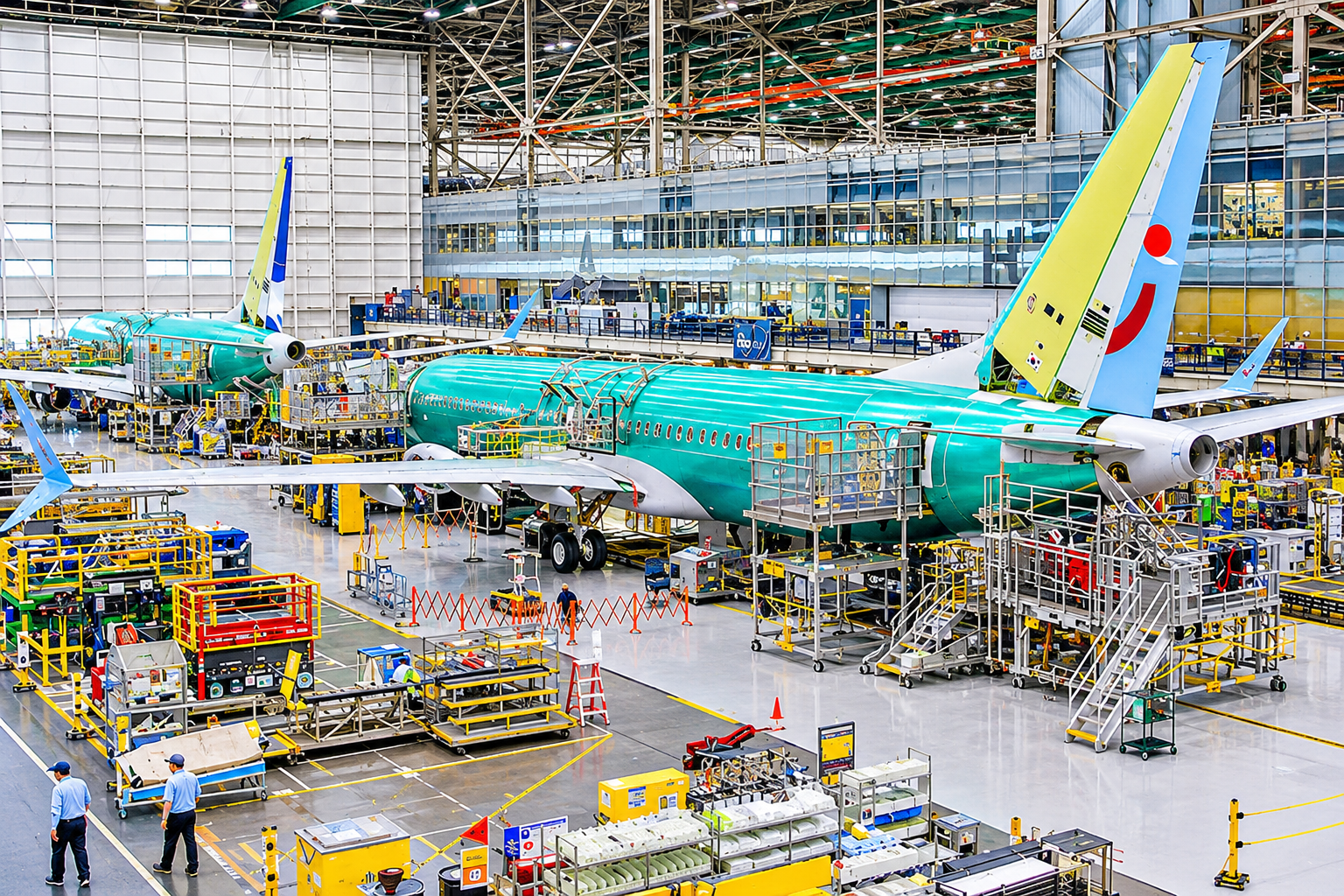
An order can bring deposits and progress payments, but it does not represent a completed aircraft sale. Boeing generally recognizes aircraft revenue when a finished jet is accepted by its customer, with the remaining payment due immediately before or at delivery. Before reaching that point, an airplane must move through the supplier network, assembly, inspections, any required rework, regulatory documentation and customer acceptance.
That sequence makes stable production more important than a short-lived monthly peak. Boeing has been working to stabilize 737 production at 47 aircraft per month, but October’s 31 MAX deliveries were the lowest monthly handoff count in a year. Production and delivery figures are not identical because completed aircraft can await customer work, documentation or correction of unfinished tasks. Persistent separation between the two, however, can tie up labor and factory space while making airline schedules less predictable.
The 787 line was stable at eight aircraft per month in Boeing’s third-quarter update, while the company delivered 11 Dreamliners in October. Some of those handovers came from stored inventory, so the delivery count did not represent an equivalent increase in current monthly production. Clearing stored aircraft is useful, but a durable recovery requires jets to move from assembly to acceptance without accumulating additional rework.
Certification and quality remain delivery boundaries
The 737-10 received amended type certification in October, removing a major regulatory barrier for Boeing’s largest MAX variant. Customer acceptance remains a separate gate: some airlines had raised concerns about taking early aircraft before an update to flight-management software was available. Turkish Airlines’ substitution rights make both the variant’s certification and its practical entry into airline fleets relevant to how its order is ultimately fulfilled.
The 777-9 has a different constraint. Boeing continues to target first delivery in 2027, but portions of its flight-test program still require Federal Aviation Administration authorization. Approval of a redesigned engine seal is also required before the aircraft can receive its type certificate. Boeing was producing roughly one 777-9 per month in October, illustrating the financial and operational exposure created when production advances ahead of final certification.
Quality oversight carries particular weight after the two 737 MAX crashes in 2018 and 2019 killed 346 people, and after a door plug separated from Alaska Airlines Flight 1282 in January 2024. The National Transportation Safety Board found that four securing bolts had been missing before the Alaska accident. Those findings do not describe the condition of jets being assembled now, but they make defect control, inspection discipline and traceability essential measures of any production increase.
Airbus’s still-larger backlog shows that long delivery queues are an industry-wide consequence of strong airline demand and constrained manufacturing capacity. Boeing’s more immediate test is specific to its recovery: turning nearly 7,000 commitments, including the 111 new firm purchases, into conforming aircraft at a pace that regulators, airline customers and its own production system can sustain.
| More aerospace and engineering stories, right in your MSN feed. Follow AMI on MSN |
By Thomas Caldwell — AMI’s senior editor for mechanical and mobility engineering, covering vehicle electronics, systems integration, electrification, chassis systems, propulsion, and safety policy.