Zhongfei Flying Car Takes Off Vertically, Then Drives After Landing
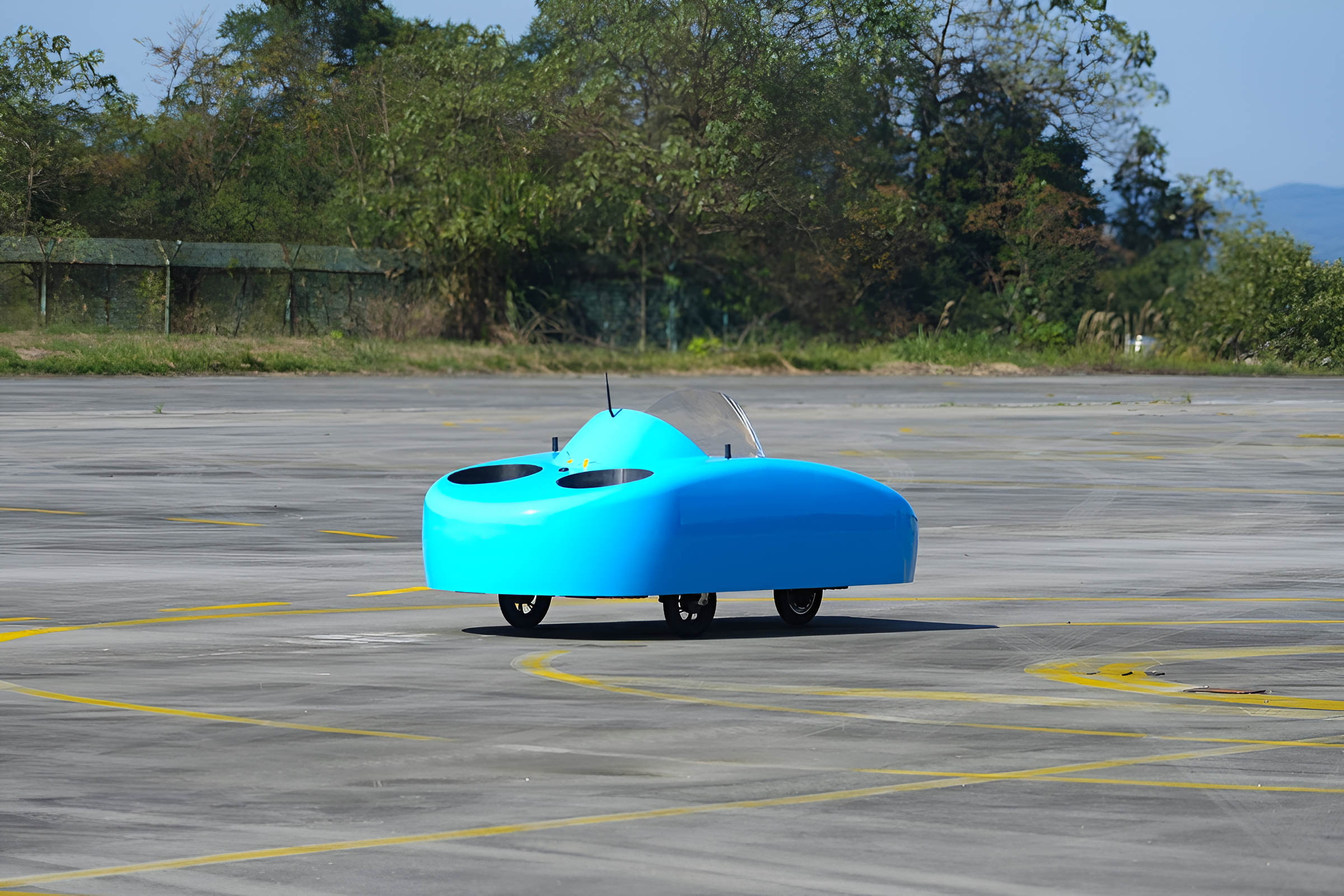
Instead of wings or exposed rotors, Zhongfei Smart Manufacturing’s new flying-car prototype relies on enclosed ducted fans that can direct thrust to lift and control the vehicle. The piloted, single-seat machine took off vertically during its maiden flight at a general aviation airport in Changsha, China, on Saturday and can drive on roads after landing.
The wingless prototype then underwent multi-scenario testing in Yiyang on Sunday. Zhongfei says it can take off and land vertically, hover, fly without a runway and transition to road travel. That combination is central to the company’s proposed use in disaster response: a rescue team could drive toward an area affected by an earthquake, flood or mudslide, then take off if damaged or blocked roads stopped further ground travel.
Vectored fans replace wings and exposed rotors
Zhongfei describes the aircraft as the world’s first piloted vehicle to use a multi-stage vector ducted-fan propulsion system. That distinction remains a company claim, but the configuration is the prototype’s defining engineering feature.
A conventional multirotor aircraft controls lift and motion by adjusting thrust from several exposed rotors. Zhongfei’s propulsion units sit inside ducts, while thrust vectoring directs their output to generate lift and control altitude. Technical director Yang Yang said the arrangement removes the risks associated specifically with exposed rotor blades. He also said it produces less noise and consumes less energy in cruise than multirotor designs.
Enclosing a fan can physically separate its blades from people and surrounding objects, an attractive characteristic for a vehicle intended to operate near roads or emergency crews. The complete safety case, however, extends beyond blade enclosure. A piloted vertical-lift aircraft must also demonstrate reliable propulsion, controllability, fault tolerance and safe operation across its intended weather and loading conditions.
The broader design compromise is equally important. Vertical takeoff eliminates the need for a runway, but hovering demands substantial power because the propulsion system must support the vehicle’s weight directly. A 2024 review of electric vertical-takeoff aircraft development describes the fundamental tradeoff between efficient hovering and higher-speed cruise. Lower rotor-disc loading generally helps hover efficiency, while designs optimized for greater forward speed can pay an efficiency penalty during vertical flight.
Zhongfei has not provided enough public test data to independently assess how its ducted-fan arrangement manages that tradeoff. The company reports a maximum speed of 150 kilometers per hour and a range of 300 kilometers. It also lists a maximum takeoff weight of 280 kilograms, including a 120-kilogram payload. The designed maximum altitude is 3,000 meters, although the stated typical operating altitude is 100 meters.
Early tests precede the harder validation work
The company says the prototype has been evaluated in complex urban environments, simulated adverse weather and several operating scenarios. Those tests follow its initial small-scale program, and the aircraft is now entering a pre-production trial phase.
That status places the vehicle well before routine service. The reported speed, range, noise, energy use and safety benefits currently come from Zhongfei rather than independently published performance measurements or a completed certification program. Pre-production trials will need to establish whether the same aircraft can repeatedly deliver those figures while carrying its intended payload and moving between flight and road operation.
Road capability also adds a second design environment. Components sized for flight must tolerate road vibration and ordinary surface loads, while equipment needed for driving adds mass that must be lifted on every flight. Flying cars consequently face overlapping aviation and road requirements, a practical obstacle that has slowed other roadable-aircraft projects even after successful demonstrations.
Zhongfei is initially positioning the single-seat vehicle for firefighting, emergency response, disaster relief, last-mile logistics and short-distance passenger transport rather than private consumer use. Yang said technical design work has also been completed for a larger model that could accommodate as many as 15 passengers, but the tested aircraft remains the single-seat prototype.
Its immediate milestone is therefore narrower than a passenger-service launch: prove during pre-production trials that the enclosed, thrust-vectoring propulsion system can turn a successful vertical takeoff and road transition into a repeatable, supportable aircraft operation.
| More aerospace and engineering stories, right in your MSN feed. Follow AMI on MSN |
By David Whitaker — Associate editor for AMI’s aerospace and drone systems desk, translating flight systems, aircraft programs, spaceflight, and UAV developments into accessible technical stories.