Hera Close-Ups Will Probe Whether NASA Cratered or Reshaped Dimorphos
The measurable result is already clear: NASA deliberately hit Dimorphos and changed its motion. The unresolved part is what that collision physically did to the small asteroid. The European Space Agency’s Hera mission is now conducting a close-up investigation intended to distinguish between two very different outcomes a conventional impact crater or a more extensive reshaping of the asteroid.
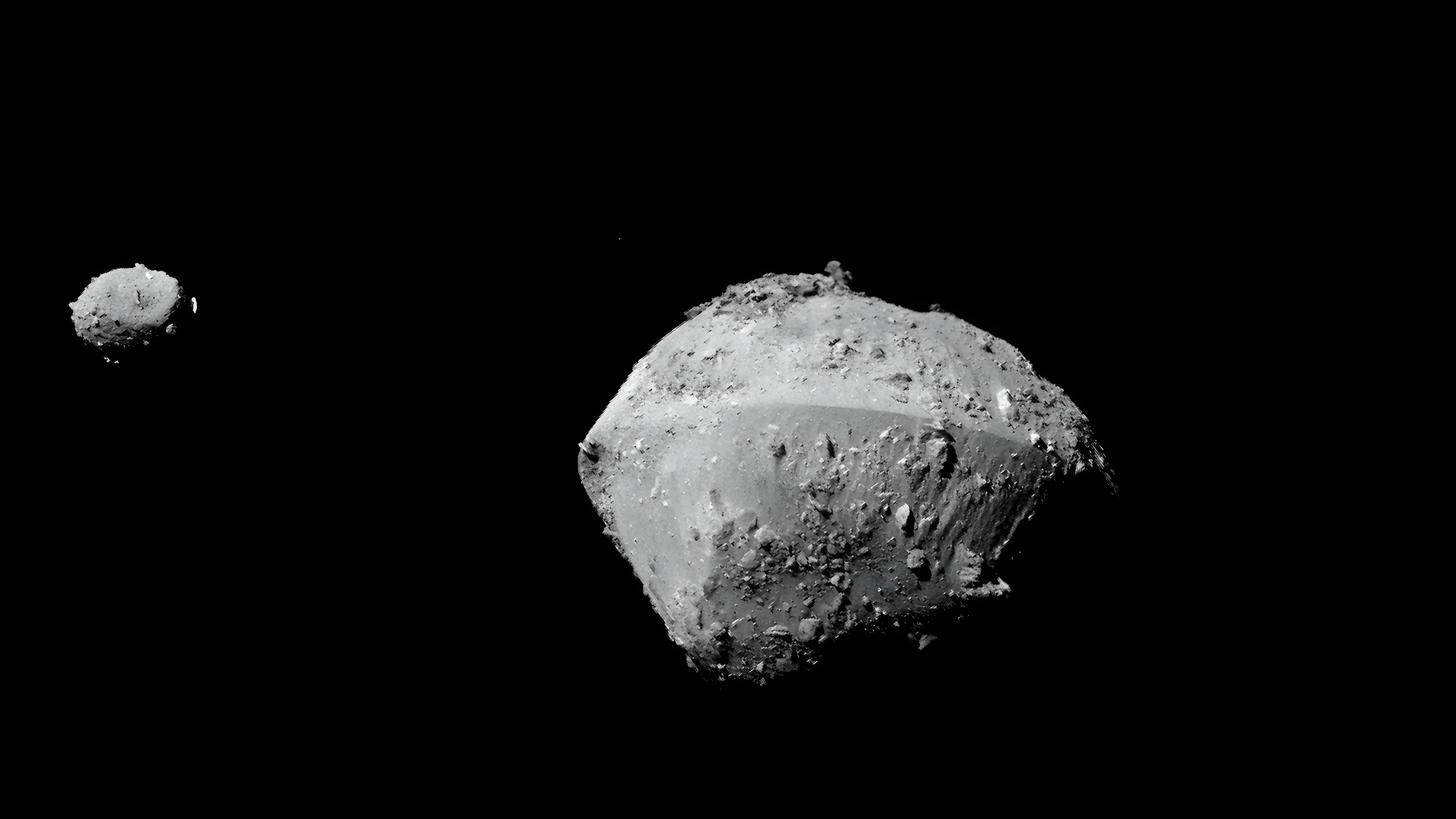
ESA plans to unveil detailed images of Dimorphos on November 25. The smallest discernible features are expected to be about 3 meters across. That resolution will expose a landscape where every clearly visible boulder is at least roughly car-size, while some rocks may span 10 meters, comparable to a bus. These substantial objects sit on a world with extremely weak gravity.
The images extend an investigation that began with NASA’s Double Asteroid Redirection Test, or DART. In 2022, the spacecraft deliberately struck Dimorphos at approximately 22,000 kilometers per hour. The purpose was to test whether a high-speed spacecraft collision could alter an asteroid’s trajectory, a planetary-defense technique known as kinetic impact.
Dimorphos orbits the larger asteroid Didymos, and neither object posed a threat to Earth before or after the experiment. Before impact, Dimorphos completed an orbit in about 11 hours and 55 minutes. The collision shortened that period by approximately 33 minutes, demonstrating that a deliberate impact could change an asteroid’s motion.
The orbit changed, but the surface holds the missing evidence
Earth- and space-based observations measured the orbital result, but they could not fully establish the condition of the impact site. Hera’s close-range survey addresses that gap. Determining whether DART excavated a defined crater or disturbed enough loosely bound material to reshape much of Dimorphos will help explain how the measured deflection occurred.
That distinction affects how engineers interpret DART’s performance. The spacecraft itself delivered momentum when it hit, but material thrown away from Dimorphos provided an additional push through recoil. NASA’s analysis found that this ejecta substantially amplified the momentum transferred by the spacecraft. The amount of amplification depends partly on the target’s structure, strength and ability to release material.
A well-defined crater would provide information about localized excavation and the mechanical response of the surface. Broader reshaping would point to a more distributed response from a weakly consolidated body. Either result would help constrain models used to predict what a kinetic impactor might do to another asteroid, but it would not make every target equivalent to Dimorphos. A more solid object could eject less material and therefore receive less additional push from recoil.
Three-meter image resolution is useful because the scale of the surrounding terrain affects interpretation of the collision. DART’s final approach images showed a boulder-covered surface rather than a smooth target. Hera’s wider close-up coverage can place the impact region within that terrain and show whether displaced rocks, disturbed material and large-scale shape changes are consistent with a crater or a body-wide rearrangement.
Hera also carries a thermal-infrared instrument supplied and operated by the Japan Aerospace Exploration Agency. Mapping how surface temperatures vary can help researchers distinguish among solid, porous or broken rock and looser material down to dust. That information complements visible images: two regions that look similar may retain and release heat differently because their physical structures are not the same.
DART proved that a spacecraft could reach a small asteroid during a high-speed encounter and alter its orbit. Hera’s investigation is designed to turn that successful demonstration into a better-characterized engineering result. The close-ups should reveal whether humanity’s first deliberate change to an asteroid’s motion left a crater or rearranged a 151-meter world covered in car- and bus-size boulders.
| More aerospace and engineering stories, right in your MSN feed. Follow AMI on MSN |
By David Whitaker — Associate editor for AMI’s aerospace and drone systems desk, translating flight systems, aircraft programs, spaceflight, and UAV developments into accessible technical stories.