


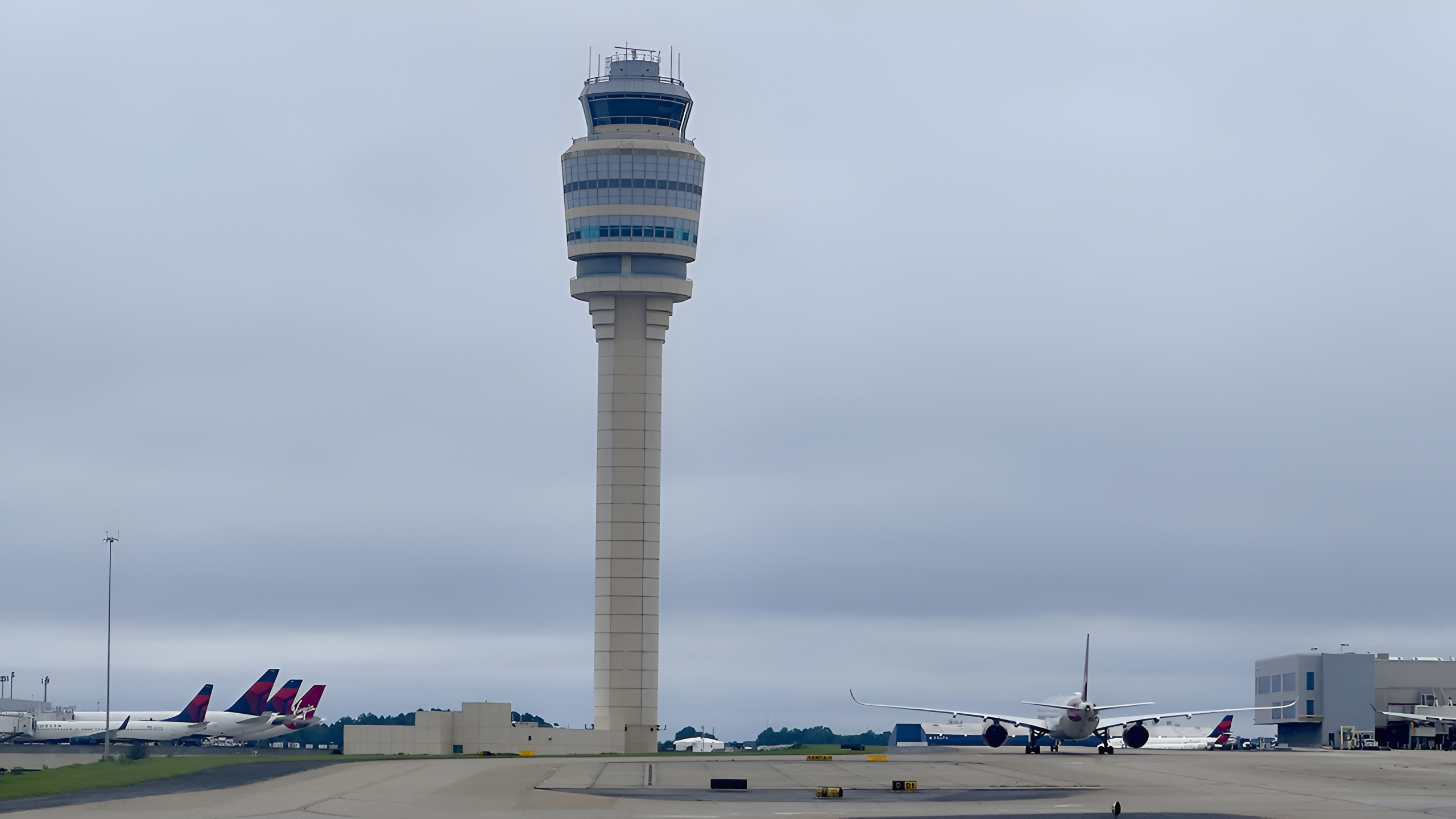
FAA Requires Dedicated Runway Supervision, Raising Delay Risk at Short-Staffed Towers
A runway procedure designed to move departures efficiently now depends on control towers having an extra person available to supervise it. Effective November 24, the Federal Aviation Administration’s Notice JO 7210.979 requires a stand-alone watch-supervision position whenever a tower uses the procedure known as Line Up and Wait. Towers that cannot fill that position may have to keep aircraft off the runway longer, potentially extending departure queues.

The policy strengthens oversight by preventing the designated supervisor from simultaneously handling another duty. It also exposes a staffing-dependent tradeoff: a tower can use the procedure only when it has enough qualified personnel to operate the relevant control positions and provide focused supervision. At facilities already short of certified controllers, the practical cost of the higher safety standard may be lower runway throughput.
What the runway procedure does
Line Up and Wait allows controllers to direct an aircraft onto a departure runway and align it for takeoff while a separate takeoff clearance is still pending. The instruction does not authorize the pilots to begin the takeoff roll. By positioning the next aircraft in advance, a tower can reduce the time between departures when traffic, runway configuration and weather permit.
University of Illinois computer science professor Sheldon Jacobson estimated that the procedure can save several seconds per departure and, in favorable weather, support a few additional takeoffs each hour. That is a modest gain for one flight, but repeated across a busy departure period it can help prevent queues from building. Poor weather can erase much of the benefit because operations slow regardless of how efficiently aircraft are positioned.
The FAA changed the governing language for stand-alone watch supervision from “should” to “must.” The watch position must be staffed by an operations supervisor or controller-in-charge and cannot be combined with another position. While Line Up and Wait is underway, local control also cannot be combined with nonlocal functions including ground control, clearance delivery, flight data or watch supervision.
Safety capacity now determines operating capacity
The new structure treats supervision as an operational resource rather than an optional layer. A controller managing the active runway remains responsible for issuing instructions and clearances, while the separate watch position provides focused oversight of the operation. The FAA said mandatory language elevates the safety standard and removes ambiguity from the previous requirement.
That separation is consistent with a basic human-factors principle: supervision loses value when the person assigned to monitor operations is also absorbed in another task. An older National Transportation Safety Board investigation illustrates the broader concern without serving as the stated basis for this new notice. In a 2001 runway-incursion incident at Dallas/Fort Worth International Airport, the NTSB found that ground and local control were combined and that the supervisor-in-charge was also handling flight-data duties. The agency identified excessive controller workload and inadequate supervision as contributing factors.
The current rule does not impose the same operational cost everywhere. A well-staffed tower may be able to establish the required watch position without changing departure flow. A short-staffed facility may have to choose between assigning a qualified person exclusively to supervision or suspending Line Up and Wait. In the latter case, aircraft remain off the runway until a takeoff clearance is available, adding time between successive departures.
The national staffing context makes that boundary consequential. The FAA counted 11,027 certified professional controllers as of September 30, compared with its target of 12,563 a gap of 1,536. About 4,000 additional controllers were in training, but training capacity is not immediately interchangeable with certified personnel who can independently fill tower positions. Facility-level staffing also varies substantially, so the passenger effect is likely to be uneven rather than a uniform nationwide slowdown.
Passengers may see delay, not a new travel requirement
Travelers do not need to alter screening, check-in or boarding preparations. Any effect arises after aircraft enter the airport’s departure sequence. AirAdvisor CEO Anton Radchenko said the most likely passenger consequence is additional time aboard an aircraft before takeoff or knock-on delays later in the day.
Timing drew criticism from Jacobson because the rule took effect two days before Thanksgiving, when six million Americans were expected to travel by air. His concern addressed implementation timing and available capacity; it did not change the FAA’s stated safety rationale. Actual effects will depend on each airport’s controller staffing, traffic level, runway arrangement and weather.
The notice is scheduled to remain effective through June 9, 2027, unless the FAA extends it, replaces it or incorporates it into a later order. Until then, the operational test is straightforward: towers may retain the seconds saved by staging aircraft on departure runways only when they can also supply a supervisor devoted exclusively to watching the procedure.
| More aerospace and engineering stories, right in your MSN feed. Follow AMI on MSN |
By Thomas Caldwell — AMI’s senior editor for mechanical and mobility engineering, covering vehicle electronics, systems integration, electrification, chassis systems, propulsion, and safety policy.



