Siemens and Innok Advance Outdoor Robot Link to Leipzig Supplier
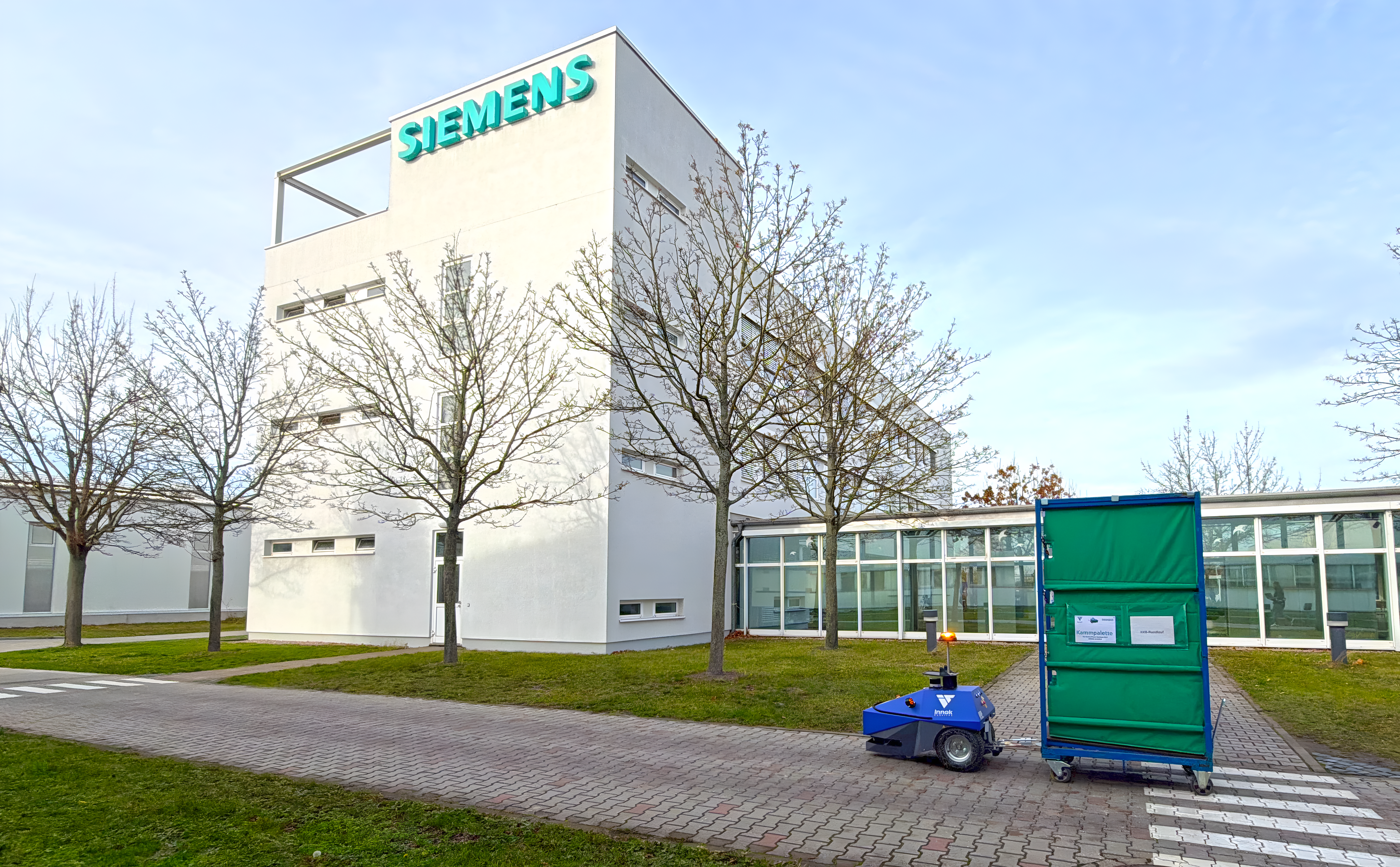
Innok Robotics and Siemens are moving beyond a successful demonstration phase toward an automated material-handling link at the Siemens plant in Leipzig. The planned system will use an all-terrain autonomous mobile robot to carry components from a neighboring supplier to the plant, extending automated transport beyond the factory’s immediate grounds.
The return journey is part of the job rather than an empty repositioning run. After delivering pre-picked components, the robot is intended to take empty transport carts back to the supplier. That creates a two-way logistics loop between separate industrial premises: loaded movements toward the Siemens plant and cart returns in the opposite direction.
Routine operation has not been announced, and neither company has provided a deployment date. Innok Robotics describes the project as entering its next stage after the demonstration, with the outdoor transport work planned for the future. The robot model, route length, payload and performance targets also remain unspecified.
Why an existing site changes the automation problem
The project’s distinctive feature is where the robot must operate. This is a brownfield deployment, meaning automation is being added to an established industrial environment and existing logistics routes rather than incorporated into a new facility designed around autonomous vehicles.
Inside a purpose-built automated plant, routes, transfer areas and surrounding processes can be arranged with robotic transport in mind. At an operating brownfield site, the machine instead has to fit around the physical layout and material flow already in place. The Leipzig project therefore focuses on connecting an existing plant with an adjacent supplier without completely redesigning both facilities around the robot.
That changes the role of the mobile platform. It is not confined to shifting material between fixed stations under one factory roof. It must support an outdoor link across the boundary between supplier and customer, while fitting into the established sequence of component preparation, delivery and empty-cart return.
The pre-picking detail is important to that sequence. Components are to be prepared before the autonomous journey begins, allowing the robot’s defined task to center on transport. At the other end of the loop, returning empty carts gives the system a recurring load in both directions and closes the handling cycle between the two sites.
Outdoor autonomy adds a broader control envelope
Innok Robotics develops autonomous mobile robots and control software for indoor, outdoor and mixed environments. Its broader technology portfolio combines satellite positioning with laser scanners, cameras and radar, although the companies have not disclosed the sensing or safety architecture selected for the Leipzig route.
That omission leaves several engineering questions open. No operating conditions have been specified, and there are no published details covering charging, transfer interfaces, route supervision or how the robot will interact with other site traffic. The announcement therefore confirms the intended logistics function, not the final configuration used to deliver it.
Those boundaries also prevent quantified claims about efficiency or safety. No cycle-time reduction, labor saving, availability target or transport capacity has been released. The present advance is more concrete but narrower: a demonstrated concept is progressing toward a defined two-way outdoor material flow.
If implemented as described, the robot will connect two existing points in Siemens’ Leipzig supply process without requiring a wholly new automated campus. That is the practical value of the project for manufacturers watching brownfield robotics: it tests whether autonomous transport can be fitted to the routes a working industrial site already has, rather than asking the site to be rebuilt around the machine. The next decisive milestone will be confirmation that the planned supplier-to-plant loop has entered routine operation.
| More aerospace and engineering stories, right in your MSN feed. Follow AMI on MSN |
By Jonathan Barrett — Editor for AMI’s future mobility and autonomous systems section, with two decades covering robotics, e-mobility, drone-vehicle convergence, and transport mechanical systems.