


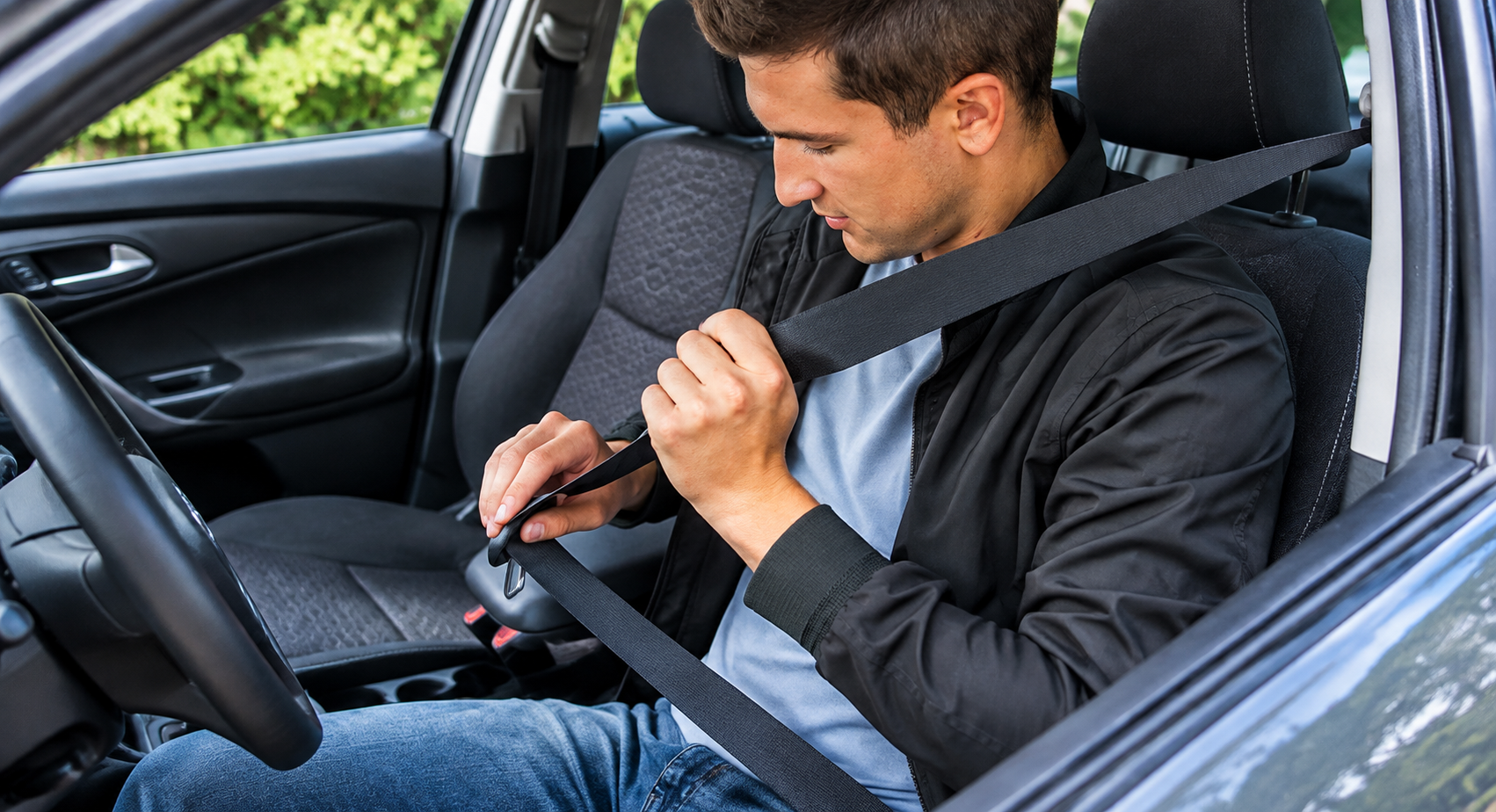
Seat-Belt Interlocks Reconsidered as 10,000 Die Unbuckled Each Year
Today’s vehicles can detect hazards, brake automatically and deploy multiple airbags within milliseconds. Yet that increasingly sophisticated safety architecture still depends on a basic action by each occupant: fastening a seat belt. Roughly 10% of people remain unbuckled, and about 10,000 people die in U.S. crashes each year while unrestrained about half of all occupant fatalities.

That annual toll has remained essentially unchanged for more than a decade, renewing interest among industry leaders and regulators in seat-belt interlocks and stronger reminders. The underlying idea is to make driving difficult or impossible until the driver buckles up. Congress rejected mandatory interlocks about half a century ago after intense public resistance, but persistent nonuse has kept the policy question alive.
Why other safety systems cannot replace the belt
Crash avoidance and occupant protection perform different jobs. Cameras and automatic emergency braking can help prevent or reduce the severity of some collisions. Once a crash occurs, airbags and other protective structures manage the remaining energy around occupants. The seat belt directly limits an occupant’s movement during a collision or abrupt deceleration.
That restraint function is foundational. The Insurance Institute for Highway Safety’s seat-belt reminder test protocol cites research estimating that belts reduce the fatality risk for front-row passenger-vehicle occupants in crashes by 45%. An unbelted occupant removes a central element from the vehicle’s designed protection strategy, leaving the other systems to manage movement they were not intended to control alone.
This is a systems-integration problem with a human decision at the interface. Automakers can refine sensors, warning logic, cabin structures and restraint deployment, but they cannot obtain the belt’s full mechanical benefit unless the occupant uses it correctly. Billions of dollars spent on advanced protection do not eliminate that dependency.
Interlocks carry a difficult human-factors tradeoff
A mandatory interlock can directly address nonuse by linking the belt buckle to vehicle operation. It can also create practical and public-acceptance problems. Any implementation must reliably determine whether a seat is occupied, whether the corresponding belt is fastened and what response is proportionate. The system also must account for passengers, rear seating positions and situations in which a belt is unfastened after a trip begins.
The historical backlash shaped federal policy. In a legal interpretation of federal restraint requirements, the National Highway Traffic Safety Administration explained that Congress imposed restrictions following public resistance to seat-belt interlocks. Federal rules required a driver warning with an audible signal lasting four to eight seconds and a visual alert lasting at least 60 seconds. The agency said manufacturers could voluntarily provide additional audible warnings if those signals were clearly distinguishable from the required warning.
That distinction opened a less restrictive path: persistent reminders rather than a hard lockout. These systems preserve vehicle operation but make belt nonuse harder to ignore through longer, louder or repeated alerts.
Persistent reminders are already changing vehicles
IIHS began rating seat-belt reminders in 2022, creating an incentive for manufacturers to improve warning behavior without waiting for a new federal mandate. Only 17% of models tested in the program’s first year received a good rating. Among 2024 models tested by October of that year, 62% received good ratings, while the share rated marginal or poor fell from 65% to 24%.
The changes can be largely software-based, but their effectiveness depends on duration, volume and seating coverage. For a good IIHS rating, an audible reminder must last at least 90 seconds when an occupied front seat remains unbuckled. The protocol also evaluates rear-seat status and requires a persistent warning when a belted rear occupant unbuckles while the vehicle is moving.
IIHS research found that a persistent reminder increased belt use among part-time users by around 30% and performed as well as a tested speed-limiting interlock. The organization estimated that good-rated reminders across the vehicle fleet could save nearly 1,600 lives annually. That finding suggests the population of nonusers is not uniform: some adamantly reject belts, while others forget or skip them on short trips.
A 2024 AAA Foundation study supports that human-factors split. Among inconsistent users, common explanations included traveling only a short distance, forgetting to buckle up and driving on low-speed roads. Persistent reminders are particularly relevant to those situational users because they intervene at the moment of the decision rather than relying solely on education or enforcement.
The policy choice is therefore broader than a binary decision between unrestricted driving and a mandatory lockout. Regulators and manufacturers can adjust warning persistence, sound level, seating coverage or vehicle-operation limits. The engineering boundary remains fixed, however: airbags, cameras and automatic braking can reduce risk, but none can fasten the restraint on behalf of the roughly one person in 10 who still travels without it.
| More aerospace and engineering stories, right in your MSN feed. Follow AMI on MSN |
By Thomas Caldwell — AMI’s senior editor for mechanical and mobility engineering, covering vehicle electronics, systems integration, electrification, chassis systems, propulsion, and safety policy.



