Air Force Pinpoints Loose Pin Behind T-38C’s Loss of Both Stabilizers
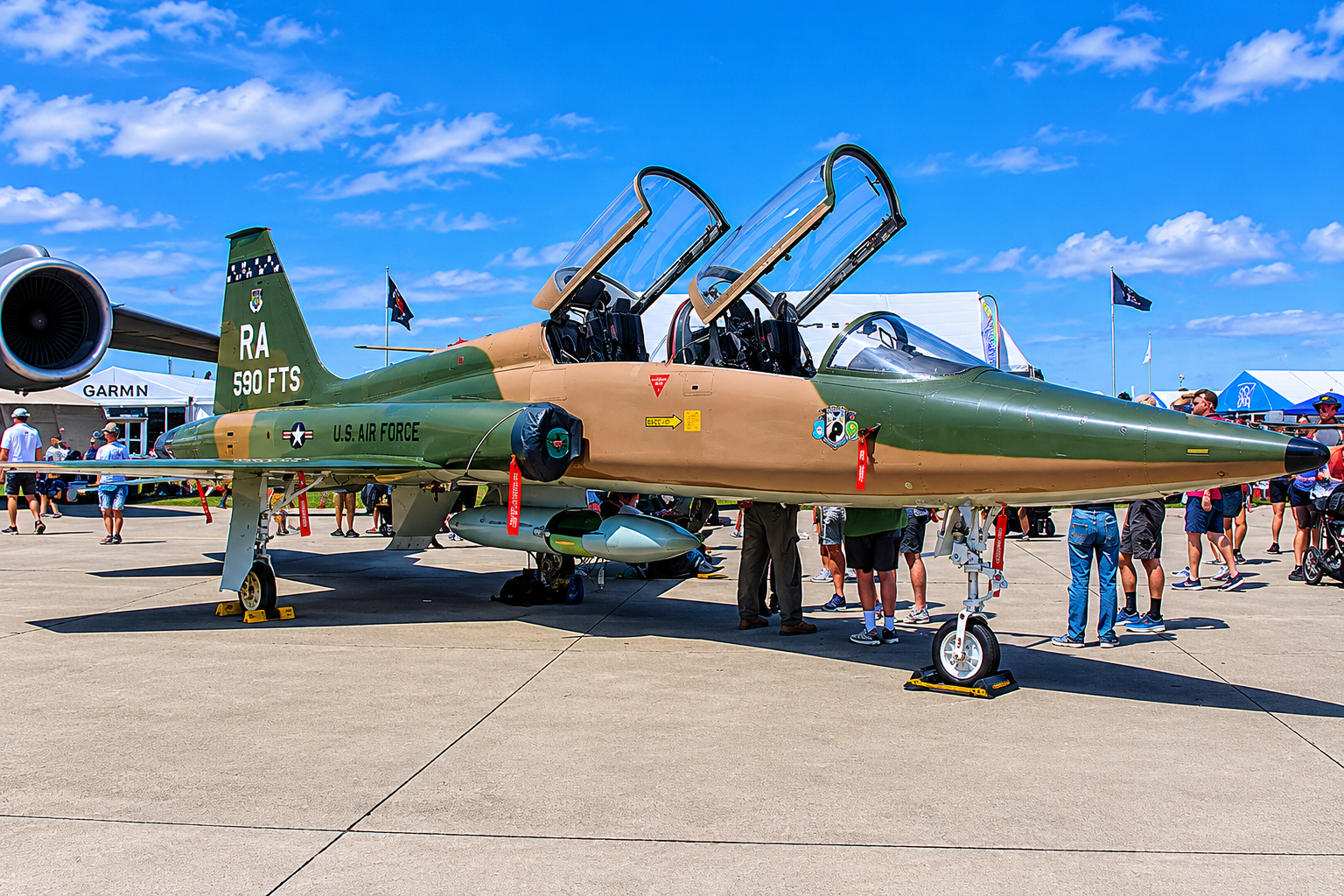
The Air Force paused T-38 flying operations on May 19, 2026, one week after a trainer crashed in Alabama, then lifted the pause on May 28 as inspections began across the fleet. The short-lived grounding was the immediate operational response to a failure that investigators later traced to an unsecured actuator pin, a missed mandatory inspection and flutter severe enough to tear away both of the aircraft’s pitch-control surfaces. The pause affected T-38 operators in several Air Force commands.

The accident investigation results, released October 30, found that the aft attachment pin for the left horizontal-stabilizer actuator had not been properly secured. It backed out during flight, allowing movement in a control system that depended on mechanical tension and rigidity. The resulting flutter overloaded a torque tube, and both horizontal stabilizers separated from the T-38C.
The two pilots an Air Force instructor and an international student whose nationality was not disclosed ejected successfully before the jet crashed in rural Lamar County, Alabama, near the Mississippi border, on May 12. The board found no evidence that either pilot contributed to the accident.
The investigation worked backward from an uncontrollable jet
T-38C serial number 66-4362 was flying second in a four-aircraft formation on a fighter-bomber fundamentals training sortie. During a 4G, 180-degree left turn in the G-warmup maneuver, the crew heard loud noises and experienced shuddering, severe vibration, negative G forces and an uncommanded pitch down.
The instructor took control and applied full aft stick, but the aircraft did not return to level flight. By that point, the surfaces used to command the nose up or down had departed. As the investigation described it, “Severe aerodynamic forces caused the horizontal stabilizers to separate from the main fuselage, which then tumbled through the air.”
The physical failure began at the left stabilizer actuator’s aft attachment. The T-38C uses actuators and steel torque tubes to move its horizontal stabilizers while maintaining the tension needed to resist unwanted motion. Once the pin backed out, play at the attachment reduced that rigidity and disturbed torque-tube tension.
Investigators reported that only 0.1 inch of displacement at the attachment point was sufficient to create conditions for catastrophic failure. This kind of free play is important in aeroelastic systems because it can reduce the speed at which flutter begins. Flutter is a feedback process: airflow drives structural motion, that motion changes aerodynamic loading, and the cycle can rapidly amplify rather than damp out.
Here, the oscillating stabilizers imposed axial and bending loads that exceeded the structure’s capacity. The left torque tube broke, after which both stabilizers departed and landed in separate locations. The board called the torque-tube break a secondary failure the initial loss of rigidity at the actuator attachment started the destructive sequence.
A required check was missing before release
The maintenance chain began in April, when the same aircraft was impounded after an uncommanded 130-degree roll to the right. Troubleshooting identified excessive play associated with the left horizontal-stabilizer actuator. Maintainers removed the actuator, repaired it and reinstalled it.
Although personnel checked the stabilizers’ range of motion, the required backlash check after the left actuator installation was not recorded in the maintenance logs. A backlash inspection measures unwanted movement between connected components the condition that later allowed the stabilizer system to lose rigidity. The aircraft nevertheless completed a functional check flight on May 1 and returned to operation.
The board identified multiple opportunities to catch the omission. Contractors who signed off the installation, a work-center supervisor, Quality Assurance personnel, the impoundment official and the authority responsible for releasing the aircraft all had roles in the maintenance and return to flight process. The aircraft’s successful functional check flight did not substitute for the unrecorded mandatory inspection.
Laboratory examinations by the Air Force Research Laboratory and Southwest Research Institute supported the in-flight overload sequence. Recovered hardware showed one-time failure from axial and bending stresses, with no fatigue found. The aft actuator pin itself was not recovered, but the remaining hardware and intact threads supported the finding that the improperly secured pin backed out.
Both pilots encountered trees after ejecting. The instructor sustained a minor facial laceration, while the student reported severe pain in the left calf and difficulty walking. They survived an aircraft the board found had become uncontrollable after both stabilizers separated a failure chain that fleet inspections had to address after one unsecured connection passed through several maintenance-control layers.
| More aerospace and engineering stories, right in your MSN feed. Follow AMI on MSN |
By David Whitaker — Associate editor for AMI’s aerospace and drone systems desk, translating flight systems, aircraft programs, spaceflight, and UAV developments into accessible technical stories.