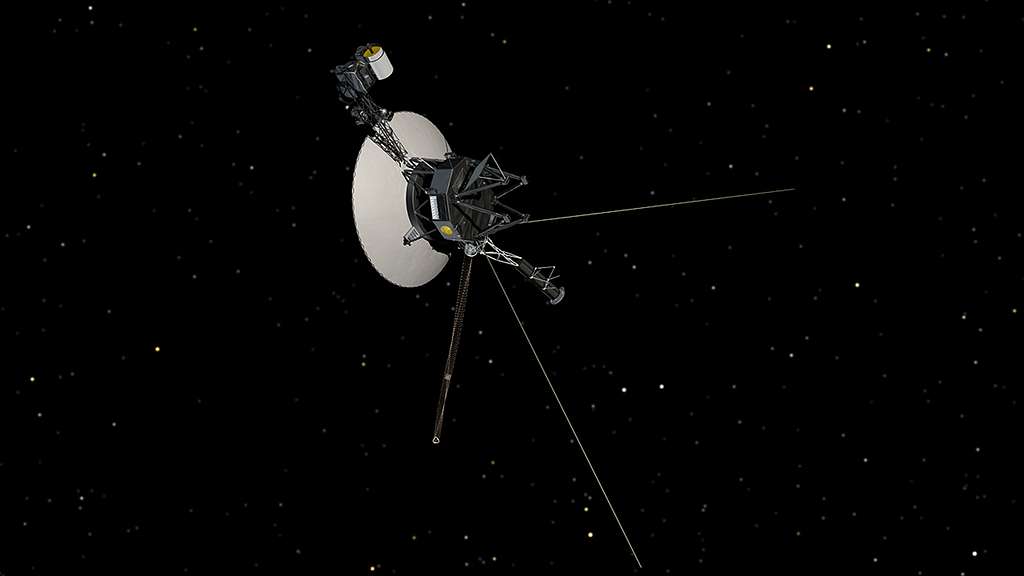
Voyager 1 Reaches One Light-Day but Returns No Science or Engineering Data
Voyager 1 can still reach Earth by radio from one light-day away, but its signal is arriving without the spacecraft’s science or engineering data. NASA confirmed that the probe crossed the historic distance on November 18, five days after the mission team detected the unresolved data failure.

The timing creates a stark engineering tension. Humanity’s most distant spacecraft remains pointed toward Earth and continues to generate a detectable carrier signal, yet NASA cannot receive the measurements or health information that give the mission practical value. According to the agency’s milestone announcement, engineers used that carrier and long-established trajectory calculations to confirm Voyager 1 had reached approximately 16.1 billion miles, or 25.9 billion kilometers, from Earth.
A radio link without usable data
A carrier is the underlying radio signal onto which information is encoded. Receiving it tells engineers that several essential parts of Voyager 1 are apparently still doing their jobs. NASA says the spacecraft’s attitude-control computer is maintaining the required Earth-pointing orientation, while its high-gain antenna and broadcasting equipment continue to function.
What is missing is the encoded telemetry. That includes scientific measurements from Voyager 1’s two remaining active instruments and engineering data describing the spacecraft’s condition. The other eight instruments from its original suite of 10 have been shut down over the years to conserve dwindling electrical power.
This separation helps narrow the investigation. The working carrier indicates that Voyager 1 has not stopped communicating entirely and that the basic pointing and radio path remain intact. The absence of telemetry suggests a problem in an onboard computer or associated process responsible for collecting information and formatting it for transmission. NASA has not identified the failed component or confirmed a cause.
The distinction is operationally important because a spacecraft can produce radio energy without delivering useful information. Engineers can detect the transmission and verify where the probe should be, but they currently lack the routine health data needed to assess its onboard systems directly. Nor can scientists use the link to recover the interstellar measurements that are the mission’s continuing purpose.
Every diagnostic exchange takes about 48 hours
Distance turns even a carefully selected test into a multiday exercise. A command transmitted from Earth now takes roughly 24 hours to reach Voyager 1. Any resulting response needs another 24 hours to return. Engineers therefore wait about two days to learn whether one command produced the intended result, and diagnosing the failure may require weeks or longer.
The one-light-day milestone makes that delay unusually easy to visualize: NASA cannot have a real-time conversation with the spacecraft because each half of the exchange occupies a full day. Engineers must prepare commands with limited current information, transmit them through the Deep Space Network and then wait for the round trip before deciding what to try next.
The mission team does have relevant experience. Voyager 1 suffered a similar carrier without data failure beginning on November 14, 2023. Engineers eventually traced that malfunction to the flight data subsystem, which packages science and engineering information for transmission. A failed chip had made part of its memory unusable, so the team divided the affected code, placed the sections elsewhere in available memory and updated references needed to keep the code working as a whole.
That earlier repair informs the current investigation, but it does not establish that the same subsystem has failed again. NASA is also examining whether the interruption is connected to a complete communications loss in late October. That episode lasted about two days before Voyager 1 resumed contact on its own and operated normally until November 14.
A five-year design still operating after 49 years
Voyager 1 launched in September 1977 for a mission originally designed to last five years and explore Jupiter and Saturn. It entered interstellar space in 2012 and has now operated for 49 years. Its radioisotope power source produces less electricity as its plutonium fuel decays, forcing the team to turn off loads and preserve only selected capabilities.
The present failure therefore sits at the intersection of extreme distance, aging electronics and a shrinking power budget. The carrier provides a meaningful foothold: Voyager 1 still knows how to point home, and Earth can still hear it. Restoring the missing data path, however, requires diagnosing an unconfirmed fault through one carefully planned 48-hour exchange at a time.
| More aerospace and engineering stories, right in your MSN feed. Follow AMI on MSN |
By David Whitaker — Associate editor for AMI’s aerospace and drone systems desk, translating flight systems, aircraft programs, spaceflight, and UAV developments into accessible technical stories.