Bao Swallowed Its Companion in First Complete Stellar Merger Record
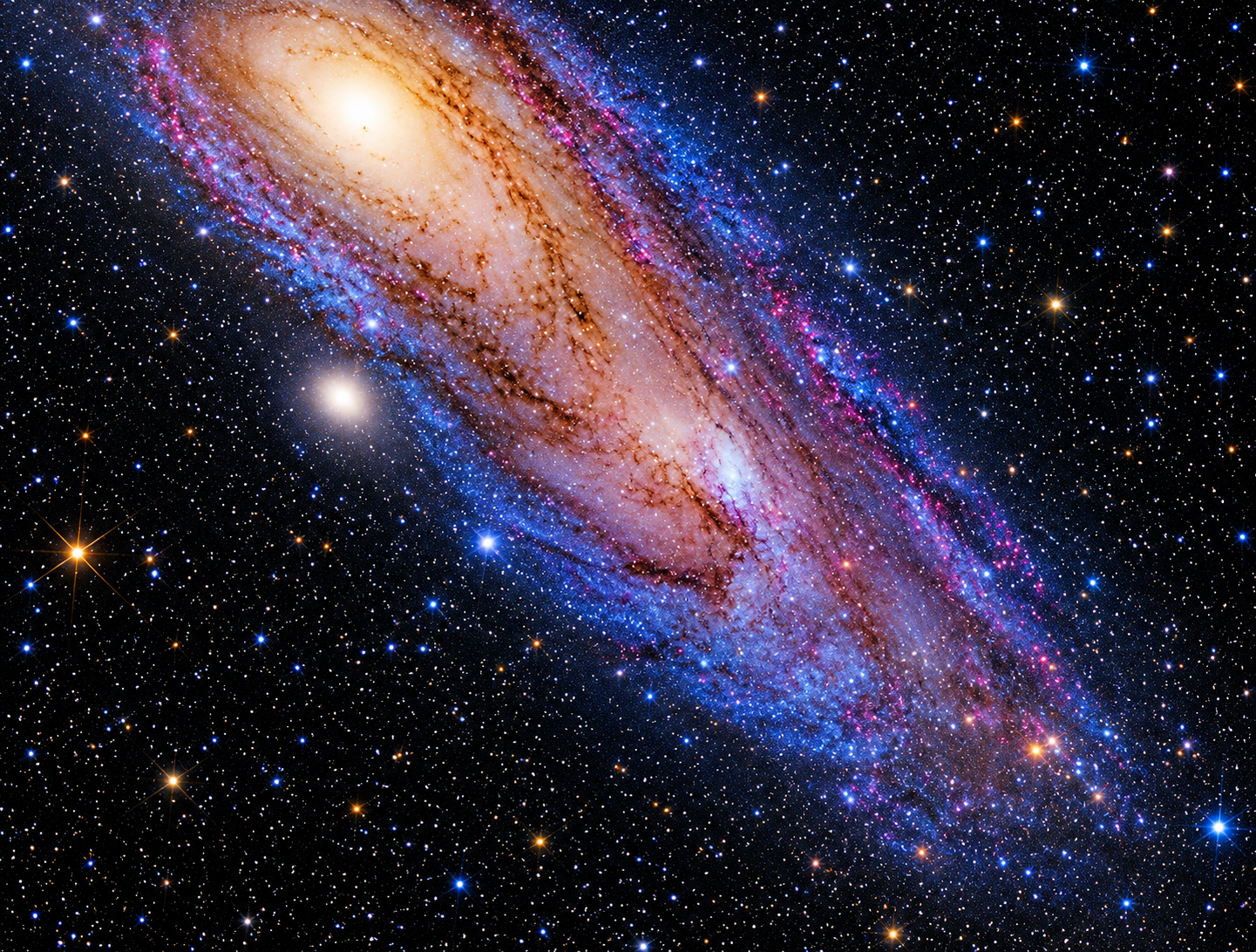
Astronomers have reconstructed the first stellar merger observed from its beginning through its culmination, following a supergiant in the Andromeda galaxy as it engulfed a companion slightly smaller than the sun. The system, formally designated AT 2025abao and nicknamed Bao, completed its transformation in just under seven years after the stars had spent thousands of years orbiting one another.
The result, described in a Nature study published Nov. 18, is striking for what remained. The merger released an enormous burst of energy, but NASA’s account of the research says Bao apparently settled into one massive star rather than producing a supernova. Continued observations will be needed to determine the merged object’s condition.
A stable system begins to brighten
Archival observations indicate that Bao maintained a consistent luminosity from 1989 until 2018. Researchers concluded that the smaller star encountered the extended surface of the supergiant around that time, beginning the final stage of a relationship that had previously evolved too slowly to follow within a human lifetime.
The team first noticed unusual behavior in February 2023 while examining infrared data from NASA’s now-retired Near-Earth Object Wide-Field Infrared Survey Explorer, or NEOWISE. “Stellar mergers are very, very difficult to observe in real time because they are hard to predict,” said Viraj Karambelkar, a Columbia University astrophysicist and the study’s first author. “However, we noticed something unusual was going on in 2023 and continued to monitor the system to see what it would do.”
That decision turned an unusual variable star into a monitored engineering problem for astronomy: detect a changing object across multiple wavelengths, keep instruments trained on it as conditions evolve and combine measurements from observatories with different capabilities. No single telescope captured the entire event.
Near-infrared observations from the Wide-field Infrared Transient Explorer at Palomar Observatory showed in September 2024 that Bao was brightening and producing dust. By July 2025, NASA’s SPHEREx observatory saw its visible output fade rapidly while its infrared emission continued to rise. The Zwicky Transient Facility then detected the eruption in visible light on Oct. 17, 2025.
Infrared instruments followed Bao behind the dust
The shift toward infrared wavelengths was physically revealing and operationally important. As the supergiant shed material, dust increasingly obscured visible light from the system. Infrared observatories could continue measuring radiation passing through or emitted by that dusty environment, preserving a record that optical observations alone could not supply.
NASA’s James Webb Space Telescope observed Bao on Dec. 24, 2025, only 47 days after the eruption’s visible-light peak. Webb’s Mid-Infrared Instrument characterized dust around the system, including material shed before the final eruption. The team combined those measurements with ultraviolet, visible, near-infrared and mid-infrared observations from several ground- and space-based facilities.
Together, the data support a common-envelope evolution scenario. Once the smaller star entered the supergiant’s outer layers, both objects moved inside a shared gaseous envelope. Drag drained orbital energy from the companion, pulling it progressively inward, while gas and dust flowed away from the system.
The researchers infer that the companion eventually plunged toward the supergiant’s core and merged with it. Study co-author Kishalay De, also at Columbia, compared the resulting energy release to “a bomb exploding inside a living star.” The merger itself was inferred from the system’s light, dust, spectra and matching stellar models rather than directly imaged inside the opaque star.
A merger without a supernova
Common-envelope evolution does not have one guaranteed ending. In some systems, the envelope can be expelled while both stars survive in a much tighter orbit. Bao took a different path: its smaller companion lost the orbital-energy contest and was absorbed.
Yet the merger did not appear to destroy the supergiant. Modeling indicates that much of its envelope remained bound, leaving a single massive object whose structure is still settling. The available observations therefore point away from an immediate supernova or collapse into a neutron star or black hole, although the remnant’s long-term state remains a target for future monitoring.
The scientific value lies in the continuity of the record. Astronomers have previously identified stellar mergers from eruptions or reconstructed them from remnants, but Bao was stable before 2018, brightened gradually as the inferred inspiral developed, became increasingly dust-obscured and then erupted while researchers were actively following it. That sequence provides direct observational constraints on how efficiently orbital energy moves through a shared stellar envelope.
Those measurements can now be used to test models applied to merger remnants that lack such a history. Bao compressed the observable conclusion of a millennia-long binary relationship into seven final orbits and left astronomers with one transformed star where two had been.
| More aerospace and engineering stories, right in your MSN feed. Follow AMI on MSN |
By David Whitaker — Associate editor for AMI’s aerospace and drone systems desk, translating flight systems, aircraft programs, spaceflight, and UAV developments into accessible technical stories.