Ferrari 296 Challenge Stradale Drops Hybrid System, Loses 158 Horsepower and 309 Pounds
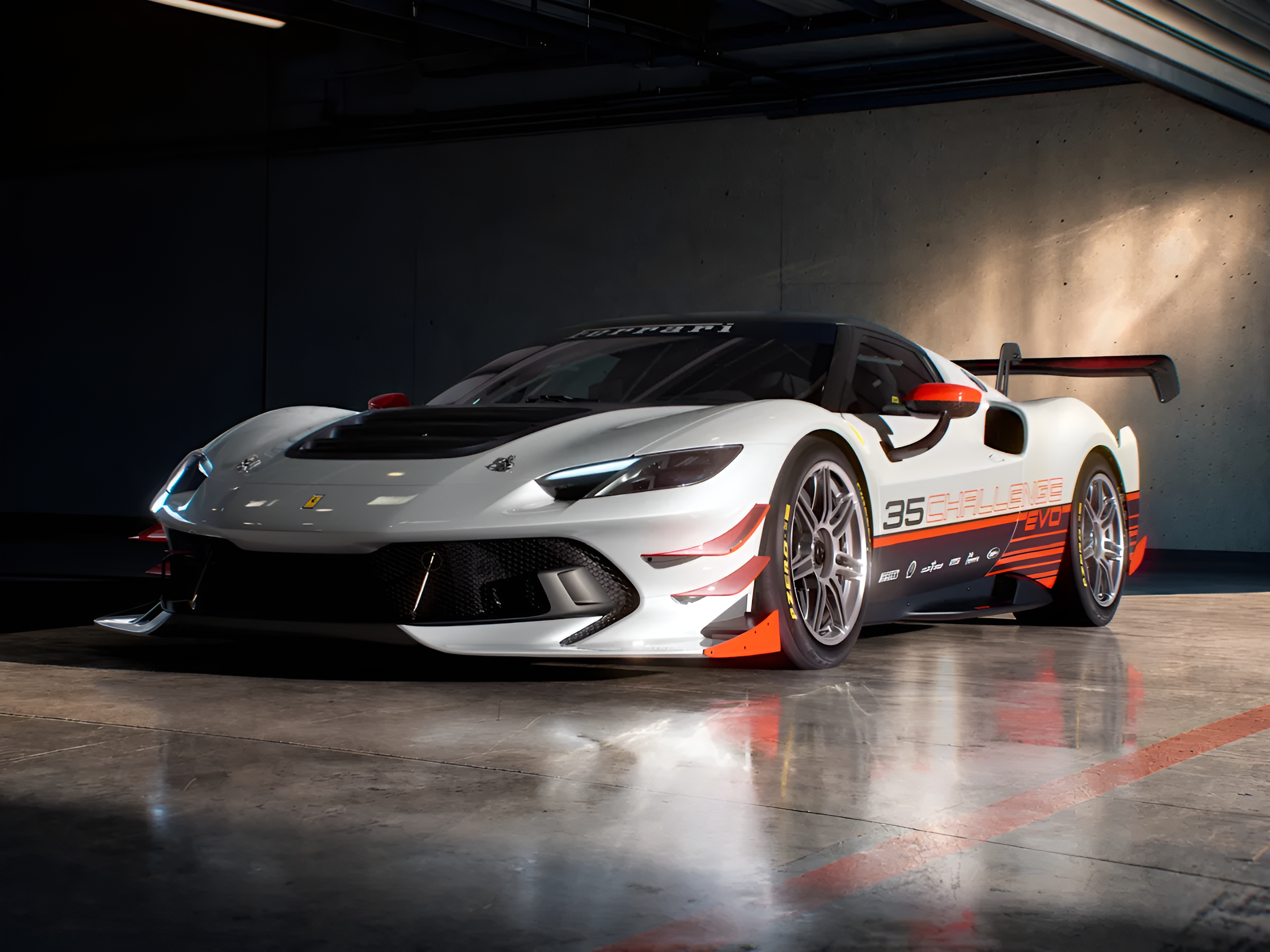
Ferrari has taken an unusual route to a faster road car: remove 158 horsepower. The newly unveiled Ferrari 296 Challenge Stradale keeps the 296 GTB’s 3.0-liter twin-turbocharged V6 but eliminates its plug-in hybrid system. Output falls from 819 to 661 horsepower, while claimed dry weight drops by 309 pounds to 2,932 pounds.
The comparison captures the engineering trade clearly. The hybrid 296 GTB uses an electric motor and battery to increase total output and fill gaps in the combustion engine’s response. The Challenge Stradale gives up that assistance and the mass and complexity accompanying it to emphasize lower weight, direct accelerator response and a more mechanically focused connection between the V6 and rear wheels.
Ferrari had already built non-hybrid versions of the 296 platform, but the 296 GT3 and 296 Challenge were restricted to circuits. The Challenge Stradale converts that basic combustion-only idea into a road-legal car, with the safety, type-approval and practical equipment that road use requires. Ferrari unveiled it on November 21 alongside the track-only 296 Challenge Evo at the Circuit de Barcelona-Catalunya.
Less power, but a claimed faster lap
Removing an integrated hybrid system affects more than the specification sheet. Without electric torque assistance, the V6 must operate on its own across the rev range. The road car retains an eight-speed dual-clutch transmission, while its powertrain was revised for the non-hybrid installation. Losing regenerative braking also required larger rear carbon-ceramic brake rotors and revised cooling, and the change in rear mass prompted suspension and geometry work.
The payoff is not merely a better power-to-weight calculation. Ferrari says the Challenge Stradale laps its Fiorano test circuit in 1 minute 18.5 seconds, 2.5 seconds quicker than the standard 296 GTB despite the power deficit. That is a manufacturer claim rather than an independent comparison, but it illustrates where Ferrari expects the lighter car to gain time: braking, direction changes, tire management and high-speed aerodynamic grip rather than maximum combined power.
Aerodynamics carry much of that burden. An extended front splitter, fixed rear wing, fully enclosed underbody and vortex generators help produce a claimed 1,360 pounds of downforce at 155 mph. Ferrari says that is 72% more than the 296 GTB. The figure applies at a speed rarely approached on public roads, so the hardware’s full benefit belongs primarily on a circuit. It also brings an unavoidable road-car compromise: large fixed aerodynamic surfaces are optimized around performance rather than visual restraint or everyday packaging.
This gives the Challenge Stradale a conceptual position similar to the Porsche 911 GT3 RS. Both are road-legal cars organized around circuit capability, aerodynamic load and driver involvement rather than headline power alone. The Ferrari remains a distinct proposition with its mid-mounted twin-turbo V6, but the Porsche is a plausible cross-shopping alternative for drivers seeking a street car with an overt track emphasis.
The Challenge Evo remains the more extreme option
Ferrari is also offering the 296 Challenge Evo for customers who do not need road legality. Its V6 produces 690 horsepower, and its revised aerodynamic package increases maximum downforce by 12% over the preceding 296 Challenge. A low-drag configuration broadens its usefulness across circuits, while updated traction-control and electronic-differential strategies are intended to improve braking stability and high-speed agility.
The Evo also receives a revised brake-pedal response and changes intended to improve consistency over race distances and reduce tire degradation. Ferrari says it is 0.8 seconds quicker around Mugello than the previous Challenge and provides an experience closer to the GT3-spec 296 GT3 Evo. It will enter the Ferrari Challenge series during the 2027 season.
The road car therefore sits between two established approaches. It is less powerful than the hybrid GTB and cannot match the operating freedom of the track-only Evo, but it combines road registration with the same 2,932-pound claimed dry weight as its racing sibling. Its reported Italian starting price is 291,000 euros, approximately $319,000, with U.S. deliveries expected in late 2027.
The defining number is not its reduced horsepower but Ferrari’s claimed Fiorano result. If replicated under comparable conditions, the 2.5-second advantage shows what the Challenge Stradale is designed to prove: on a circuit, removing mass and adding usable aerodynamic load can be worth more than retaining 158 horsepower of hybrid assistance.
| More aerospace and engineering stories, right in your MSN feed. Follow AMI on MSN |
By Robert McKinney — Editor-in-Chief for AMI’s automotive and mobility coverage, with a mechanical engineering background and a decade reporting on powertrain systems, EV innovation, and global vehicle manufacturing.