Pentagon Image Shows Shenlong’s Cargo Bay as Satellite Recaptures Emerge
China’s Shenlong space plane reportedly released and recaptured the same companion object twice during its fourth known orbital mission, adding operational context to a detailed image recently made public in a Pentagon assessment. Open-source tracking records indicate that object 2026-024H was released on June 21, 2026, recaptured around July 12, released again in late August, approached again on September 10 and recaptured on September 13.
The sequence, documented in an open-source account of the Shenlong program, suggests that the uncrewed spacecraft can repeatedly deploy, approach and retrieve a small satellite or similar object. It still provides no evidence that Shenlong carries a weapon. Satellite release and retrieval can support experimentation, inspection, servicing and reusable payload testing as well as military missions.
That distinction sharpens the central question raised by the newly public orbital image: what does Shenlong’s visible hardware enable, and how much can be inferred about its purpose?
A cargo bay with a demonstrated orbital role
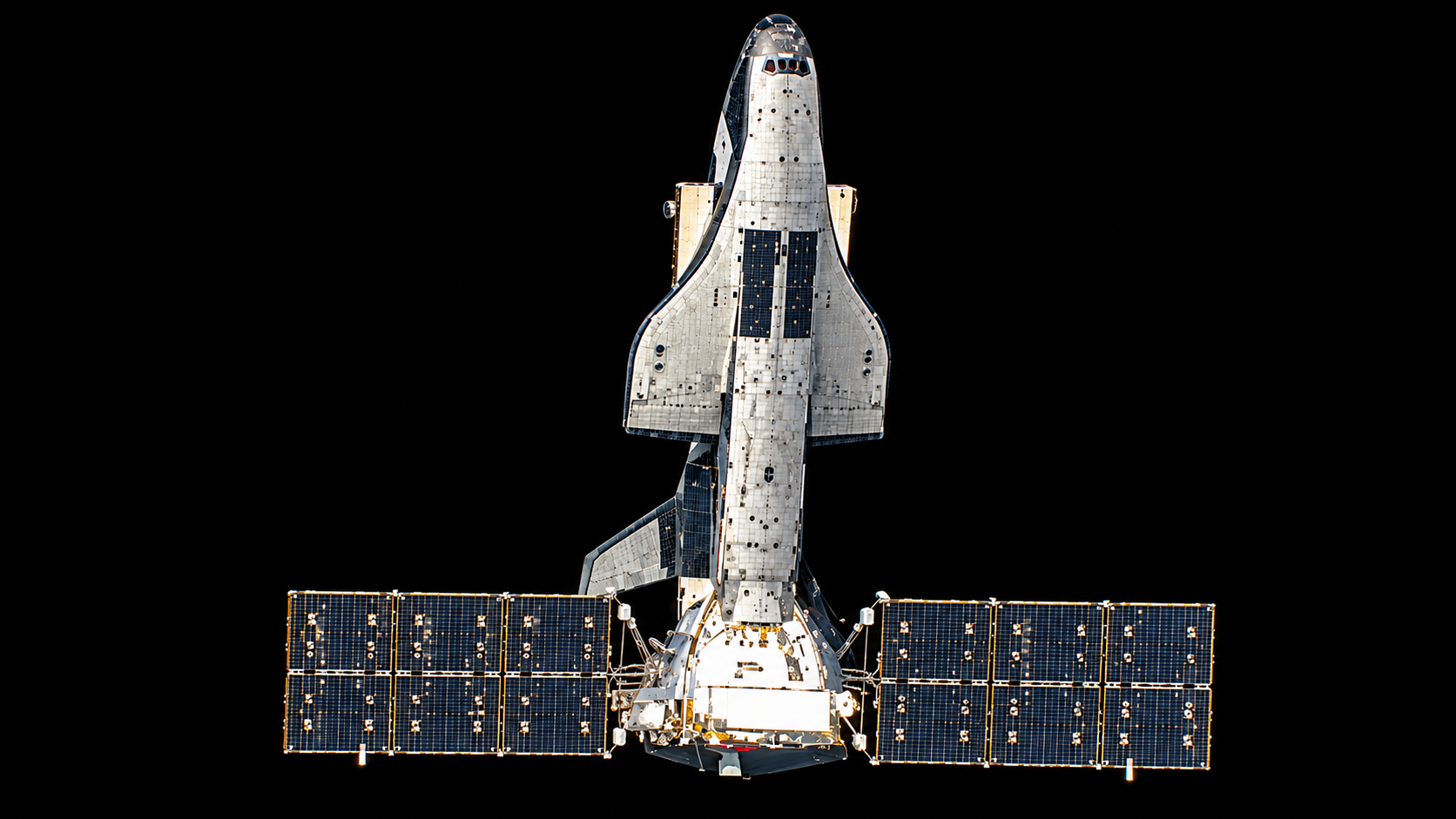
The full-resolution commercial-satellite image was captured in 2024 by American imaging company Vantor, formerly Maxar. The Defense Intelligence Agency published it on October 26, 2026, in a new assessment of space-security threats, according to FlightGlobal’s account of the disclosure.
The photograph shows a compact, winged spacecraft with a dark thermal-protection surface, a vertical stabilizer and stub wings. White structures extending from its upper fuselage appear to be open clamshell cargo-bay doors. An attached rear module carries two deployed solar arrays, although the Pentagon assessment does not identify that module’s purpose.
Apparent bay doors are more consequential when viewed alongside the fourth mission’s reported release and recapture sequence. A payload compartment could carry small satellites, experiments or other equipment into orbit and potentially return hardware to Earth. Repeated recovery of a deployed object would add another layer: the vehicle would need to coordinate its own orbit with the companion object and complete controlled approaches closely enough to retrieve it.
Those operations require more than endurance. Rendezvous and proximity flight depend on guidance, navigation, propulsion and control systems that can manage the relative motion between two spacecraft. NASA’s overview of rendezvous and docking systems also identifies trajectory design, sensors, maneuver planning and collision avoidance as core parts of such missions.
Four missions show a developing test program
Shenlong has flown four known orbital missions since 2020. Its first flight lasted two days, while the next two remained in orbit for 276 and 268 days. The fourth launched in February 2026 and was still in orbit in late October. The progression from a short initial flight to missions lasting roughly nine months indicates that Shenlong has moved beyond a basic launch and return demonstration.
The latest tracking account also extends a pattern observed on earlier flights. The DIA says that in November 2022 Shenlong appeared to conduct station-keeping with a companion satellite at a separation of about one kilometre. The objects reportedly approached within 100 metres, and the agency assessed that they possibly rendezvoused before the satellite was released again. During the third mission, Shenlong also released and interacted with an object.
The reported fourth-flight sequence is more revealing because it involved repeated release and retrieval rather than one observed close approach. Separating by several thousand kilometres before returning to the object indicates a broader demonstration of orbital coordination, although the public record does not establish the retrieval mechanism or the experiment’s objective.
The image does not establish an armed spacecraft
The DIA discusses Shenlong within a wider assessment of China’s counterspace development, including systems intended to disrupt, damage or destroy satellites. That surrounding threat assessment does not identify a weapon aboard the space plane. Neither the visible cargo bay nor the reported handling of a companion satellite establishes an armed role.
Shenlong broadly resembles the U.S. Space Force’s Boeing X-37B because both are uncrewed, reusable winged vehicles built for extended orbital operations and runway returns. The comparison defines the vehicle class, not its mission. Publicly available information about Shenlong’s dimensions, payloads and objectives remains far more limited.
The Pentagon image now has stronger operational context than when Vantor captured it in 2024. Shenlong’s apparent cargo bay is paired with a mission record that includes long-duration flight, satellite deployment, controlled proximity operations and reported repeated retrieval. What remains out of view is just as important: the contents of the bay, the retrieval hardware and the intended purpose of those demonstrations.
| More aerospace and engineering stories, right in your MSN feed. Follow AMI on MSN |
By David Whitaker — Associate editor for AMI’s aerospace and drone systems desk, translating flight systems, aircraft programs, spaceflight, and UAV developments into accessible technical stories.