NASA’s Revised Moon Plan Makes Orion Fly Backward, Forcing Tank Changes
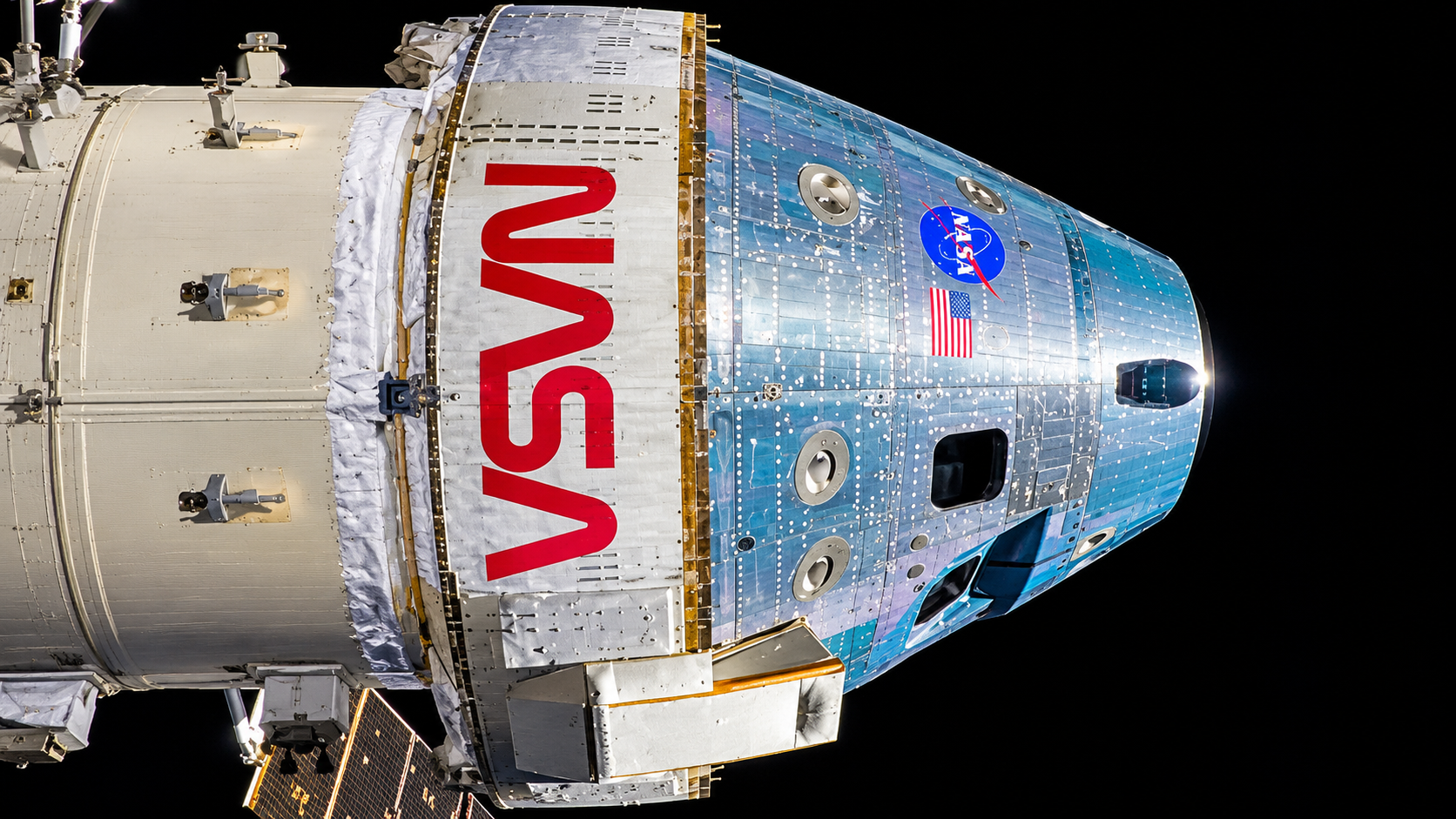
A revised Moon-flight plan intended to give NASA’s commercial lunar landers more operating flexibility has transferred a consequential engineering problem to Orion. Under NASA’s revised operations, Orion would travel toward the Moon docked to SpaceX’s Starship lander and facing in a direction the crew spacecraft was not designed to fly.
The unusual posture places Orion’s European Service Module at the front of the combined spacecraft while Starship pushes from behind. That reverses the acceleration direction expected by Orion’s existing design, changing where liquid propellant settles inside the service module’s tanks. The European Space Agency and prime contractor Airbus are therefore modifying the tanks for missions using Starship.
Why direction matters inside a fuel tank
A spacecraft tank contains both liquid and gas. When a vehicle accelerates, the liquid responds to that force and collects toward one side of the tank. The propulsion system and tank internals must be designed around where the liquid and gas will be under the expected operating conditions.
Orion’s normal flight posture produces an expected direction of acceleration through the spacecraft. Starship’s proposed trans-lunar burn would push the docked stack in the opposite direction relative to Orion, moving the service module’s liquid propellant toward the gas-inlet side of its tanks rather than toward its intended location.
“When you push it the other way, the liquid goes to the gas end of the tank, and you don’t want the liquid in the gas part. Bad things can happen to you,” said Kirk Shireman, Lockheed Martin’s Human Spaceflight Exploration and Orion program manager. Lockheed Martin builds Orion for NASA.
The problem is fundamentally one of propellant acquisition and phase separation. Propulsion hardware must consistently receive the fluid it is designed to handle, even while the liquid and vapor inside a tank shift under acceleration or in low gravity. NASA describes propellant-management devices generally as hardware that separates liquid and vapor and transfers vapor-free propellant from a storage tank. The available information does not identify what specific internal changes ESA and Airbus have selected for Orion.
Starship gains flexibility while Orion absorbs the constraint
Under the evolved SpaceX concept, multiple Starship vehicles would support propellant aggregation in low-Earth orbit. The lunar Starship would then meet Orion in Earth orbit, dock with it and perform the burn that sends the combined stack toward low lunar orbit. Two of Orion’s four astronauts would later transfer to Starship for the descent to the lunar surface, while two remained aboard Orion.
This arrangement reduces demands elsewhere in the mission. NASA says aggregating propellant in low-Earth orbit provides greater flexibility for the timing of Orion’s launch, while having Starship perform the trans-lunar injection burn lowers the amount of propellant the lander must aggregate compared with the previous architecture. Direct access to low lunar orbit also reduces the time required for astronauts returning from the surface to reconnect with Orion.
Those gains come with a clear systems-engineering trade: changing the rendezvous location and assigning Starship the Moon-bound burn alters the mechanical and fluid environment experienced by Orion. A mission architecture can therefore make one vehicle’s operation easier while invalidating assumptions embedded in another vehicle’s hardware.
The burden also crosses organizational boundaries. ESA provides the European Service Module, Airbus builds it under ESA contract, and Lockheed Martin is NASA’s Orion prime contractor. The service module is not a passive adapter; it supplies Orion’s propulsion, maneuvering, electrical power, thermal control, water and breathing gases. Its tanks and propulsion system are mission-critical parts of the spacecraft carrying four astronauts.
NASA has also revised the meeting point for Blue Origin’s Blue Moon lander, moving its rendezvous with Orion to low lunar orbit. But the service-module-first tank problem described by Shireman is tied specifically to the Starship docking and propulsion arrangement.
The tank modifications are now part of making that arrangement viable. NASA’s lander flexibility is being purchased with a concrete redesign obligation for Orion’s European suppliers: the crew spacecraft must manage its propellant correctly even when another vehicle pushes it toward the Moon from what was originally the wrong direction.
| More aerospace and engineering stories, right in your MSN feed. Follow AMI on MSN |
By David Whitaker — Associate editor for AMI’s aerospace and drone systems desk, translating flight systems, aircraft programs, spaceflight, and UAV developments into accessible technical stories.