Sandia Builds Six-Inch Robot for Hanford Pipes Cameras Cannot Reach
Hanford’s underground waste pipes present a severe mismatch between inspection need and physical access. Some run for hundreds of feet, narrow to 2 inches in diameter and turn through multiple 90-degree bends. Traditional push cameras reportedly managed only about 10 feet before tight turns stopped them.
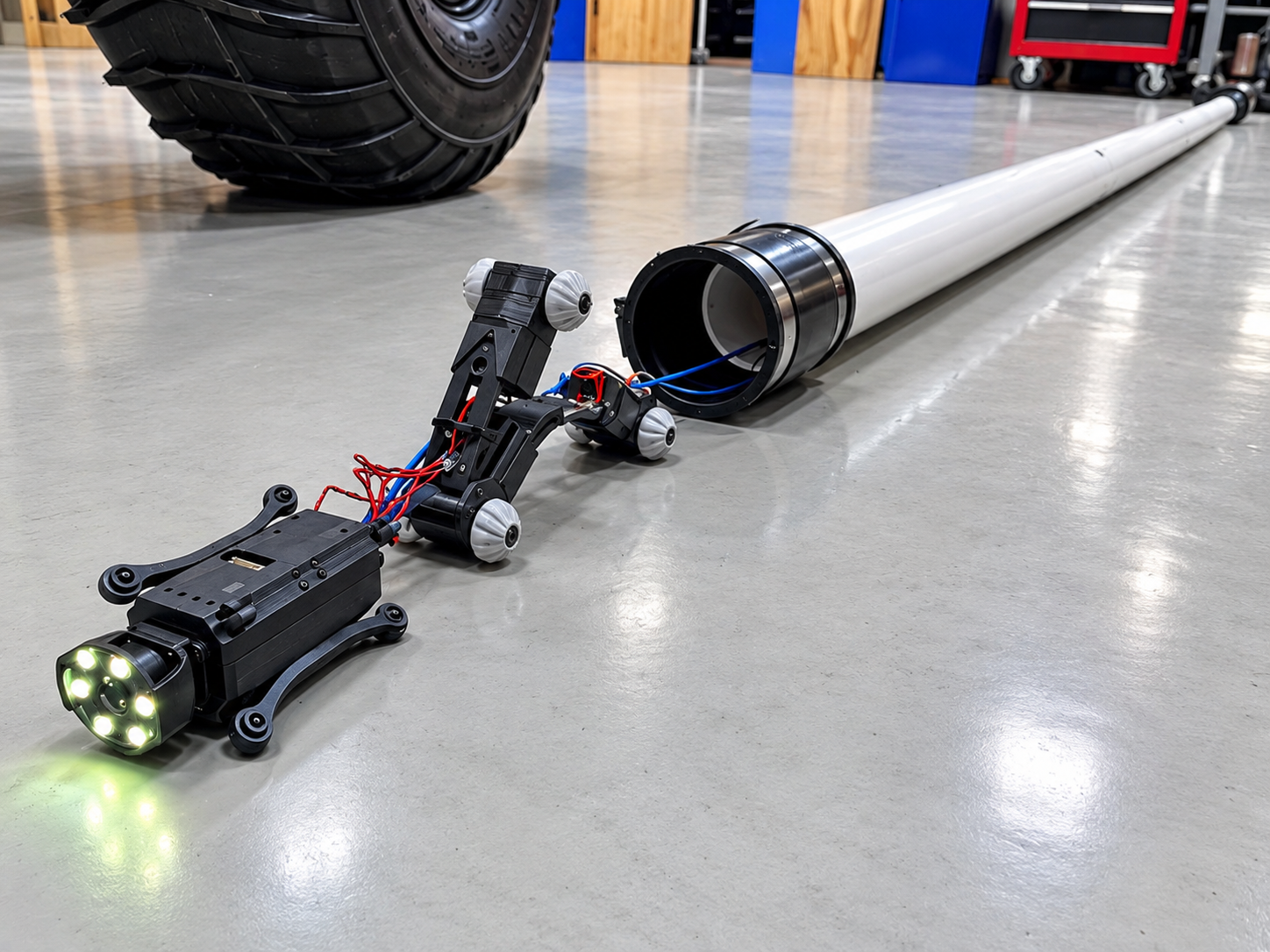
Sandia National Laboratories has built a six-inch long robot to get past those constraints. Called SPIINE, the crawler combines six driven wheels, a flexible body, adjustable LED lighting and an onboard high-resolution camera. Sandia has completed successful laboratory tests, but the robot has not yet been field-tested in the decades-old pipes at Washington state’s Hanford Site.
The Sandia project addresses pipes used to transfer radioactive waste between underground storage tanks. Hanford, now a decommissioned nuclear production complex managed by the Department of Energy, was established in 1943 as part of the Manhattan Project and housed the world’s first full-scale plutonium production reactor.
A flexible robot for an inflexible route
SPIINE stands for Self-Propelled Interior Inspector for Non-destructive-testing Examination. At approximately 2 inches by 6 inches, it is designed around the minimum pipe opening rather than a conventional mobile-robot footprint. Its multi-axis structure allows the pipe wall to guide and reorient the body as it enters an elbow.
“We wanted a flexible body to let the pipe sort of guide the robot,” mechanical engineer Steve Buerger said. The adaptive wheels provide contact as the body changes orientation, while steering gives an operator control over features such as junctions. A standard video game controller is used to operate the system.
This compliance is central to the design. A rigid probe long enough to carry useful sensors can bind as it moves through a sharp bend. A segmented body can distribute that change in angle across several joints while keeping its wheels pressed against the pipe. Sandia’s crawler has driven through 90-degree turns in testing, the capability that conventional cameras lacked.
The immediate objective is visual access. “Our initial target is just being able to get eyes in the pipe,” engineer Daniel McArthur said. “The goal is to be able to inspect for corrosion or other types of damage like cracks or anything that would raise a concern.” Adjustable lighting supports the camera as surface color, deposits and viewing distance change inside the enclosed pipe.
The cable is part of the propulsion problem
The robot remains tethered by a single cable carrying power and data while also bearing mechanical loads. That avoids depending on a small onboard battery for a journey potentially extending hundreds of feet, but it introduces drag. Every bend increases the force required to pull the cable, particularly when several elbows separate the crawler from its access point.
Sandia’s answer is distributed propulsion. Multiple robots or propulsion modules can be connected in series along the same cable, applying force at several points rather than asking the leading crawler to pull the entire tether through every turn. It is the robotic equivalent of supporting and advancing a long hose around several corners instead of pulling solely from its far end.
The motors are also intended to carry inspection payloads. Possible additions include ultrasonic or electromagnetic probes capable of measuring pipe-wall thickness. Conventional ultrasonic equipment is often too bulky to pass through the smallest pipes and their elbows, so Sandia is exploring microscale sensors that preserve the crawler’s turning envelope.
More than two years of development have included changes to wheel compounds and power transmission. Those choices must account for limited motor force as well as sludge, caked deposits and protrusions that could reduce traction or block movement. A design that performs on clean laboratory pipe may encounter a substantially less predictable contact surface at Hanford.
Field testing and recovery remain ahead
The next step is real-world testing at Hanford. Before routine deployment, the team is also working on a self-cleaning function for the camera lens or dirty pipe wall and a fail-safe recovery system for a disabled or stuck crawler. Recovery is especially important in a narrow transfer line with few access points, where leaving the inspection machine behind could create another obstruction.
The project’s present boundary is therefore clear: SPIINE has demonstrated the locomotion needed to move beyond the roughly 10-foot reach of earlier cameras, including negotiation of sharp bends, but Hanford’s actual pipe conditions remain the decisive test. Success there would turn a six-inch camera carrier into a practical inspection platform while keeping workers away from inaccessible and potentially hazardous spaces.
| More aerospace and engineering stories, right in your MSN feed. Follow AMI on MSN |
By Jonathan Barrett — Editor for AMI’s future mobility and autonomous systems section, with two decades covering robotics, e-mobility, drone-vehicle convergence, and transport mechanical systems.