Tesla’s New Driver-Assist Display Generates AI Road View but Remains Supervised
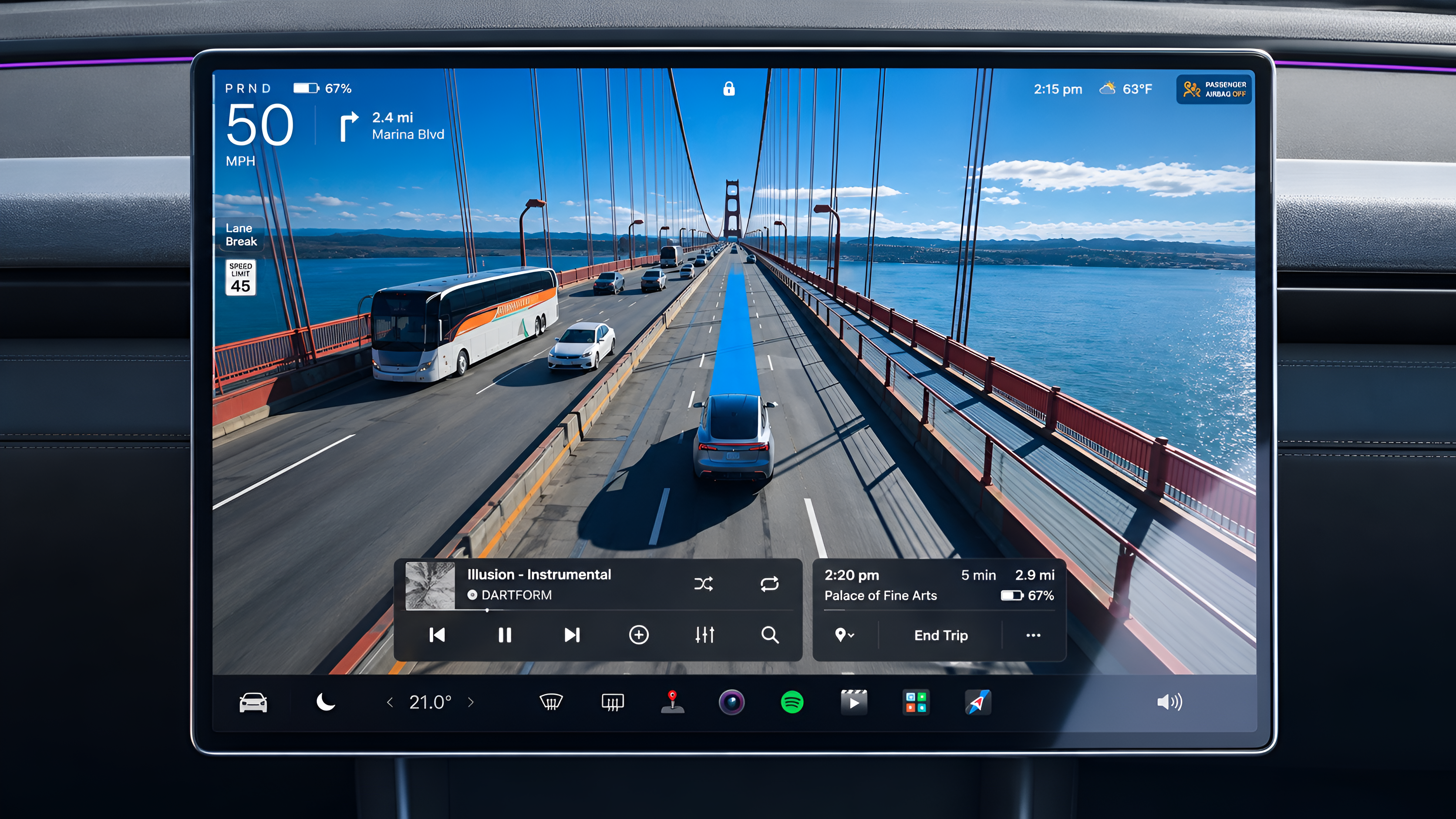
Tesla’s new Reality View does not put raw camera footage on the center screen. Instead, it converts features extracted by the vehicle’s neural network into a continuously generated representation of the road, surrounding traffic and objects. Introduced with Full Self-Driving (Supervised) V15.0.1, the interface gives drivers a more detailed look at what the software believes is around the car but it remains a generated interpretation with acknowledged clarity and latency limits.
The rendering begins with Tesla’s Universal Vision Encoder, which processes camera inputs into a common set of visual features. Elon Musk described those features as feeding two separate paths: an approximately 3-billion-parameter model that produces driving actions and an approximately 1-billion-parameter model that generates Reality View. The screen therefore draws from the same underlying perception features used by the driving system, rather than recreating the scene through conventional graphics or simply relaying a camera image.
According to the release notes for software version 2026.38.6.11, Tesla began sending FSD V15.0.1 to an initial group of customers on November 21. Reality View replaces the previous collection of explicit model signals with a single end-to-end visualization that Tesla says requires less total computing power.
The generated scene can represent road surfaces, potholes, puddles, pedestrians, small animals, nearby vehicles and speed cameras. Directional arrows communicate upcoming turns, while thumbtack-style markers identify possible parking positions. Drivers can choose a full-screen visualization, conventional map, split-screen arrangement or a quieter display mode. The interface also allows a driver to touch the overhead view to select a destination, requested lane change or parking space.
That combination makes Reality View more than decorative rendering. It is intended to communicate both the system’s interpretation of its surroundings and what it plans to do next. Yet visual realism is not a measurement of perception accuracy. A generated pedestrian, pothole or vehicle shows how the model represented an object for display; the image alone does not validate the classification, predicted motion or resulting driving decision.
The distinction is particularly important because FSD V15 remains a supervised driver-assistance system. Tesla reports limited image clarity and some delay in the current implementation. Musk said Reality View runs at 36 frames per second and suggested future optimization could reduce camera-to-screen latency by roughly 35 percent. Until that work is completed, the displayed scene necessarily trails the physical environment to some degree, even as the driving model operates from its own processing path.
Tesla says the rendering model uses half of one TRIP accelerator on the AI4 computer, which has six such accelerators across two main chips. Separating display generation from driving-action output is a practical architectural choice: the interface can become richer without making the generated image itself part of the control command. It also creates a clear engineering tradeoff, because every additional display workload consumes processing capacity and must meet thermal, power and response-time constraints inside the vehicle.
Interface design can also influence how drivers judge automation. A 2026 simulated-driving study of continuous system-certainty displays found that presentation patterns affected takeover response time and eye behavior, although they did not significantly change trust or workload. Reality View is not described as a certainty display, but the research highlights the difference between showing a polished reconstruction and communicating how confident the system is about that reconstruction.
V15 extends beyond the display. Tesla says it adds learned navigation based on fleet route preferences, parking suggestions informed by vehicle history, revised speed behavior in school zones and poor weather, speed-camera slowdown and a bike-rack mode. The company also lists improved detection or avoidance involving potholes, debris, animals and deep standing water. Those are stated software changes; performance across ordinary customer driving has not yet been independently established from the limited first-wave rollout.
The broader architectural move is the upgraded visual encoder, which Tesla says is shared among its consumer vehicles, Robotaxi program and Optimus humanoid robot. A common perception backbone can reduce duplicated model development and allow improvements in visual feature extraction to support multiple products. It also couples those programs at a foundational level: each application still needs its own control logic, operating boundaries and validation because recognizing a scene does not make driving a car and controlling a humanoid equivalent tasks.
Reality View makes Tesla’s internal representation far more visible to the driver, while the shared encoder shows how the company intends to reuse perception technology across vehicles and robots. The immediate boundary is equally visible: V15’s generated road scene may be detailed, but the software still requires human supervision, and reducing display latency remains unfinished work.
| More aerospace and engineering stories, right in your MSN feed. Follow AMI on MSN |
By Robert McKinney — Editor-in-Chief for AMI’s automotive and mobility coverage, with a mechanical engineering background and a decade reporting on powertrain systems, EV innovation, and global vehicle manufacturing.