Hydrogen Cars Face Uphill Battle Against Batteries
Hydrogen’s appeal as a transport fuel lies in its fundamental chemistry: when it reacts with oxygen, the only byproduct is water, and the reaction releases significant energy. This makes it an alluring candidate for zero-emission mobility. Senior automotive executives have long promoted its potential, with some envisioning it as a rival to battery-electric vehicles (BEVs) in the race to decarbonize road transport.

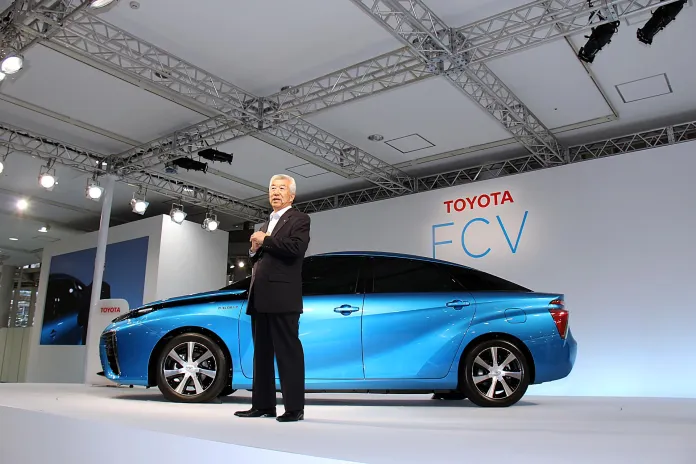
Among the most vocal advocates is Toyota. Its chair, Akio Toyoda, recently stated his belief that battery-electric cars will peak at 30% market share, with hydrogen and internal combustion engines comprising the remainder. Toyota’s Mirai sedan remains one of the few hydrogen fuel cell vehicles (FCEVs) available to consumers, joined by Hyundai’s Nexo SUV. BMW’s chief executive, Oliver Zipse, has also championed the technology, calling hydrogen “the missing piece in the jigsaw when it comes to emission-free mobility.” BMW is trialing its iX5 Hydrogen model, powered by Toyota fuel cells, while continuing heavy investment in battery platforms. Zipse has emphasized that “one technology on its own will not be enough to enable climate-neutral mobility worldwide.”
Hydrogen is abundant in the universe but scarce in pure form on Earth. Most is produced from methane via steam reforming, a process that emits carbon dioxide. Zero-emission “green hydrogen” is generated through electrolysis, splitting water into hydrogen and oxygen using renewable electricity. In vehicles, hydrogen can be combusted or used in a fuel cell, where it reacts with oxygen over a catalyst—often platinum—to produce electricity for an electric motor.
Proponents highlight operational advantages. Jean-Michel Billig, Stellantis’ chief technology officer for hydrogen fuel cell vehicle development, points to rapid refueling—around four minutes—along with higher payload capacity and longer range. The Mirai, for example, can travel roughly 400 miles per fill. Stellantis has begun producing hydrogen-powered vans in France and Poland, targeting commercial fleets that require minimal downtime. “They need to be on the roads,” Billig said. “A taxi not running is losing money.” He expects that by the “end of this decade, hydrogen mobility or BEV will be equivalent from a cost perspective,” though Stellantis plans to produce both.
Skepticism remains strong among energy analysts. Elon Musk has dismissed the concept as “fool sells,” questioning the logic of converting green electricity into hydrogen instead of using it directly in BEVs. David Cebon, professor of mechanical engineering at the University of Cambridge, notes that “if you use green hydrogen it takes about three times more electricity to make the hydrogen to power a car than it does just to charge a battery.” He adds, “It’s difficult to do very much better.”
Michael Liebreich, founder of Bloomberg New Energy Finance, ranks hydrogen for cars in what he calls “the row of doom,” citing minimal prospects even for niche adoption. “The answer is no,” he said when asked if hydrogen could overtake batteries in cars. He warned that automakers banking on large-scale hydrogen car markets are “just wrong” and risk costly disappointment.
Beyond efficiency losses, hydrogen faces infrastructure and logistics challenges. The gas is flammable, must be stored under high pressure, and leaks easily. Its low volumetric energy density compared to fossil fuels means more frequent tanker deliveries unless on-site production is available. Europe has only 178 hydrogen filling stations, half in Germany, according to the European Hydrogen Observatory. The UK has nine, compared to 8,300 petrol stations and 31,000 public charging locations.
The International Energy Agency projects hydrogen could supply 16% of road transport energy by 2050, largely in heavy-duty segments such as buses and long-haul trucks. Even Toyota’s technical chief, Hiroki Nakajima, has acknowledged that hydrogen cars have “not been successful” due to fuel supply constraints, with better prospects in commercial and long-distance applications. Toyota is also experimenting with a hydrogen-powered Hilux pickup.
Market data underscores the gap: fewer than 300 hydrogen vehicles have been sold in the UK over two decades, compared with one million BEVs. With substantial investment flowing into battery technology and charging infrastructure, the momentum strongly favors electric drivetrains. For hydrogen advocates, the immediate challenge is securing abundant, low-cost green hydrogen and determining whether its highest-value use lies in sectors beyond passenger cars.