EV Market Momentum Defies Slowdown Narratives
Recent headlines have painted a picture of an electric vehicle market in retreat, with talk of slowing demand, hesitant automakers, and even rental giants like Hertz trimming their EV fleets. Yet the data tells a different story. In 2023, U.S. sales of battery-electric vehicles reached nearly 1.2 million units, with another 190,000 plug-in hybrids sold, according to EVadoption. That total of 1.36 million represented 8.8 percent of the 15.5 million new cars sold, the highest share on record. Globally, EV sales also hit unprecedented levels.

Forecasts for 2024 suggest the upward trajectory will continue. Colin McKerracher of Bloomberg projects U.S. EV sales just shy of 1.9 million units, capturing 13 percent of the market. Supply constraints that plagued the industry over the past four years are expected to ease, potentially lifting overall vehicle sales by more than a million units compared to last year.
Battery-electric models in 2023 matched conventional hybrids at roughly 8 percent of the market. Tesla alone accounted for about half of all EVs sold, and since 2011 has delivered roughly half of the 2.5 million EVs now on U.S. roads.
The second half of 2023 did see a slowdown in the rate of EV sales growth, driven by higher interest rates, a lack of affordable models, shortages of certain popular vehicles, and persistent concerns over public charging reliability. Importantly, this was a deceleration in growth, not an actual drop in sales volume.
Automakers have adjusted their timelines. GM and Ford postponed some EV battery and assembly capacity expansions, citing the need to manage capital in a high-interest-rate environment. Delays are not cancellations, but they do shift the arrival of key models.
Meanwhile, new entrants are reshaping the market. Kia’s 2024 EV9, a three-row midsize SUV with dimensions similar to the Telluride but a longer wheelbase for added interior space, arrives at a price point below other three-row electric SUVs like the Mercedes-Benz EQS SUV, Rivian R1S, and Tesla Model X. U.S. production in West Point, Georgia, begins in May, with dealer arrivals expected by midsummer. A Hyundai Ioniq 7 counterpart is slated for later in the year.
GM’s Ultium platform, heralded since 2020 as the backbone of its EV future, has stumbled. The company projected 400,000 EV sales by mid-2024, but in 2023 delivered only 13,838 Ultium-based vehicles. Of the nearly 76,000 EVs GM sold last year, 82 percent were Chevrolet Bolt models, which ceased production at year’s end. Production issues appear linked to automated machinery for inserting individual cells into battery modules, though GM has declined to elaborate. The result: minimal availability for models like the Chevrolet Silverado EV, Blazer EV, Equinox EV, Cadillac Lyriq, and GMC Hummer EV.
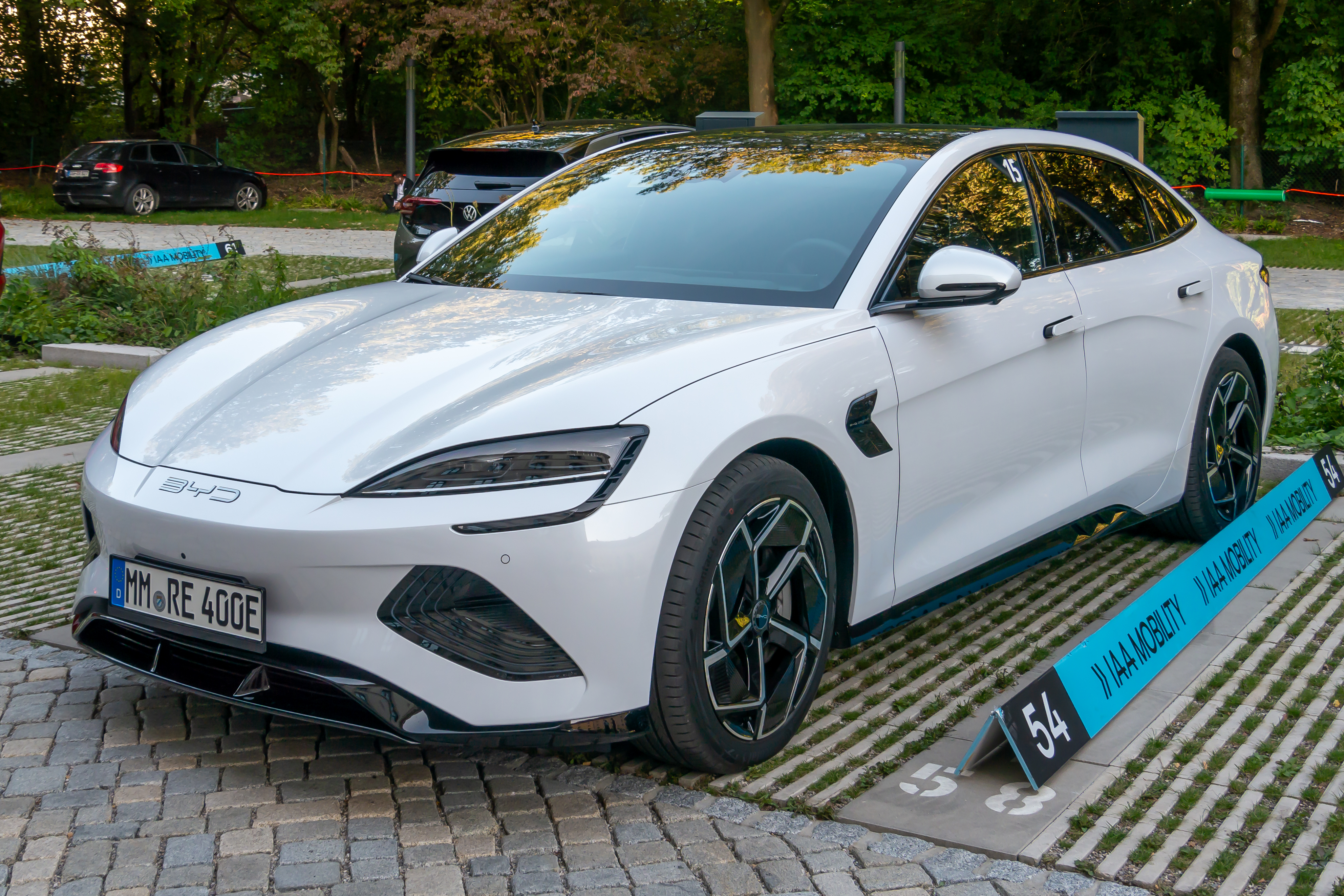
Other manufacturers are moving quickly. Hyundai-Kia continues to expand offerings, and Chinese automakers are eyeing the U.S. market. The Volvo EX30, a subcompact SUV starting under $40,000, arrives this summer. With a 27.5 percent tariff on China-built cars, companies like BYD may route exports through countries such as Mexico or Brazil to avoid duties.
McKerracher describes U.S. EV sales in 2024 as “the toughest to call” among global markets, noting Tesla’s dominance, Hyundai and Kia’s momentum, and the fact that only Ford and GM have claimed demand is “faltering.” Incentive structures shifted on January 1, with stricter sourcing requirements reducing the number of qualifying models for purchase rebates, but allowing immediate point-of-sale application. Leasing remains a route to secure the full rebate under separate provisions.
Globally, the U.S. accounts for just 11 percent of EV sales. China leads with an expected 10 million EV sales this year—nearly 40 percent of its new vehicle market—driven by a decade of coordinated investment across government levels. This scale has given Chinese manufacturers cost advantages and control over critical supply chains. Only Tesla matches their volume. Detroit’s automakers, despite substantial commitments, remain far from competing at that level.
The U.S. market poses unique challenges, with a preference for large pickups and SUVs uncommon elsewhere. Even so, more plug-in models will be available to American buyers in 2024 than ever before, and sales are set to surpass last year’s record.