Hera’s Asteroid Chase Is Testing How Earth Might Deflect a Threat
The largest manoeuvre of the Hera mission, in terms of fuel expenditure, was done using this manoeuvre, and was used to test all of the systems that we will require during the braking and rendezvous manoeuvres later this year as we arrive at Didymos, ESA flight dynamics specialist Francesco Castellini said upon the most recent deep-space burn of the spacecraft.

This is the essence of the recent change in speed of Hera and the reason why the change is important in navigation. The probe of the European Space Agency is not a mere crossing of space on the way toward two asteroids. It is nearing the sole asteroid system whose orbit has been purposefully modified by humans, transforming an initial impact experiment into an engineered engineering experiment.
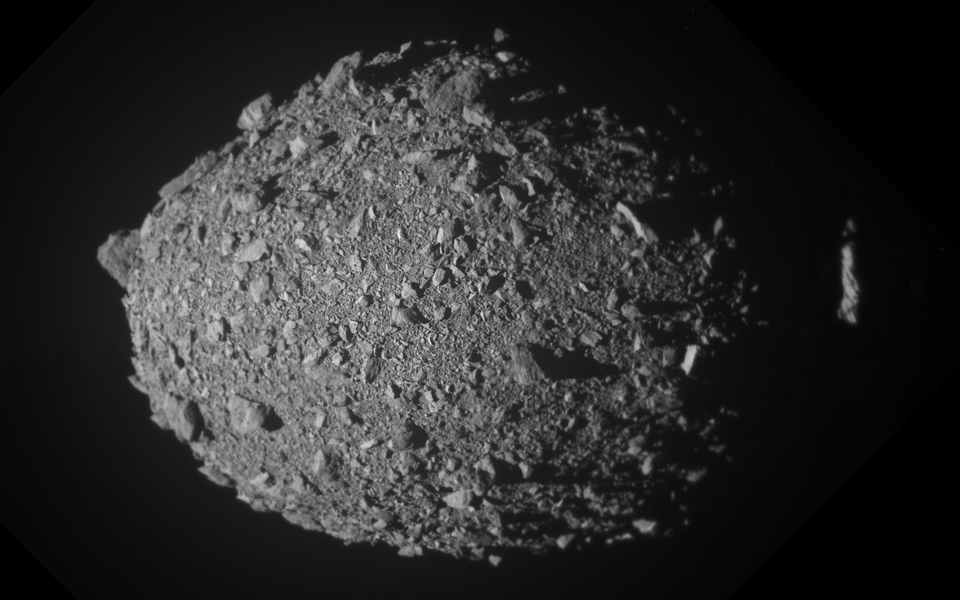
Hera is now heading to Didymos and its smaller companion Dimorphos, the target of the NASA DART spacecraft in 2022. It was shown that a kinetic impactor can alter the orbit of an asteroid, shifting the orbit of Dimorphos by more than 30 minutes. What is still less clear is the efficiency of the movement of momentum through the asteroid, how the surface was re-formed, how much was kicked off, and what it alludes to in the use of the same method in different conditions. That is Hera’s job.
Its last maneuver used 123 kilograms of hydrazine and altered the velocity of the spacecraft by 367 meters per second, a jump that ESA described as comparable to the acceleration of a spacecraft at rest to supersonic speed. The fire was a rehearsal of the much more sensitive work to come, as well. In contrast to a planetary arrival, a rendezvous with small and dark asteroids requires infinite correction, braking, and onboard decision-making since overcoming the communication lag with the Earth makes direct piloting impractical.
Hera has been training to fit within such an environment by ESA. In March 2025, Mars flyby, the spacecraft tested autonomous vision-based navigation, which the spacecraft will require when Didymos first emerges as a distant dot in the star fields. The engineers are also loading new software to operate on close proximity including updating the laser altimeter, monitoring systems of Hera and those used in deploying CubeSat. It is difficult to transmit software to the spacecraft across deep space, as Anna Schiavo of the Hera flight control team explained it like a video call with Mars, 0.004 percent the speed of a home internet connection, with a lag of around twenty minutes.
When it gets there Hera will take at least six months to survey a target that planetary science has hardly approached: the first comprehensive survey of a binary asteroid. The mothership will chart out the system, examine the DART crater and launch two little companions. Milani will study the mineral make-up and dust of the asteroids, and Juventas will monitor the subsurface by means of radar. It will be challenging to run those spacecrafts since the force of the gravity is very weak that even sunlight can significantly disrupt their paths, and not all orbits are viable.
Hera is broader in its value, which is methodological. The defense of the planet cannot be based on the one dramatic collision and a victorious outcome. It requires the size of craters, the mass of asteroids, interior structures, ejecta activities as well as performances of navigation in the vicinity beaches. Hera is being constructed on that missing piece of evidence with findings that are expected to transform asteroid deflection into a demonstration to a technique that can be carried out with repeatability to protect the earth. By the moment that Hera starts its close examination of Dimorphos, the mission will be doing much more than returning to DART. It will be challenging whether planetary defense can transition off of proof of concept to operational science.