

Why NASA Sees Lunar Nuclear Power as the Key to Deep Space Exploration
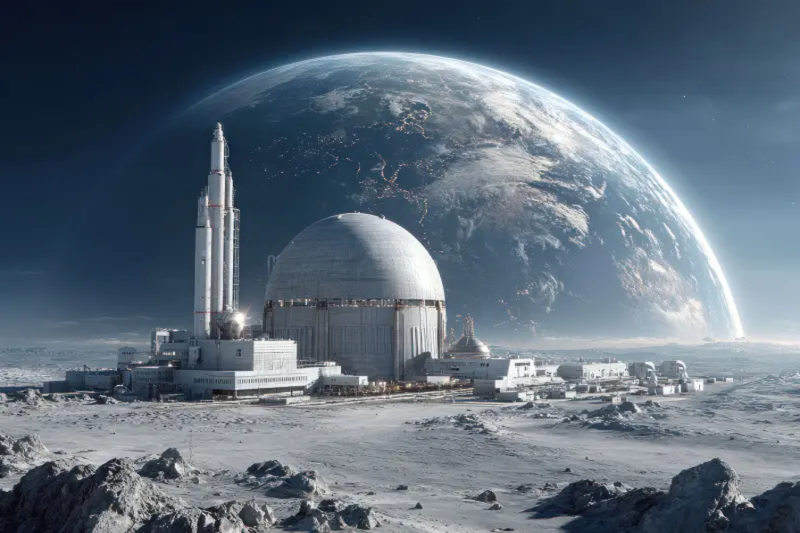
One of the most actual tasks of space exploration of the last decades was the creation of a technology that would provide for the power source in space. Solar batteries were ideal in orbit, in sunny regions of our planet, but not in regions with long night, for example, on the moon, which has two weeks of night, or in regions with Martian dust storms. This problem was solved by NASA, which put a fission reactor on the surface of the moon.

This is one of the most highlighted regions of focus for this agency’s Artemis program, which is aimed at developing a presence on the moon that will essentially be a precursor to missions to Mars. NASA has agreed to cooperate with each other with regards to developing a fission surface power system that will prove useful for operations on the surface of the moon as part of a cooperative agreement with the United States Department of Energy. The MOU is another aspect of a cooperative agreement that has existed for over fifty years.
Unlike solar stations, nuclear fission reactors operate in all types of weather: during eclipses, in the presence of dust, and at low temperatures. The future reactor will employ a closed-type Brayton cycle power conversion system. The system will be made as efficient as possible so that it becomes possible to increase the power level to a higher one at a later date if needed. The initial plan of NASA is to develop a system with an electrical power of 100 kW.
Technical heritage is an important element in design. The project is based on an assumption that has been justified by the launch of the Kilopower project, which suggested that a small fission reactor is able to function in a safe way in both normal and off-normal operating conditions. The KRUSTY experiment in 2018 suggested that a small fission reactor that uses a heat pipe is able to function in a reliable way for Stirleing engines for generating electricity.
The scaling of this technology to a 40 kW class of reactors for missions to the moon is in development. The other aspect of the utmost importance that fits into this puzzle is that of safety. The organizations that conduct risk analysis that entails simulation of accidents that could happen when landing or launching nuclear materials include Sandia National Laboratories. A Safety Analysis Report is a document that is very valuable when one is seeking approval to move on with the process of launching. A key aspect of this report is that it gives a considerable input with respect to gaining approvals that are required to move on with the process of launching.
There exist some engineering issues concerning the distribution of power on the surface of the moon. A microgrid system is being developed by NASA that will link distant locations in a disaster situation. The locations that will be linked by microgrids include a habitat module and a mining station. The microgrids will ensure a constant distribution of power to locations with a high consumption rate of electricity. The idea of a microgrid on the moon will be based upon previous experiences with microgrids on earth but with a novel system of distribution of power. The development of a microgrid system will be a game-changer in terms of exploration.
With a constant power source in place, it will be possible to have a permanent staff presence, powerful scientific experiments, and unmanned systems functioning throughout the lunar night. Having a nuclear reactor in place at the moon could also provide a step toward Mars, because these problems would have to be addressed at Mars too, such as sunlight and adverse environmental conditions. Looking forward into the future, nuclear surface power is about so much more than simply turning on the lights, it’s about taking the next giant leap for mankind into our solar system.