US Qeshm Strike Reveals Undisclosed Air Campaign Beside Hormuz
The United States struck an Iranian air-defense facility on Qeshm Island on Nov. 2, exposing a series of smaller attacks that had continued for several weeks without public disclosure. The latest operation was described by U.S. officials as limited, but its location beside the Strait of Hormuz places the continuing air campaign next to a shipping corridor already operating under severe pressure.

President Donald Trump acknowledged the strike during a Nov. 3 Fox News interview. “It was just a minor attack; it wasn’t war,” he said. Trump said Iran had spent about two months building an anti-aircraft facility and that U.S. forces struck upon its completion.
They built an anti-aircraft facility. It took them about two months. We watched it get built. As soon as it was completed, we hit it last night very nicely, Trump said. His account indicates that the facility’s construction had been monitored, but no public military assessment has identified its equipment, described the damage or explained how the result was verified.
The claimed MQ-9 loss remains unresolved
U.S. officials said Iranian forces fired at American aircraft during the operation. Iran’s Islamic Revolutionary Guard Corps claimed it downed a U.S. Air Force MQ-9 Reaper, a remotely piloted aircraft used for long-duration surveillance and other missions. A U.S. official disputed the claim and said no American aircraft were believed to have been lost.
U.S. Central Command declined to comment, leaving no detailed public account of the participating aircraft, the complete target set or the battle-damage assessment. No supporting material described in the available reporting resolves Iran’s MQ-9 claim. The established facts are narrower: Iranian forces fired at U.S. aircraft, Iran announced a shootdown, and a U.S. official said the operation produced no American aircraft loss.
That disagreement is operationally significant even without disclosing tactical details. A confirmed Reaper loss would show that an Iranian air-defense engagement destroyed a U.S. remotely piloted aircraft. The American account instead describes hostile fire during a completed strike without a confirmed loss. Until Central Command or another authoritative source releases more information, those remain competing versions rather than a settled combat result.
Why Qeshm’s location raises the stakes
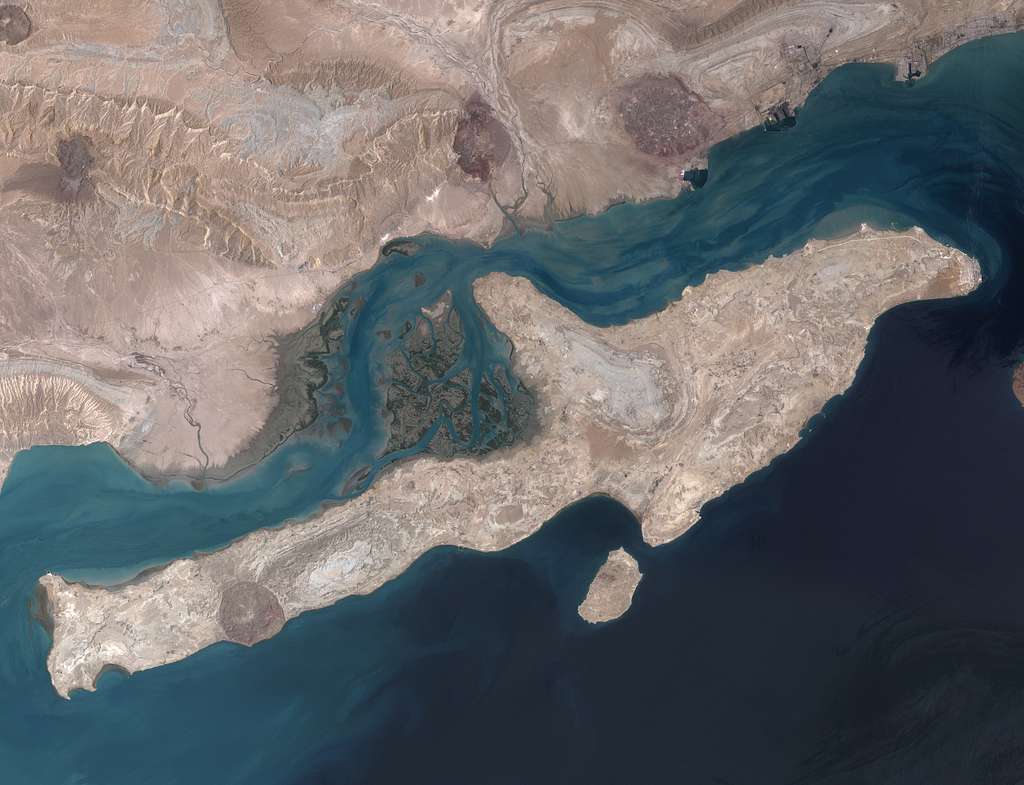
Qeshm Island hosts Iranian military sites and lies in the Persian Gulf just outside the Strait of Hormuz. The U.S.-Iran war began in February, and Iran has repeatedly attacked commercial shipping in the strait during the conflict. That geography connects an air-defense strike to a much larger operating problem: military aircraft, merchant vessels and naval forces are using the same geographically constrained region during continuing hostilities.
A recent Joint Maritime Information Center assessment rated the threat to commercial shipping as severe and documented eight projectile attacks on four tankers and four containerships during Oct. 11 and 13. U.S.-facilitated traffic averaged about 30 vessel transits per day from Oct. 11 through Oct. 14, roughly 22% of the historical 2025 benchmark of about 138 daily transits.
Central Command subsequently cited more than 40 commercial ships moving through Hormuz in a different 24-hour period. The figures use different windows and do not establish the same traffic trend, but both sit well below the prewar benchmark. Ships are still passing through the strait; normal commercial throughput has not returned.
The difference between keeping a channel open and restoring routine operations is substantial. Reduced traffic, vessels waiting at anchor, continuing attacks and military-facilitated movements all impose practical limits even when the waterway remains navigable. A new strike on nearby air defenses also adds uncertainty for aviation and maritime operators without requiring a broader air campaign to be publicly declared.
Repeated strikes create an accountability gap
The last publicly announced U.S. strikes before Qeshm occurred in early September, when American forces attacked five Iranian tankers after attempted strikes on U.S. military vessels. Iran then launched missiles at Muwaffaq Salti Air Base in Jordan and damaged some U.S. aircraft. Officials said later U.S. attacks included air defenses and other facilities, but those operations were not announced as they occurred.
The lack of disclosure also intersects with an unresolved authorization dispute. House Concurrent Resolution 86 would direct the removal of U.S. forces from hostilities against Iran without a declaration of war or specific congressional authorization, while preserving a limited exception for defense against imminent attack under the War Powers framework. The Senate agreed to the resolution in June, but the available legislative status does not show it completing the full process.
Iranian Deputy Foreign Minister Kazem Gharibabadi said on Nov. 3 that Tehran remained “in a state of war” and retained what it described as a right to respond while military action continued. That leaves the central tension intact: Washington characterized the Qeshm operation as minor, but it followed weeks of undisclosed attacks beside a chokepoint where shipping remains far below normal and the claimed loss of an American MQ-9 is still disputed.
| More aerospace and engineering stories, right in your MSN feed. Follow AMI on MSN |
By David Whitaker — Associate editor for AMI’s aerospace and drone systems desk, translating flight systems, aircraft programs, spaceflight, and UAV developments into accessible technical stories.