SpaceX Plans First Double Starship Catch, With Sonic Booms Near Cameron County
SpaceX’s bid to recover an entire Starship launch system would bring the upper stage back over populated parts of northern Mexico and southern Texas before it reaches Starbase. If Flight 15 proceeds as planned on November 13, some residents in and near Cameron County could hear sonic booms as the spacecraft passes north of South Padre Island and makes its final turn toward the launch site.

The return is the central tension in SpaceX’s first planned attempt to catch both parts of Starship. Recovering the Super Heavy booster is only the first half of the test; bringing the orbital upper stage back requires a roughly 22-hour mission, repeated spacecraft checks, a controlled reentry and a final engine-assisted approach to the tower. The FAA’s Starship project page identifies public safety, including overflight of populated areas, as part of its licensing review for commercial launch and reentry operations.
Flight 15 is scheduled to lift off from Pad 2 at Starbase during a 75-minute window opening at 4:45 p.m. Central time. SpaceX plans to send the upper stage to orbit, deploy 26 Starlink V3 satellites and then spend about 21 hours coasting to align the spacecraft’s return with South Texas. The mission remains a planned test, and the catch depends on the vehicle remaining healthy throughout that extended flight.
The catch decision comes after hours of checks
For most of the mission, Starship would follow the suborbital trajectory used for Flight 14. That initial path preserves an option to direct the spacecraft over the Indian Ocean if the mission ends early rather than commit it immediately to a return toward land.
After reaching orbit, ground teams would assess the propulsion system, communications, flight computers, navigation sensors and structural condition. Those checks turn the long coast into more than a timing exercise: it is also a sustained evaluation of whether the spacecraft is fit to begin the return to Starbase sequence.
If operating data do not support the catch attempt, SpaceX could direct Starship toward designated Pacific splashdown areas, including locations off Hawaii or Chile. The FAA has also evaluated expanded contingency landing areas for cases in which the catch tower is unavailable, vehicle parameters are outside acceptable limits or other safety circumstances prevent a Starbase landing.
Only after Starship clears those decision points would it conduct a one-engine deorbit burn. The spacecraft would then approach from west of Starbase, crossing populated areas in northern Mexico and southern Texas while avoiding major Rio Grande Valley cities. Four large flaps would control its path through the atmosphere before it crossed the Gulf of Mexico and turned back toward the pad.
Why Cameron County may hear the return
A spacecraft moving faster than sound generates pressure disturbances that sharpen into shock waves. Those waves spread across a ground footprint rather than arriving only at a single point directly beneath the vehicle. Their sound at any particular location can vary with the flight path and atmospheric conditions, but people within that footprint may hear one or more booms.
For Flight 15, the planned track north of South Padre Island and the final turn toward Starbase place parts of Cameron County near that sonic-boom footprint. The sound would be a consequence of the upper stage’s supersonic return, before the final low-altitude landing maneuver and tower catch.
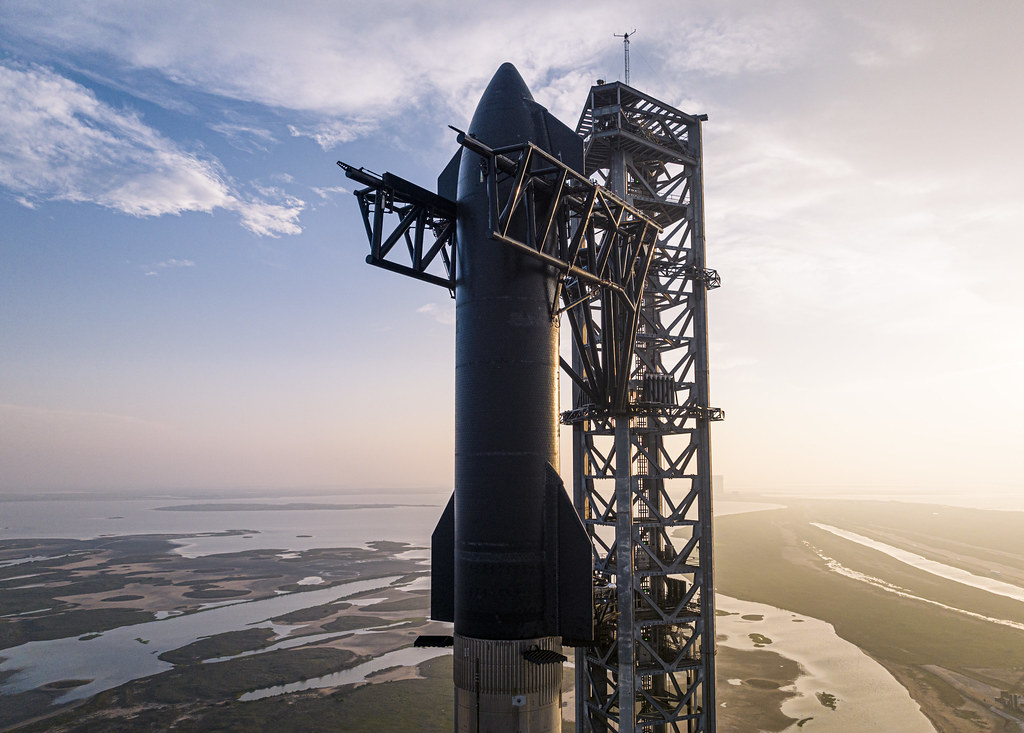
Near Pad 2, Starship would transition from its horizontal “bellyflop” descent by igniting three sea-level Raptor engines and flipping upright. It would then descend with one engine still operating as the tower’s mechanical arms closed around the spacecraft. Super Heavy would separately return to the launch site for its own tower catch.
SpaceX has previously returned Super Heavy to tower catches while sending Starship to ocean landings. Flight 15 would move the recovery problem to the complete system, including the stage that travels to orbit and returns with far more energy. The defining milestone will not be liftoff or even orbital insertion, but whether Starship passes every health check required to make the final approach over South Texas.
| More aerospace and engineering stories, right in your MSN feed. Follow AMI on MSN |
By David Whitaker — Associate editor for AMI’s aerospace and drone systems desk, translating flight systems, aircraft programs, spaceflight, and UAV developments into accessible technical stories.