Boston Dynamics Atlas Debut at CES Puts Factory Humanoids in Focus
Atlas’s production version is already being built, and Hyundai proposes to deploy it first in 2028 at its electric-vehicle plant near Savannah, Georgia. That juxtaposition hardware taking the place of stage choreography instructions to factory work instructions sums up the reason why the most recent Atlas reveal are more important to engineers than to the crowds at the demos.

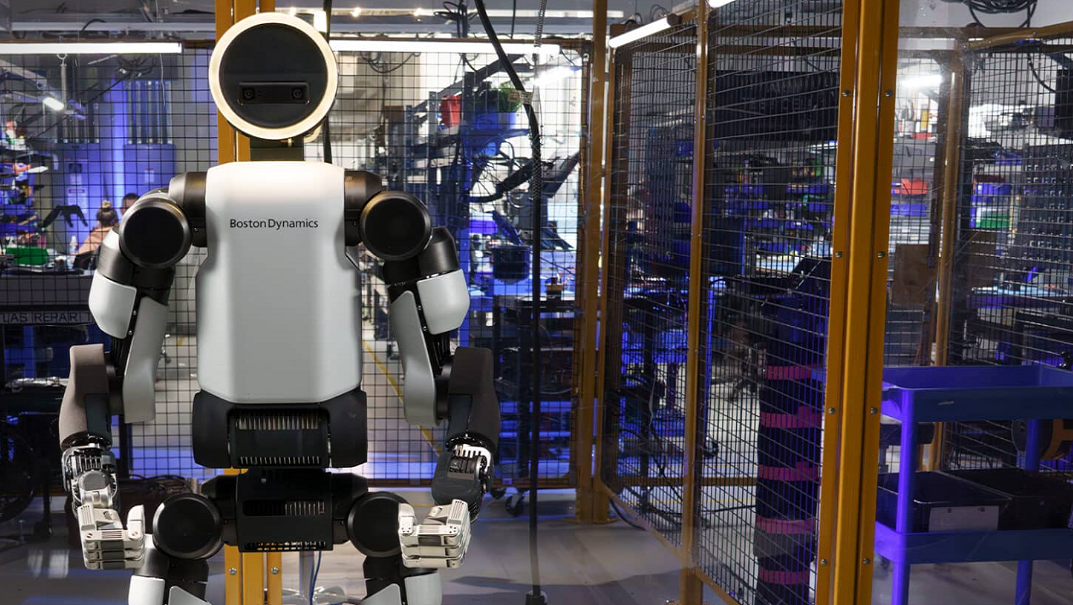
During the CES stage in Las Vegas, the humanoid prototype created by Boston Dynamics made a feat that no humanoid demos have ever dared attempt, it ran live on stage, minutes at a time and made no visible stumble. The robot started its slow, almost careless walk on the stage, and, “For the first time ever in public, please welcome Atlas to the stage,” Zachary Jackowski, who said: Please welcome Atlas to the stage, the first time she sees him in her life. By opting to depict a full-size biped in a ballroom, as opposed to an alternative highlight reel that was more tightly cut, the message to the robotics community that the company was confident in repeatability was implicit the most difficult currency in commercializing robotics.
The plan puts Atlas in a comfort zone: auto making where robots have already taken over the process of welding, painting, high-throughput pick-and-placement, but also where the human hand commands a host of variable movements. The initial mentioned task, parts sequencing, may seem banal until it is transformed into the engineering requirements: a small-footprint machine that travels between aisles of human size, mixed containers, and recovers against the small inconveniences that arise in actual plants. The Hyundai arc in the long-term outlook, which is planned to be started in 2028 with sequencing techniques, and then to 2030 with assembling components, is going to extend slowly as the long-term positive results in the safety and quality of the robot are proven.
The two facts that characterize “productizing” a humanoid in the year 2026 are sensing, and interaction. Boston Dynamics has also focused on the fact that Atlanta requires more than athletic motion to be of use in the presence of people. The director of Atlas behavior of the company Alberto Rodriguez has positioned the objective as natural human interaction, which cannot be separated with safety when a system is able to utilize large forces to arm length.
The Atlas displaying at CES is said to have 56 degrees of freedom, human-scale hands with sensory touch and is capable of lifting 110 pounds. Even hardware is grounded in the safety narrative: Atlas is said to have 360-degree vision to be able to see people around it, it is not designed to perform isolated maneuvers, but to move back and forth inside a factory. Claims of operating environment are important, as well, since factories contain loading docks, seasonal temperature changes and dust and spray exposure; Atlas has been said to work in the -20°C to 40°C in industries.
The center of gravity however, is software. Hyundai declared a collaboration whereby the AI foundation models of Google DeepMind will be incorporated with Atlas as a pilot project to increasing the work on “robot foundation models.” Carolina Parada stated that we built our Gemini Robotics models to introduce AI to the real physical world, which refers to the cooperation to multimodal systems designed to perceive, reason, and act on various robot bodies. The practical implementation in the case of Boston Dynamics is less about the individual model, but a reduction in the time gap between “this robot can do it once” to this robot can do it all shift, across the fleet.
An internal process of transforming deployment into a data pipeline has also been described by Hyundai: a new Robot Metaplant Application Center (RMAC) in the U.S. which aims at training robots on validated movements-lifts, turns, and handling patterns-then returning the resulting training data to continued improvement. The latter is a general trend in the industry: robots are becoming both products and ongoing learning systems that are altering the way integrators consider commissioning and versioning, as well as updating and re-certifying.
The safety standards in the workplace are also heading in the same direction. ISO has initiated a multi-year initiative to humanoid guidance, such as the proposed ISO 25785-1, to cover risk assessment and human-robot collaboration protocols. The humanoids make traditional safety assumptions more complicated in that they travel through human paths and have loads at human torso height, and may reposition rapidly as fixed-base industrial arms cannot. The standards effort is an recognition that the concept of “fenceless guarding” and mobile manipulation needs a new vocabulary as compared to the old robot cells.
The Atlas stage walk is barely a footnote in that respect. More importantly, the fact that Boston Dynamics and Hyundai are discussing in volumes of production and the rhythm of operations rather than prototype indicates the more consequential message. Hyundai has outlined aspirations of producing 30,000 humanoids per year by 2028, which again is only realistic with discipline in the supply-chain, test infrastructure, and service plans that are more akin to automotive thought than to research laboratory tradition.
The humanoid market is already filled with announcements of humanoids, yet the public demos are infrequent exactly due to the fact that the masses will not tolerate the robots trembling out of indecisive behavior. The decision to utilize a live CES reveal meant that, in choosing a live CES reveal, Boston Dynamics put reliability and human-facing behavior on a similar stage as locomotion. In case Atlas manages to achieve parts sequencing and initial assembly assistance, it is not due to its resemblance to a person. It will achieve the fact that the whole stack, consisting of actuation, sensing, fleet learning, and safety case, is resilient to daily variability of the factory, and does not transform every failure into a human action.