Artemis II TLI Burn Validates Orion’s Deep-Space Mission Design
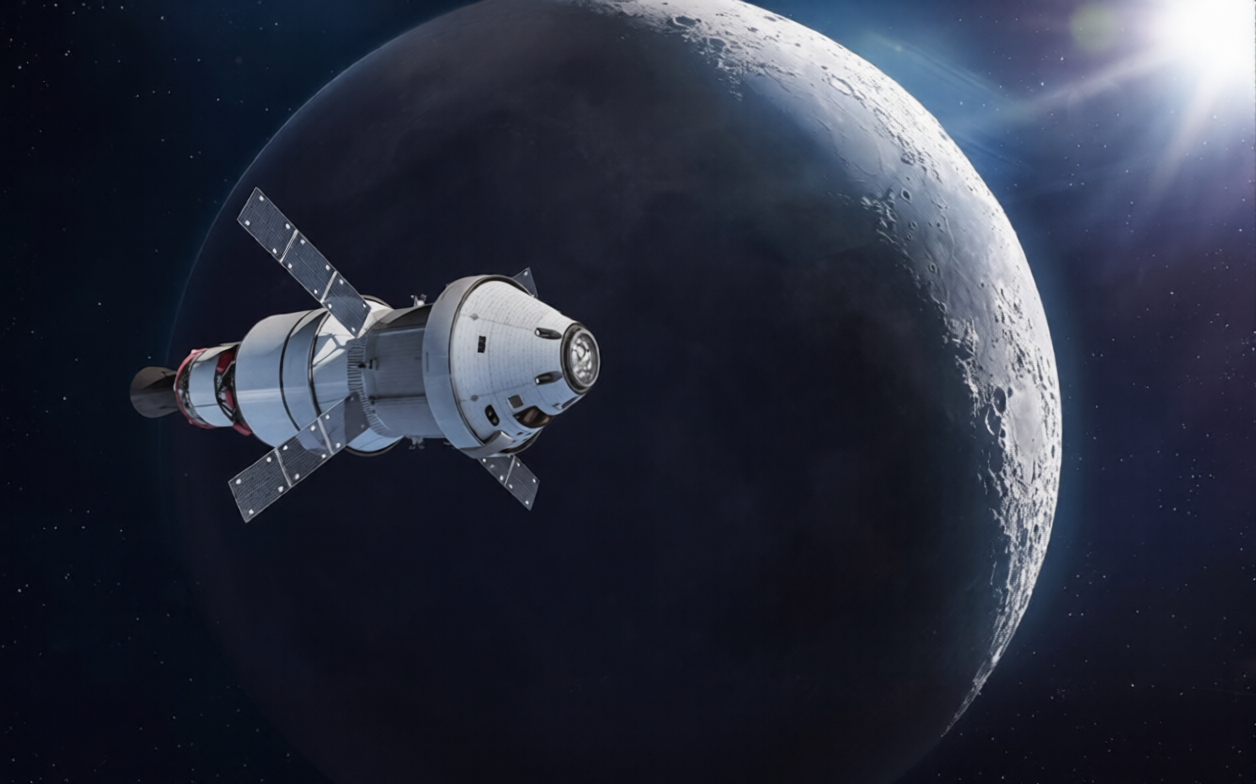
It was when Orion executed its translunar injection burn just before 8 p.m. ET on April 2 that Artemis II cleared its crucial technical hurdle. While launching puts a spacecraft into space, TLI transforms it into a bona fide mission architecture test flight. Orion launched to space atop NASA’s super heavy-lift Space Launch System from Kennedy Space Center in Florida at 6:35 p.m. ET on April 1, 2026, and within just 23 hours the flight controllers gave the green light for the burn. The roughly six-minute-long burn powered up the spacecraft to reach escape velocity required for it to embark on a three-day journey toward the moon, accelerating it fast enough to break free from the gravitational pull of our planet. NASA has identified it as the single most critical engine firing of the entire 10-day test flight.

Why? Because Artemis II isn’t simply a manned circumlunar trip. The mission is a true systems test of NASA’s rocket, the Orion spacecraft and the ground teams controlling it as an integrated system. The successful execution of the TLI burn is a sign of more than proper propulsion performance it’s an affirmation of timing, navigation, guidance, the ability to communicate effectively from mission control to the spacecraft itself and a sign of the crew’s readiness to execute such maneuvers in a deep-space environment.
It is the truth that we are re-entering at the moment we do the TLI, Christina Koch emphasized ahead of the mission. That encapsulates perfectly why the event is considered the key moment of the test flight in many ways. After all, once Orion embarks on its outbound journey, the mission enters cislunar space for a demonstration of the mission architecture and operations that NASA will continue using for future trips beyond low-Earth orbit (LEO).
And the orbit itself plays a major role in that demonstration. As part of Artemis II, Orion performs what is known as a free-return orbit, circling some quarter-million miles away from Earth, making a fly-by past the moon and returning using gravity assist maneuvers provided by the satellite. Lakiesha Hawkins explained that this technique has a long history dating back to Apollo 8 and 13.
From an engineering perspective, a free-return orbit makes perfect sense for the testing purposes. Unlike other approaches, this mission design allows NASA to minimize the reliance on major propulsion events to correct the course of the spacecraft. And the lack of a need to perform them successfully is a clear signal that Orion has been placed safely in the correct position, allowing NASA to fine-tune rather than recover its flight path down the line. In case of a first crewed Orion mission beyond LEO, that difference matters a great deal.
The early flight phase provided additional insight into how Orion performs as an operational spacecraft beyond simple transportation duties. The four-astronaut crew onboard (Reid Wiseman, Victor Glover, Jeremy Hansen, and Christina Koch) performed a piloting exercise with the spacecraft navigating around the jettisoned propulsion system. That maneuver’s purpose is to assess Orion’s manual piloting capabilities, a necessary feature to have when performing proximity operations in space.
While such maneuvers may not receive as much media attention as propulsion burns, they are nonetheless extremely important for future missions. NASA expects to rely on manual flight capability in a situation where astronauts will have to dock with lunar landers in orbit or land on the surface, thus necessitating a good understanding of vehicle’s handling and control capabilities.
Some initial problems that were encountered are more routine in nature, although still related to spacecraft preparation. The crew had trouble keeping the cabin at a desired temperature level and briefly woke up due to a planned engine firing used to fine-tune Orion’s orbit ahead of its final TLI burn. Neither problem is catastrophic in any respect, but these incidents do show one of the reasons why test flights happen in the first place to assess vehicle’s performance and crew procedures under conditions as close to mission operations as possible.
Finally, Artemis II became the first crewed mission in 54 years that went beyond LEO and back. That milestone, while certainly important in its own right, is only a minor detail when considering the more substantial lessons learned. It shows NASA how well Orion performs in the environment it was designed for as a fully integrated system of propulsion, navigation, crew training and operations, and free-return mission design. If NASA plans to further utilize Orion’s mission capabilities to conduct increasingly complex operations, the test flight is the ideal environment in which to prove that they actually work.
By David Whitaker — Associate editor for AMI’s aerospace and drone systems desk, translating flight systems, aircraft programs, spaceflight, and UAV developments into accessible technical stories.