Army Evaluates CF3D for Repeatable Missile Composite Production
A new Continuous Composites program for the US Army is trying to answer a manufacturing question much more significant than any prototype component: Can continuous-fiber additive manufacturing provide missile structures with the yield, throughput, and repeatability required by defense programs?
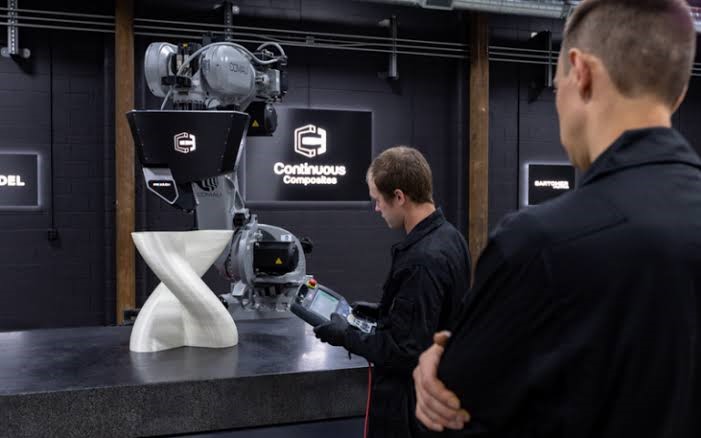
The company signed a multi-year contract with the US Army DEVCOM Aviation and Missile Center to explore the capabilities of their CF3D process to fabricate parts used in existing and upcoming missile configurations. The development is conducted in collaboration with the Manufacturing Technology program of the Army and coordinated by America Makes, with all activities concentrated around the Precision Strike Missile architecture.
The critical aspect is not the fact that yet another additive process is going to be explored for defense purposes. The actual significance of this effort lies in the emphasis made by the US Army on production discipline reduction of variability, improvement of yield, and creation of a scalable production process for parts that are challenging to manufacture consistently in conventional aerospace manufacturing environment.
It is quite a known problem in manufacturing of composite structures. Components such as nose cones, fins, leading edges, and bulkheads are particularly unforgiving when it comes to manufacturing. These parts pose a combination of tough mechanical requirements along with problematic geometries and material and process controls that contribute to generation of scrap and rework, causing variable cycle times. As far as missile manufacturing is concerned, the result is industrial bottleneck.
The CF3D process is going to be explored precisely as one of the ways to address this challenge as the nature of continuous fiber additive manufacturing represents a totally different process and design approach compared to the conventional layup or other composite approaches. The particular importance of the project is associated with the utilization of advanced materials and fiber-steered design, the latter is what makes the US Army interested in the project.
And it is precisely the last mentioned aspect that makes the difference between success or failure for many advanced manufacturing projects. A process can create a good demonstration article, but fail the even tougher test of producing parts reliably in quantities because of inconsistency of machine performance, material quality, inspection flows, and qualification issues. Now the defense manufacturing efforts seem to be aimed exactly at addressing this challenge of translating technical feasibility into producible solutions.
This particular program is just one of the elements of the wider qualification push. America Makes and the National Center for Defense Manufacturing and Machining initiated the AACAMS project that is devoted to creating roadmaps for scaling continuous fiber additive manufacturing for use in Department of Defense programs. In parallel, DEVCOM AvMC is also involved in another effort related to Velo3D and Raytheon Technologies to develop a scalable and repeatable process of laser powder bed fusion processing for Aluminum CP1. Different material systems, different process mechanics, but the same industrial task qualification and repeatability of the process output rather than isolated examples of additive success.
It is a correct frame of mind for US manufacturers and program managers interested in the progress in this field. The bottleneck is no longer in the ability of additive manufacturing to produce complex geometries. It is in the stability of the process window, maturity of quality controls, and resilience of the supply chain that would allow addressing the demands for real procurement volumes.
Continuous fiber additive manufacturing poses an additional challenge in terms of materials. The structures made of long fibers (carbon, fiberglass) and polymer matrix are strong and light, but only if the deposition, consolidation, and path controls are well-managed. Any scalable process for fabrication of missile structures should demonstrate this consistency of controls.
CEO of Continuous Composites, Steve Starner, said that the company is focusing on “some of the toughest challenges related to high-performance and high-temperature materials.” Also, he stated that the aim is to reduce program risk, improve system capabilities and prepare customers for scalable future production aligned with Department of Defense priorities.
These statements are consistent with the goals declared by the US Army. In case of structures such as fins, leading edges, and bulkheads, the issue is not only the structural efficiency. It is the ability of the process to reliably produce those parts at acceptable cost efficiency and accelerated time frame while maintaining mechanical properties. This is the problem of manufacturing readiness before anything else.
For the US industrial base, this is the valuable signal coming from the program. If CF3D proves itself capable of producing missile structures repeatedly, then it would be one more step towards the transition of additive manufacturing from capability demonstration to qualified, scalable output. And in case of defense manufacturing, this transition is the place where real engineering value is being won or lost.
By Edward Collins — Senior editor for AMI’s performance systems and mechanical design coverage, focused on powertrains, drivetrain systems, manufacturing precision, materials, and high-performance engineering.