Pratt & Whitney F135 Case Project Pushes Large-Scale Metal Additive
Pratt & Whitney and GKN Aerospace have signed a technology development agreement to test a difficult manufacturing question with real propulsion relevance: can a large structural engine case for the F135 be built additively at full scale, while still matching the current design closely enough to remain compatible, interchangeable, and certifiable?

That is the core technical point here. This is not a clean-sheet engine redesign and it is not a small bracket-level additive trial. The programme is aimed at a large engine case structure for the F135, the engine that powers the F-35, and the target is a full-scale demonstrator rather than a reduced test article. For U.S. readers, that makes the effort notable because it touches a major Pratt & Whitney propulsion programme where manufacturing repeatability, dimensional control, and certification discipline matter as much as raw build capability.
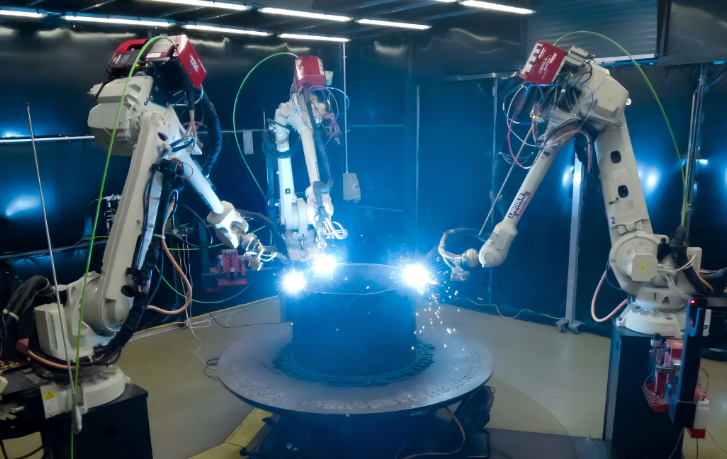
The development work will be led from GKN Aerospace’s facility in Kongsberg, Norway, with support from the Norwegian Defence Materiel Agency. The manufacturing route selected is GKN’s laser-directed energy deposition with wire process. In practical terms, that puts the project in the category of large-format metal additive manufacturing intended for structural hardware, not just low-mass secondary parts. GKN says the process has been developed and matured over several years, which matters because large aero-engine structures impose a very different burden on process stability than smaller additive components.
The engineering challenge is straightforward to describe and hard to execute. An engine case is a structural part, so the manufacturing method has to deliver the right geometry, consistency, and material performance at a size where distortion control, deposition quality, and finishing precision become central issues. The stated ambition is to produce a full-scale component while maintaining compatibility and interchangeability with the current engine design. That requirement is critical. If a new manufacturing route produces a part that only works with a revised architecture, the industrial value changes completely. If it can drop into the existing design envelope, the case for sustainment, spares, and future production becomes much stronger.
That is also why certification sits at the center of the programme. Additive manufacturing in aerospace has already moved into selected applications, but large high-performance engine structures remain a tougher proving ground. A component at this scale has to show more than basic manufacturability. It has to support a path to qualification and certification under the same design constraints as conventionally produced hardware. The timeline attached to the programme reflects that reality: a first demonstrator component is expected by 2027, with product certification targeted by the end of 2028.
GKN describes the initiative as a significant step in applying additive manufacturing to large-scale, high-performance aero-engine structures, and says the component is expected to be among the first of its kind at this scale in military engine applications. That framing is credible because scale changes the economics and the engineering simultaneously. As parts get larger, traditional manufacturing can involve long lead-time material routes and substantial machining. Additive methods, if they can meet the same design and certification requirements, open a different production model.
The potential benefits being assessed are the ones manufacturing engineers will recognize immediately: supply-chain resilience, shorter lead times, lower material usage, and higher overall efficiency. None of those gains should be treated as automatic. They have to be proven against actual process capability, post-processing demands, inspection requirements, and certification evidence. But for a U.S.-linked engine programme, even the possibility is important. A qualified large-format additive route could broaden sourcing options and reduce dependence on slower conventional pathways for certain structural parts.
Sébastien Aknouche, senior vice president at GKN Aerospace, said the collaboration brings together industrial capability and advanced manufacturing expertise, adding that it reflects an ambition to further develop and industrialise additive technologies for demanding aerospace applications. Chris Johnson, vice president of the F135 programme at Pratt & Whitney, said the agreement supports technologies tied to the long-term needs of the programme and contributes to future engine readiness.
The deeper significance is not that additive manufacturing is new. It is that this project is testing whether a large structural propulsion component can be built additively without giving up interchangeability or a viable certification path. If that can be demonstrated on an F135 engine case, the result is more than a one-off part. It becomes evidence that large-format metal additive manufacturing may be ready to move from promising process to certified industrial tool in high-consequence aerospace production.
By Edward Collins — Senior editor for AMI’s performance systems and mechanical design coverage, focused on powertrains, drivetrain systems, manufacturing precision, materials, and high-performance engineering.