


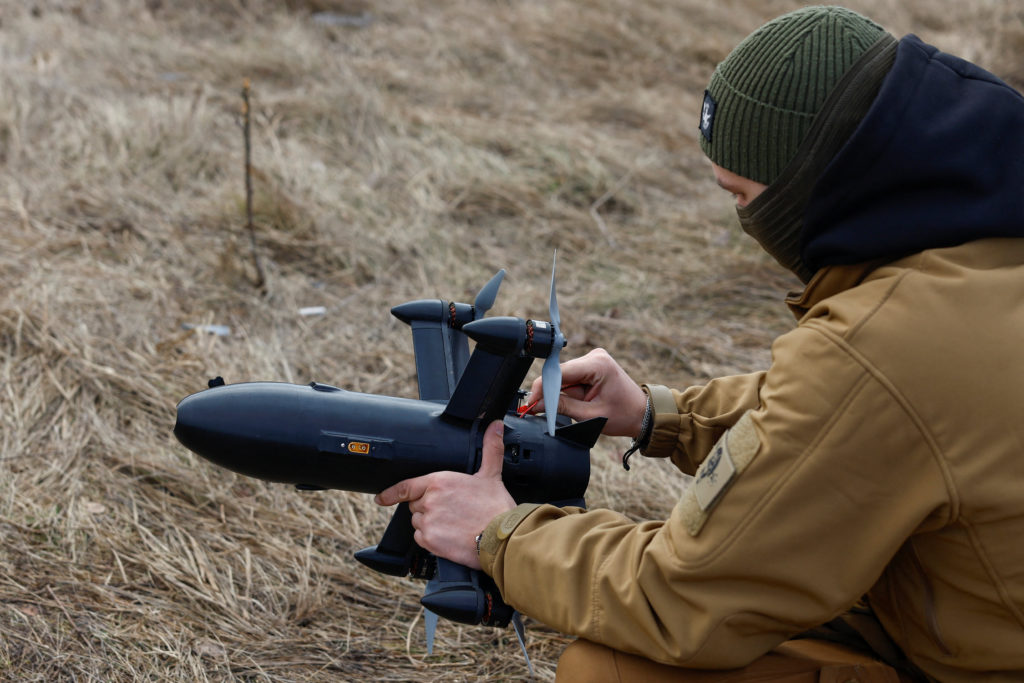
U.S. and Ukraine Sign Agreement for American Testing of Ukrainian Combat Drones
The United States and Ukraine signed an agreement allowing Ukrainian combat drones to be sent to the U.S. for military testing and evaluation, Ukraine’s ambassador to the United States told NBC News in a report published July 30, 2026. The ambassador said the agreement was signed the previous week. Its confirmed effect is to give the U.S. military a formal route to examine Ukrainian systems; it does not establish that the Pentagon will purchase, produce or deploy them.

The arrangement matters because it moves cooperation from broad interest toward direct access to hardware developed during an active war. Testing can give American evaluators firsthand information that cannot be established through demonstrations, specifications or operational accounts alone. It can also help the military determine whether particular designs are relevant to U.S. modernization requirements without committing to acquisition.
The framework reportedly covers more than aerial vehicles. RFE/RL described the signed document as a bilateral statement of intent expected to create a pathway for Ukrainian land, air and maritime drones to be exported to the United States for testing and evaluation. That account also said the U.S. military could request specific platforms for assessment rather than operational deployment.
That distinction is central. A statement of intent can establish access and cooperation while leaving contracts, funding and production decisions for later. No drone models, manufacturers, U.S. test organizations, evaluation criteria, delivery schedule or program cost have been identified. The agreement’s full text also has not been made public in the available reporting.
Testing appears to predate the newest agreement
The July 30 disclosure adds a formal bilateral framework to activity that Ukrainian officials had described earlier in the month. On July 10, Ukrainian President Volodymyr Zelenskyy said the United States was already receiving and testing Ukrainian-made aerial and maritime drones. Defense News reported his statement that testing was underway and that Ukraine had received positive feedback.
Those earlier statements do not identify which systems were assessed or prove that they met a defined U.S. requirement. The newly reported agreement is therefore best understood as a formal pathway that may organize or expand testing, not as the beginning of all evaluation activity and not as approval for a purchase.
For the U.S. military, the value of access will depend on how evaluations are structured. A complete drone assessment concerns the system around the aircraft as well as the airframe itself: control equipment, software, communications, supporting hardware, maintenance needs and logistics all affect whether a design can be used reliably. The Pentagon has applied that system-level approach in its own drone initiatives, where evaluations can consider durable components, ground-control equipment and support assets alongside flight performance.
However, no such test plan has been disclosed for the Ukrainian systems. It remains unknown whether American evaluators will emphasize flight characteristics, autonomy, communications, maintainability, manufacturing repeatability, operator workload or another set of requirements. Without named platforms and criteria, comparisons with existing U.S. drones would be premature.
Evaluation is only the first acquisition gate
Even a technically successful evaluation would not automatically produce a procurement program. A foreign-developed drone would still have to fit a defined military need and satisfy the applicable security, supply-chain, software, integration and support requirements. A system optimized for rapid wartime iteration may also require changes before it can enter a standardized American acquisition and sustainment structure.
Production presents a separate question. RFE/RL reported that broader cooperation could eventually include manufacturing Ukrainian-designed drones in the United States, but the signed statement is not a production contract. There is no confirmed decision on domestic assembly, licensing, quantities, participating factories or which government would fund any follow-on work.
The agreement’s immediate importance is consequently narrower and more technically useful than the rhetoric surrounding international drone partnerships can suggest. It gives U.S. military organizations a route to put Ukrainian systems through American evaluation rather than relying solely on descriptions of wartime use. What follows will depend on disclosed test results, documented requirements and separate procurement decisions. For now, access to the hardware is confirmed; adoption is not.
By Stephen Wallace — Editor for AMI’s aerospace integration and unmanned mobility coverage, focused on drone manufacturing, VTOL systems, autonomous networks, and air-ground mobility links.


