Cygnus X-3 Accelerates Particles to 30 Times Prior Milky Way Limit
Thirty quadrillion electron volts is the number that turns Cygnus X-3 from an already unusual binary star system into an extreme cosmic accelerator. Observations by China’s Large High Altitude Air Shower Observatory indicate that particles inside the system reach at least 30 peta-electron volts, or 30 PeV about 30 times a previously cited 1 PeV limit for Milky Way accelerators.

The LHAASO team reported the result in National Science Review, according to an August 2026 update from the Chinese Academy of Sciences. The measurement does not mean a 30 PeV piece of matter flew directly into the detector. LHAASO recorded ultra-high-energy gamma rays, a form of light, and researchers used their energy, direction, spectrum and changing intensity to infer that matter near Cygnus X-3 had been accelerated to tens of PeV.
A compact system with a powerful jet
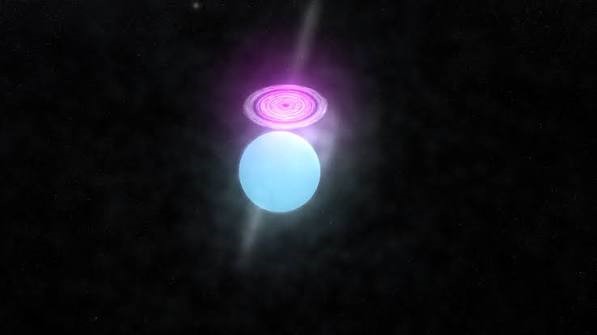
Cygnus X-3 lies nearly 30,000 light-years away in the constellation Cygnus. It contains a compact object either a black hole or neutron star orbiting a massive companion. The compact object draws material from its companion’s intense stellar wind, while part of that inflowing material and energy feeds powerful jets.
That arrangement supplies the basic ingredients of a cosmic accelerator: fast plasma, magnetic fields and a concentrated flow of energy. In the researchers’ model, protons accelerated in the inner jet interact with the dense field of photons around the binary. Those interactions can produce gamma rays carrying a fraction of the original protons’ energy. Producing the observed light would require the protons to reach tens of PeV, supporting the team’s estimate of at least 30 PeV.
The distinction matters because LHAASO detects the secondary gamma-ray signature, not the accelerated protons at their source. The detected gamma rays reached energies of several PeV; two events were reconstructed at 3.73 plus or minus 0.41 PeV and 3.08 plus or minus 0.34 PeV. The much larger 30 PeV figure describes the inferred energy of the particles needed to generate that light.
How an observatory detects light it cannot see directly
LHAASO sits about 4,410 meters above sea level in China’s Sichuan Province and covers roughly 1.36 square kilometers. Gamma rays at these energies do not reach a conventional camera intact. When one strikes Earth’s atmosphere, it initiates a cascade of secondary particles called an extensive air shower.
Surface and underground detectors sample that shower. One important discriminator is its muon content: showers initiated by ordinary charged cosmic rays generally contain more muons than gamma-ray showers. Selecting comparatively “muon-poor” events helps LHAASO reject the much larger cosmic-ray background and reconstruct a gamma ray’s arrival direction and energy.
The Cygnus X-3 signal was detected at approximately 10 standard deviations overall. It also changed on month-long timescales, with the variability reported at 8.6 standard deviations. That changing output coincided with a high state observed at lower gamma-ray energies by the space-based Fermi Large Area Telescope.
Researchers additionally found 3.2-standard-deviation evidence that the ultra-high-energy signal follows Cygnus X-3’s 4.8-hour orbital cycle. That is suggestive rather than definitive, but the time variation is important: a distant, unrelated source would be less likely to reproduce behavior tied to the compact binary’s activity and orbital period.
The 30-fold comparison needs a boundary
The earlier 1 PeV figure was a cited theoretical ceiling for familiar Galactic acceleration environments, including stellar explosions and regions around black holes. Cygnus X-3 does not invalidate every model carrying that scale. Instead, the observation indicates that a compact, jet-producing binary can operate well beyond it under the right magnetic, geometric and radiation-field conditions.
The proposed proton mechanism also remains an interpretation rather than a directly sampled process. The spectrum and variability can be naturally explained by proton-photon interactions in the inner jet, while the paper argues that rapid energy losses make an electron-based explanation unrealistic for the PeV radiation. Alternative production locations or interaction channels have not been eliminated completely.
Further observations will need to strengthen the tentative orbital modulation, track additional high-energy events and test whether the spectrum repeatedly hardens near 1 PeV during active periods. For now, gamma rays that spent nearly 30,000 years crossing the galaxy point back to a binary system compact enough to complete an orbit in just 4.8 hours and energetic enough to push matter toward at least 30 PeV.
By David Whitaker — Associate editor for AMI’s aerospace and drone systems desk, translating flight systems, aircraft programs, spaceflight, and UAV developments into accessible technical stories.