NASA’s Perseverance Finds 245-Foot Mars Rock Record of Repeated Asteroid Impacts
A 245-foot-thick stack of rock on Mars may preserve a sequence of asteroid impacts from nearly 4 billion years ago. After examining the formation with NASA’s Perseverance rover, researchers concluded that its changing layers were probably deposited by multiple impacts rather than one isolated collision.
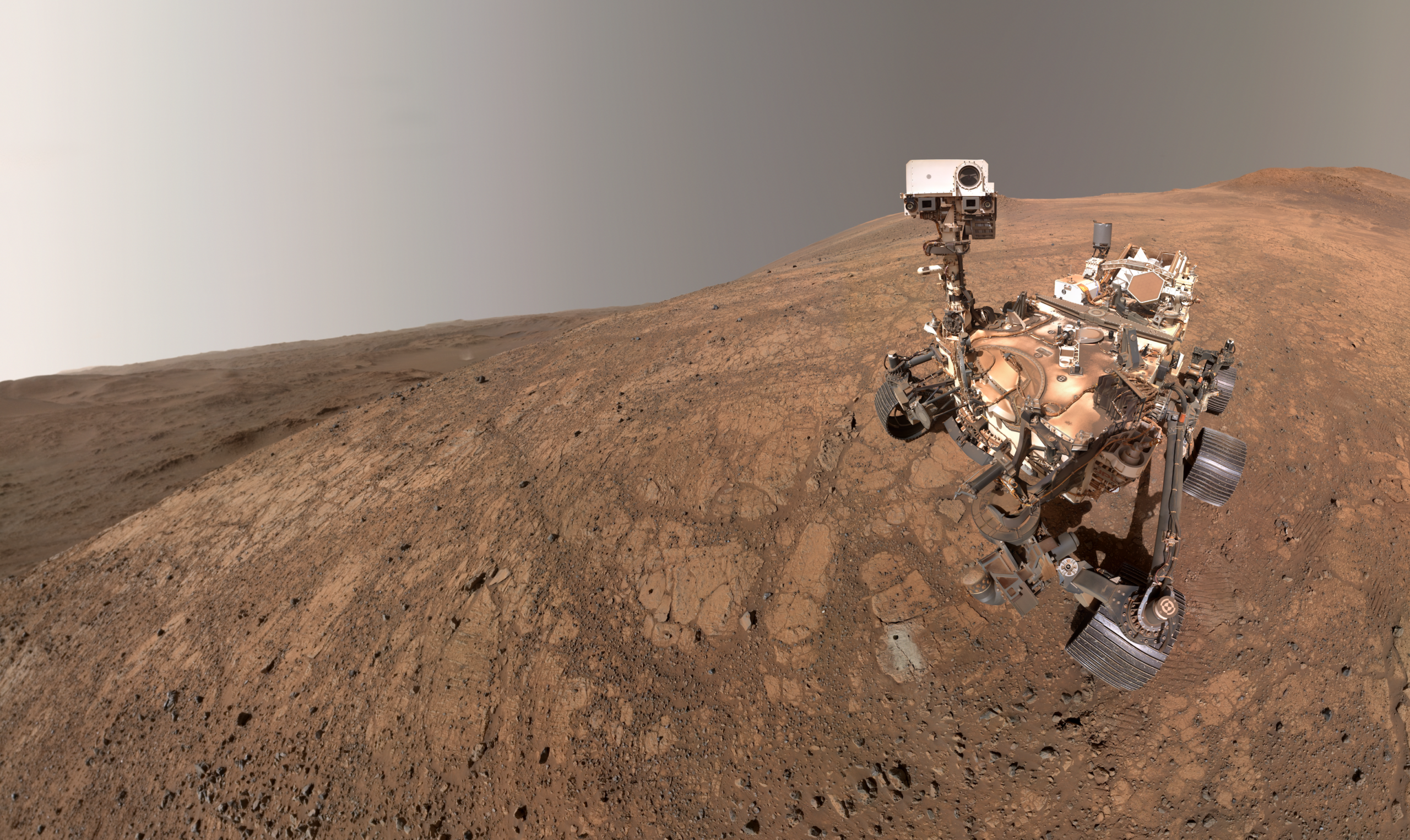
The formation described by NASA’s Jet Propulsion Laboratory is called the Broom Point member. Perseverance studied it after descending the western rim of Jezero Crater in early 2025. Likely more than 3.9 billion years old, it ranks among the oldest terrain directly examined by a Mars rover.
The investigation began with repetition. Perseverance’s instruments identified six distinct rock types, including breccias made from angular fragments and fine-grained layers of pulverized dust. Those materials do not occur just once; similar combinations return at different levels throughout the approximately 75-meter exposure.
That recurring structure matters because a single impact would be less likely to produce a long succession of changing debris layers. Instead, the variations between coarse fragments, fine fallout and glassy particles indicate that impacts of different sizes and at different distances repeatedly delivered material to the same region.
Molten fragments strengthen the impact interpretation
Some angular fragments contain cavities interpreted as voids left by gas bubbles when molten material cooled. Perseverance also found numerous tiny, dark, glassy beads distributed through the layers. Volcanic activity can make similar droplets, but researchers attribute these beads primarily to impacts because they occur in such high abundance.
Together, the molten fragments and beads provide a mechanism for constructing the formation. An impact can eject melted rock, shattered crust and fine dust over a broad area. Material from a nearby, smaller collision would not necessarily resemble fallout from a larger, more distant event. A changing series of such deposits could therefore produce the six rock types and recurring layers observed at Broom Point.
“The different rock layers are a record of variable-sized impacts occurring at different distances from where this rock sequence was accumulating,” said Alex Jones, an Imperial College London doctoral student and the paper’s lead author. “Some large impacts took place very far away, some small impacts nearby. Their debris all ended up landing here, constructing this thick section of rock.”
There are still unresolved parts of that reconstruction. Several deposits resemble fast, ground-hugging debris flows. Comparable flows on Earth can form when molten rock encounters water or ice, rapidly generating steam. The Martian layers therefore may record an interaction with water or ice, but the observations do not establish how much was present.
Some layers were also folded or disturbed while still soft. That suggests additional material arrived before earlier deposits had fully hardened, adding another clue that Broom Point accumulated through multiple episodes rather than a single event.
Nearly vertical beds point to later disruption
Deposition was only the first stage. Many Broom Point beds now tilt by more than 80 degrees, leaving layers that were likely deposited closer to horizontal standing nearly vertical. Scientists suspect the approximately 1,200-mile-wide Isidis Basin impact first overturned and tilted the rocks. A later impact formed the roughly 28-mile-wide Jezero Crater, potentially fracturing and uplifting the already disturbed formation until erosion exposed it.
That proposed Isidis-to-Jezero sequence has not been conclusively established. It is a working interpretation intended to account for both the extreme tilt and Broom Point’s position near Jezero. The rocks clearly record major disruption, but assigning each deformation stage to a specific impact requires tighter age constraints.
Perseverance has already collected the most consequential pieces of the investigation: two cores named Bell Island and Main River. Rover instruments can establish composition, texture and stratigraphic relationships in place, but laboratory equipment on Earth could perform more precise dating. If a future mission returns the cores, scientists could test when the deposits formed and how frequently impacts were occurring on early Mars.
That possibility extends the value of two small samples beyond Jezero Crater. Earth’s plate tectonics has recycled or heavily altered much of the crust from the same ancient period, while Mars lacks comparable global crustal recycling. Broom Point may therefore preserve a chapter of early planetary bombardment that Earth can no longer show directly.
For now, the rover has supplied a compelling sequence: six rock types, recurring breccias and dust, once-molten fragments, abundant glassy beads and layers disrupted both during and after deposition. Bell Island and Main River hold the prospect of converting that relative sequence into a dated record but only if those cached cores eventually reach an Earth laboratory.
By David Whitaker — Associate editor for AMI’s aerospace and drone systems desk, translating flight systems, aircraft programs, spaceflight, and UAV developments into accessible technical stories.