Eve’s Rear Propeller Starts Transition, but Full Wing-Borne Flight Remains Ahead
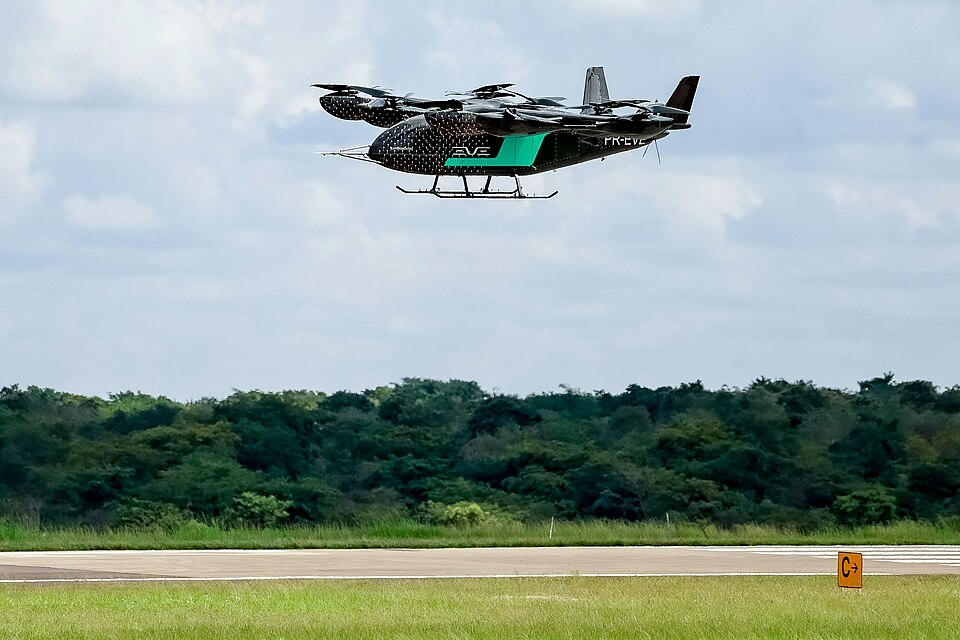
Eve Air Mobility has activated its electric aircraft’s rear propeller in the air for the first time, beginning the prototype’s progression from vertical lift toward forward, wing-borne flight. The partial transition flight announced August 3 demonstrated airborne operation of the pusher propulsion system, but it did not complete the transition to airplane-like flight.

That distinction defines the milestone. Eve’s engineering prototype stabilized at 27 knots and reached a maximum ground speed of 30 knots while the rear pusher operated at up to 1,200 RPM. The aircraft flew for 3 minutes and 9 seconds, traveled approximately 0.84 nautical miles and reached a maximum altitude of 90 feet above ground level.
These are deliberately limited test conditions, not a demonstration of the aircraft’s intended operating envelope. The flight established that Eve could bring the pusher into the propulsion and control sequence while airborne and gather data at the opening edge of transition. The company has not disclosed the lift-to-cruise handoff criteria, detailed control laws or performance threshold that would constitute a complete transition.
Why pusher activation matters
An electric vertical takeoff and landing aircraft must do more than hover and accelerate independently. Its propulsion, flight controls, structure and aerodynamic surfaces have to work together as the source of lift begins shifting toward the wing. That changing balance makes transition testing a central integration task rather than a simple speed run.
On Eve’s configuration, the rear propeller supplies forward thrust while the aircraft advances out of the vertical-lift regime. As airspeed rises, the wing is expected to assume a greater share of the lifting work. The first airborne pusher activation therefore checks a basic design premise: the aircraft can introduce forward propulsion during flight and remain within the controlled test conditions established for this early envelope point.
The test does not by itself establish performance across higher speeds or more demanding combinations of thrust, aerodynamic loading and control authority. Eve said its flight-test engineering team is continuing structural and loads analyses. Those analyses matter because each expansion point must account for how changing airflow and propulsion settings load the airframe, not merely whether the aircraft can reach a higher indicated speed.
Marcelo Basile, Eve’s head of engineering, said the collected data will support continued envelope expansion toward higher speeds and more complex transition testing. Over the coming weeks, the company expects to conduct additional flights with the pusher activated while progressively raising the prototype’s airspeed envelope.
Flight testing and certification remain separate hurdles
The partial transition also should not be read as confirmation of certification progress. Eve formalized its type-certificate application with Brazil’s National Civil Aviation Agency in February 2022. The company engaged the Federal Aviation Administration in 2023 for a concurrent validation process and applied in 2026 to begin European Union Aviation Safety Agency validation. Those regulatory tracks provide important U.S. and international context, but Eve has not linked this particular flight to completion of a certification requirement or disclosed a certification timeline.
For a powered-lift program, successful prototype flights produce engineering data; certification requires the applicant to show compliance against an agreed certification basis and accepted means of compliance. A developmental envelope point can contribute to that broader effort without being a certification test or regulatory approval in itself.
Eve also plans datalink evaluations after the flight-testing program. Those tests are intended to assess radio-link performance and support operations at speeds up to 50 knots. The company has not said that the prototype reached that speed during the partial transition flight the confirmed maximum ground speed was 30 knots or specified when the datalink work will begin.
The next consequential evidence will come from repeated pusher activations at progressively higher airspeeds, supported by structural and loads analysis. Until Eve documents the criteria and results for a complete handoff toward wing-supported flight, this remains what the measured flight demonstrated: the first controlled step into transition, not the transition’s completion.
By David Whitaker — Associate editor for AMI’s aerospace and drone systems desk, translating flight systems, aircraft programs, spaceflight, and UAV developments into accessible technical stories.