FAA Proposes 0.11-Pound-Per-Square-Foot Supersonic Noise Limit Over U.S. Land
Faster passenger flights over the continental United States could return only if aircraft developers solve the problem that helped exclude them in the first place: disruptive noise on the ground. The Federal Aviation Administration has proposed replacing the speed-based restriction on civilian supersonic flight over U.S. land with a noise-based standard, including a surface-pressure limit of 0.11 pound per square foot.

The June 2026 proposal would repeal the prohibition adopted in 1973 and shift the regulatory question from whether an aircraft exceeds the speed of sound to what people below actually experience. It is not a final rule, and the FAA aims to complete its planned standards by mid-2027. Until then, the existing restriction remains in place.
A limit changes what manufacturers must prove
A measurable surface threshold could open a certification pathway without guaranteeing that any particular aircraft or route will qualify. Manufacturers would need to demonstrate that their designs or operating methods reliably keep shock-wave effects within the prescribed limit not merely under favorable test conditions, but across the conditions relevant to proposed service.
That distinction is central because a conventional sonic boom is not ordinary engine noise. When pressure disturbances generated by supersonic flight combine into stronger shock waves, they can reach the ground as an explosion-like report. The proposed policy would make control of that pressure signature part of the practical basis for overland approval.
The change could benefit travelers if future aircraft cut journey times by half or more, as the FAA says supersonic service potentially could. Residents beneath routes, however, would bear the recurring noise consequence if the standard, measurement process or operating controls proved inadequate. Regulators therefore must weigh technological feasibility and economic reasonableness against community acceptability rather than treating speed alone as the public benefit.
Boom and NASA are pursuing different control methods
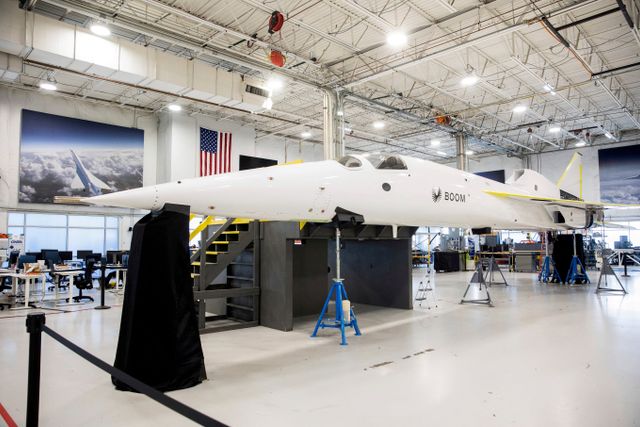
Boom Supersonic is developing an operational approach known as Mach cutoff. It uses aircraft altitude, speed, atmospheric conditions and navigation calculations to bend or refract shock waves upward before they reach the surface. Boom demonstrated the technique with its experimental XB-1 aircraft in early 2025 and plans to apply it to the proposed Overture airliner.
Mach cutoff potentially avoids designing an entire passenger aircraft around a low-boom shape, but its certification challenge is repeatability. Because the method depends partly on atmospheric conditions and precise flight management, an approval framework would need a credible way to establish when and where the aircraft can remain below the surface limit. Boom says Overture would have a quiet mode that automatically selects the fastest efficient speed without creating an audible boom, but that remains a company claim about a future aircraft.
NASA’s X-59 takes an airframe-centered approach. Its elongated shape is intended to distribute weaker, more evenly spaced shock waves along the aircraft instead of allowing them to merge into a concentrated boom. NASA expects the resulting sound on the ground to resemble a car door closing from roughly 20 feet away.
The X-59 first flew in late 2025 and subsequently completed three supersonic flights, reaching Mach 1.4. Those flights establish progress in the research program, not certification of a passenger airliner. NASA still plans to measure the aircraft’s sound and conduct community-response testing. The agency intends to provide data that could support possible International Civil Aviation Organization standards by 2031.
Boom CEO Blake Scholl has questioned whether NASA’s shaping approach can scale economically to an airliner, but that criticism is not an independently established finding. Conversely, the X-59’s expected quiet signature does not prove that a larger commercial aircraft can deliver the same result while meeting passenger-capacity and operating requirements. The two programs are addressing different parts of the problem: one emphasizes routing through a variable atmosphere, while the other alters how the aircraft creates and distributes its shock waves.
Community response remains a certification issue
Past testing shows why a technically measurable limit cannot be separated from human response. A 1964 Oklahoma City program exposed residents to 1,253 sonic booms over six months and generated about 12,400 complaints and damage claims. Yet a survey of 3,000 residents found that 73% said they could live with sonic booms. Those figures illustrate that tolerance can vary even when exposure is widespread, making frequency and perceived disturbance important alongside peak pressure.
The FAA proposal could remove a blanket regulatory barrier, but it does not settle which noise-control architecture will work at practical passenger-aircraft scale. That answer will depend on repeatable surface measurements, community testing and a certification process capable of accounting for both aircraft design and changing atmospheric conditions. The next decisive milestones are the FAA’s planned final standards and NASA’s ground-noise data the points at which quiet supersonic flight must move from a demonstrated possibility to a verifiable operating condition.
By Thomas Caldwell — AMI’s senior editor for mechanical and mobility engineering, covering vehicle electronics, systems integration, electrification, chassis systems, propulsion, and safety policy.