Ford Reportedly Plans First Four-Door Mustang, With Hybrid Power Under Study
The Ford Mustang’s two-door shape has remained central to its identity for decades. Ford is now reportedly considering the first production Mustang car with four doors, a change that could make the performance model more useful to families while testing how far the company can stretch one of its best-known names.
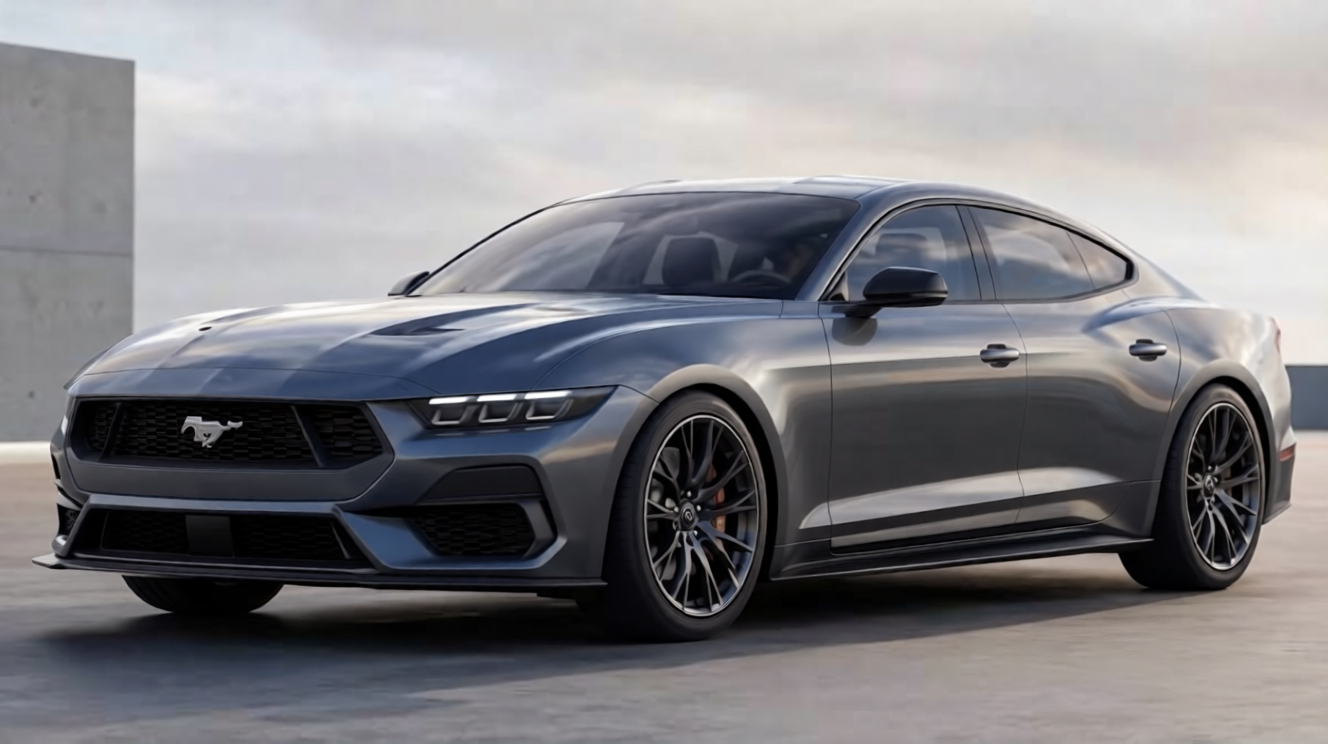
Ford showed dealers a proposed four-door Mustang at a recent meeting, according to accounts from people familiar with the presentation. The gasoline-powered car could reach showrooms before the end of the decade and may incorporate hybrid assistance. Ford has not announced the model or confirmed that it has received final production approval.
That distinction matters. Automakers routinely present future products to dealers and review vehicles internally well before committing to manufacturing specifications, investment and launch timing. Ford previously displayed a version of the four-door vehicle at an internal event in June, but product plans can still change or be canceled before production. Asked about the proposal, a Ford spokesperson said, We do not comment or speculate about future products.
Four doors create more than a styling change
People familiar with the dealer presentation described a vehicle resembling the current Mustang coupe with an additional pair of doors. If that basic concept survives development, Ford would need to preserve recognizable Mustang proportions while creating easier rear-seat access and more usable passenger space.
The packaging challenge extends beyond cutting two more openings into the body. A four-door design affects the body sides, roof structure, door apertures, seals and crash-load paths. It can also require a longer wheelbase or revised seating geometry, depending on Ford’s passenger-space target. None of those dimensions or structural decisions has been disclosed, so it is too early to determine how closely the model would share its underlying architecture with the current Mustang.
Added space could broaden the car’s appeal to buyers who want Mustang styling and performance but cannot comfortably use a conventional coupe. The current four-door Dodge Charger demonstrates the practical distinction: rear doors remove the need for passengers to climb behind folded front seats, while a larger passenger compartment can make a performance car viable as everyday transportation. That comparison does not establish the Ford’s final size, mass or layout, which remain unknown.
A hybrid V-8 remains a possibility, not a specification
Two people familiar with the proposed Mustang said hybrid power was under consideration, while one characterized it as a hybrid V-8. Ford has not confirmed either configuration. There is no disclosed information about the electric motor arrangement, battery, transmission, driven wheels, output, fuel economy or whether the system would require external charging.
A hybrid system could serve several engineering purposes. Electric assistance can supplement engine torque, recover some energy during deceleration and reduce fuel use under selected operating conditions. It can also add battery mass, cooling requirements, high-voltage safety hardware and control complexity. The actual balance would depend on whether Ford prioritizes efficiency, acceleration, all-wheel-drive capability or some combination of those goals.
Those choices would have direct effects on vehicle dynamics. A four-door body and electrified powertrain could increase mass compared with a conventional coupe, requiring corresponding work on springs, dampers, brakes, tires and stability controls to preserve the responses buyers associate with a Mustang. Without specifications or test data, no conclusion can yet be drawn about performance or efficiency.
Ford has a commercial reason to reconsider the formula
U.S. Mustang sales fell from more than 122,000 vehicles in 2015 to about 45,000 last year. Ford has also discussed returning to the sedan market if it can do so profitably after largely withdrawing from passenger cars other than the Mustang.
A four-door Mustang could address both issues by extending a familiar name into a more practical body style rather than establishing an entirely new sedan brand. Ford already applies the Mustang name to the separately counted Mach-E electric crossover, but a production four-door car would still be unprecedented for the badge; earlier sedan concepts and prototypes did not reach assembly lines.
The unresolved milestone is a formal Ford announcement. Until that happens, the four-door body, hybrid system and pre-2030 timing remain elements of a reported product plan not specifications customers can order. Production approval will determine whether the Mustang’s next expansion becomes a real family-friendly performance car or remains another design study.
By Thomas Caldwell — AMI’s senior editor for mechanical and mobility engineering, covering vehicle electronics, systems integration, electrification, chassis systems, propulsion, and safety policy.