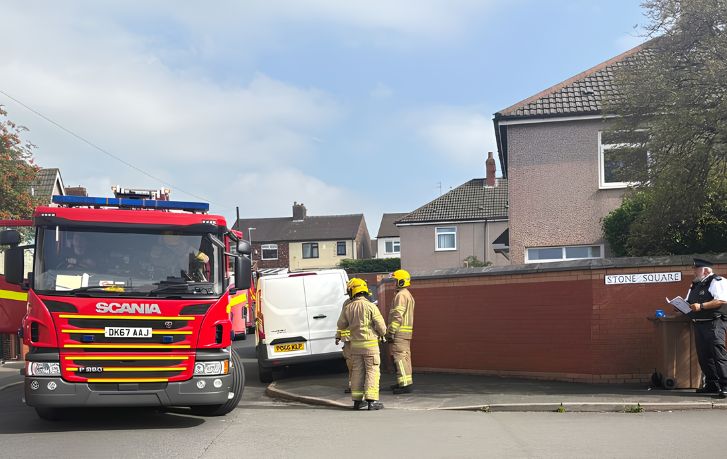
Charging E-Scooter Battery Caused Bootle Fire That Killed Mother, Three Children
A charging e-scooter battery caused the rapidly spreading house fire that killed a mother and three of her children in Bootle, investigators have determined. The Merseyside Fire and Rescue Service finding says an electrical event sent the lithium-ion battery into thermal runaway inside the Stone Square home during the early hours of September 22, 2026.
Elisha Brabin, 36, and her children Leo, 16, Ellis, eight, and Prudence, seven, died. Fire crews arrived at 3:45 a.m. and found the semi-detached house well alight. Six fire engines attended at the incident’s height, but the fire service said the speed and intensity of the fire prevented a different outcome.
How a battery failure escalates
Thermal runaway occurs when a lithium-ion cell generates heat faster than it can release it. Rising temperature can then drive further heating within the battery, producing an intense fire that spreads quickly. That feedback process is why a failing mobility battery can develop differently from many ordinary household ignition sources.
The investigation establishes that an electrical event caused the battery to enter thermal runaway. It does not identify a particular manufacturing defect, charger mismatch or owner action as the initiating fault. Those possibilities therefore should not be assigned to this case without a more specific finding.
The location and timing of charging are important because they determine whether occupants can detect a problem and still reach an exit. A scooter or e-bike positioned in a hallway or near a doorway can become both an ignition source and an obstruction. Charging while people sleep also delays recognition of warning signs and reduces the time available to respond.
Merseyside Fire and Rescue Service recorded 150 fires linked to products containing lithium-ion batteries in the region between April 2023 and August 2026. Sixty-seven, or 45%, occurred in homes. Of those residential fires, 30 began between 9 p.m. and 8 a.m. Five deaths were linked to lithium-ion battery fires in Merseyside during the wider period.
National figures provide broader context but are not a complete incident count. The UK Office for Product Safety and Standards received voluntary notifications of 267 e-bike and e-scooter fires during 2025. Of those, 147 occurred in residential or other indoor properties, while 86 were confirmed to have happened during charging. Because reporting is voluntary and some records lack charging information, the figures cannot be used to estimate a national fire rate or compare fire services.
Five warning signs require immediate attention
Fire officials identify five signs that a lithium-ion battery may be failing: swelling or bulging; hissing or cracking sounds; a strong or unusual smell; charging that stops, takes too long or does not complete; and smoke or gas. Electrical Safety First warns that what looks like smoke during venting may be toxic gas. If a battery is venting, occupants should leave the building, stay outside and call emergency services rather than trying to control the event with a household extinguisher or fire blanket.
The charging system also matters. Officials advise owners to use only the battery and charger supplied with the vehicle or approved by its manufacturer. A replacement charger may physically connect while providing unsuitable electrical characteristics, so universal chargers should not be treated as automatically interchangeable. Substandard third-party batteries are another identified concern, although neither issue has been confirmed as the specific trigger in the Bootle fire.
Merseyside Fire and Rescue Service recommends charging during the day, preferably outside the home when possible, and never while occupants are asleep. Batteries should be allowed to cool before charging, inspected for damage and disconnected when charging is complete. E-bikes and e-scooters should not be charged or stored where they obstruct an escape route. Owners considering an e-bike conversion are advised to consult a bike shop rather than undertake an unsupported conversion themselves.
The same concern is beginning to affect transport policy. Merseyrail plans to prohibit non-folding or modified e-bikes from its trains and stations from January following a safety review. The restriction is not yet in force, and it does not cover every battery-powered mobility device. Its stated rationale is that a rapidly developing battery fire would be especially difficult to manage in trains, tunnels and underground stations.
The Bootle finding does not show that every e-bike or e-scooter battery is unsafe. It does show why charging cannot be treated as a passive background task: battery condition, charger compatibility, supervision and an unobstructed exit all remain parts of the safety system.
| More aerospace and engineering stories, right in your MSN feed. Follow AMI on MSN |
By Thomas Caldwell — AMI’s senior editor for mechanical and mobility engineering, covering vehicle electronics, systems integration, electrification, chassis systems, propulsion, and safety policy.